The caption does the work before you've read anything
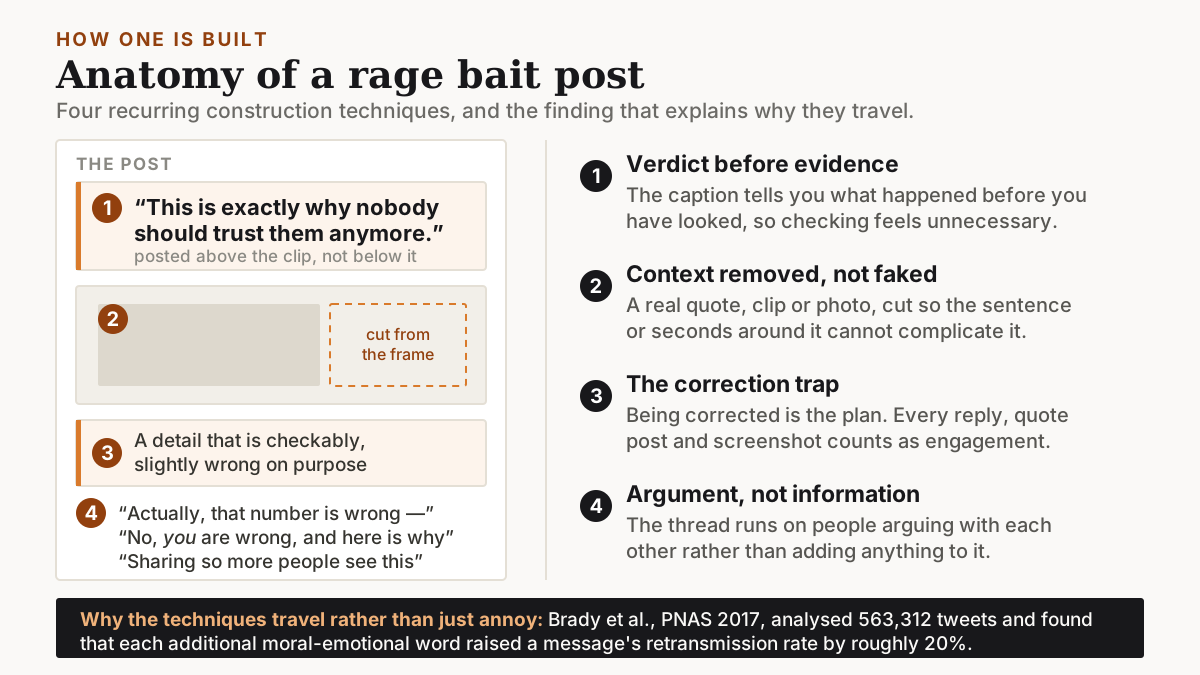
Most rage bait follows the same basic move: the caption delivers a verdict before you have seen any of the material it is supposedly describing. "This is exactly why..." or "Nobody is talking about..." tells you how to feel about a clip or screenshot before you have looked at it, which matters because first impressions are sticky. Once you have decided how to feel, the actual content mostly just has to avoid contradicting that feeling too obviously.
This is different from a strong opinion stated up front. An opinion invites you to check the reasoning. A rage bait caption is written so that checking feels unnecessary: the caption already told you what happened. The Five Key Questions of media literacy framework is built around catching exactly this move, by asking who wrote the caption and what it wants you to feel before you look at anything else.
Cropping and context removal
The second technique is selective framing: a quote without the sentence before it, a clip without the seconds after it, a photo without the caption that explains it. This works because most people do not go looking for the missing context. They react to what is in front of them, and the post is built assuming that is exactly what will happen.
None of this requires fabrication. A real quote, a real clip, and a real photo can all be rage bait if what surrounds them is cut in a way that changes what they appear to mean.
The correction trap
A subtler version bets on being corrected rather than believed. The post states something slightly, checkably wrong, on a topic people care enough about to fact-check in the replies. Every correction is itself engagement: a reply, a quote post, a screenshot shared elsewhere with "someone needs to see this." Whether the original poster was right stops mattering once the argument is running on its own.
The number behind why this works: 20% per word
There is an actual figure behind why these techniques spread rather than just annoy. Brady, Wills, Jost, Tucker, and Van Bavel's 2017 study in PNAS, "Emotion shapes the diffusion of moralized content in social networks," analyzed 563,312 tweets about three polarizing US political issues (gun control, same-sex marriage, and climate change) and found that each additional moral-emotional word in a message, "disgusting," "outrageous," "shameful," and similar terms, increased its retransmission rate by roughly 20%.
The same study found the effect was bounded by group membership: moral-emotional language spread messages further within a political in-group than across the aisle to people who disagreed. That detail matters for rage bait specifically, because a caption engineered to provoke a specific audience's anger doesn't need to convince anyone outside that audience. It just needs to travel fast inside it, which the caption-first, context-stripped structure is built to do.
Platforms noticed before most users did
In December 2017, Facebook published "Fighting Engagement Bait on Facebook," a policy announcement that named the pattern directly: posts explicitly asking people to like, share, or comment to boost reach, with the company's own example being posts like "LIKE this if you're an Aries." Facebook said it would demote individual posts using the tactic and apply stricter penalties to pages that did it repeatedly.
That the company felt it needed a named policy is itself evidence the technique was working well enough to distort the News Feed. TIME's coverage of the change framed it as Facebook admitting its own ranking system could be gamed by anyone willing to ask for engagement directly.
Why the crackdown didn't fix it
Facebook's 2017 policy targeted a specific, crude pattern: posts that explicitly ask for likes, shares, or tags. Rage bait rarely asks for anything. It just states something and lets anger do the sharing on its own, which is exactly the kind of engagement the 2017 rules were not written to catch. Naming and demoting one tactic does not remove the underlying incentive; it just pushes creators toward tactics the policy does not mention.
The automated piece was already part of that same 2017 announcement: Facebook said its teams had reviewed and categorized hundreds of thousands of posts to train a machine-learning model that could detect different types of engagement bait, with pages that repeatedly used the tactic facing steeper drops in reach than individual posts did. Meta's current Content Distribution Guidelines still describe demotion for engagement bait today, though the page no longer spells out that training detail. Either way, a model trained to catch a known pattern is playing catch-up with whatever the next pattern turns out to be. Rage bait's core appeal, per the PNAS finding above, is an emotional reaction that doesn't require asking for anything, which is harder to define as a rule than "asks for a like."
A note on how this was researched
This explainer deliberately does not name or link to specific viral posts or accounts. The construction techniques described here are drawn from Meta's own published policy language and from peer-reviewed research on how emotionally charged content spreads, not from a curated set of examples we picked out ourselves. Pointing at specific posts risks giving them more of the exact attention their captions were built to extract; the pattern is the useful thing to recognize, not any single instance of it. For a closer look at the platform incentive side of this rather than the construction side, see Why Platforms Reward Rage Bait.