
Where these questions come from
The Five Key Questions of media literacy weren't invented for the internet. They belong to the Center for Media Literacy, a nonprofit founded in 1989 by Elizabeth Thoman, which published them as part of its CML MediaLit Kit in 2002 and followed up in 2005 with a book of 25 classroom lesson plans built around them. They're meant to be asked about any media (a magazine ad, a movie, a news segment), not just social media posts.
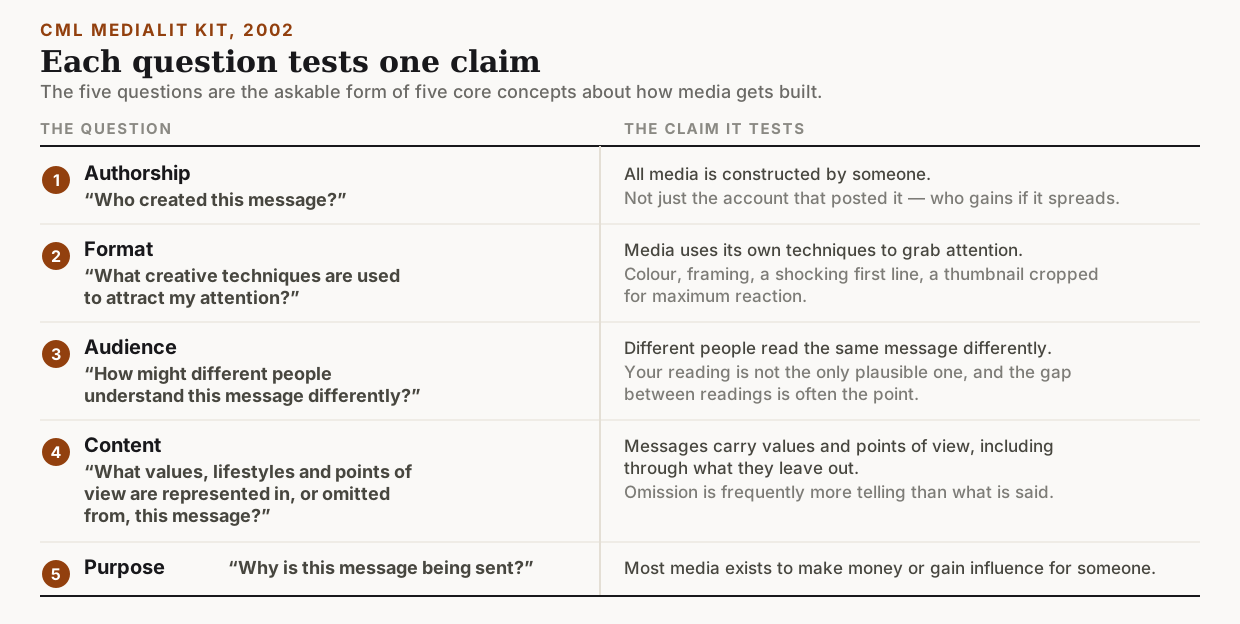
They pair with five core concepts, which are really the claims the questions are testing: that all media is constructed by someone, that it uses its own techniques to grab attention, that different people read the same message differently, that messages carry values and points of view (including through what they leave out), and that most media exists to make money or gain influence for someone.
CML has always been modest about the lineage. Its own materials say the five questions "flow from the Five Core Concepts which have evolved from traditional categories of rhetorical and literary analysis," and credit Australian and Canadian media educators whose work came first. The insight CML claims is narrower and more practical than inventing the ideas: concepts are hard to teach, questions are easy to ask, so they turned one into the other.
One thing worth untangling, because the two get blurred together constantly: NAMLE, the National Association for Media Literacy Education, is a separate organization. Founded in 1997, it describes itself as the leading voice and convener for media literacy education in the US, it publishes the Core Principles of Media Literacy Education, and it hosts CML's lesson plans on its Media Literacy Week site. But NAMLE's own Key Questions for Analyzing Media is a different framework with a different shape: three groups (Authors and Audiences, Messages and Meanings, Reflections and Evaluations) covering eight categories, not five questions. NAMLE did not write the five below, and does not maintain them.
The five questions themselves
Each question is quoted below exactly as CML prints it on the Five Key Questions summary page of the MediaLit Kit, with CML's own one-word name for the concept it tests, followed by a plain gloss of what it asks you to do in practice. Other handouts in the same Kit word a few of them slightly differently.
1. Authorship. "Who created this message?" Not just the account that posted it, but who benefits if it spreads.
2. Format. "What creative techniques are used to attract my attention?" Color, framing, a shocking first line, a thumbnail cropped for maximum reaction.
3. Audience. "How might different people understand this message differently?" Your read isn't the only plausible one, and the gap between readings is often the point.
4. Content. "What values, lifestyles and points of view are represented in, or omitted from, this message?" Omission is frequently more telling than what's actually said.
5. Purpose. "Why is this message being sent?" To inform, to sell something, to build an audience, or to make someone angry enough to share it.
Trying them on something you saw today
Take a hypothetical: a 12-second clip of someone saying something outrageous, cropped from a much longer conversation, captioned as if it speaks for itself. Question one asks who clipped it and posted it, and whether that account has anything to gain from it spreading. Question two points at the caption itself, usually written to make the reaction feel obvious before you've watched anything.
Question three is the one people skip: if you showed the full, uncropped clip to someone who disagreed with you politically, would they hear the same thing you just heard? Question four asks what's outside the frame. Literally: the seconds before and after the clip, which is usually exactly what's missing. Question five is the blunt one: this message exists because a short, outrage-shaped clip travels further than a long, complicated one.
None of this requires proving the clip is fake. Most rage bait isn't fabricated. It's real footage, selectively framed. The rage bait explainer covers why that framing works on you even when you already suspect it.
Where people get this wrong
The most common mistake is treating media literacy as a synonym for fact-checking. Fact-checking asks "is this true." The five questions ask a broader set of questions about construction and intent, and a completely factual post can still be framed manipulatively: technically accurate, selectively presented, and built to provoke a specific reaction.
The second common mistake is applying scrutiny selectively: running the five questions on content you already distrust, and skipping them for content that confirms what you already think. The framework is only useful if it's applied evenly, including to sources you like.
Why this matters more for rage bait than most content
There is also evidence that question-style prompts of this kind actually shift behavior, which is more than most media literacy advice can claim. A preregistered study by Guess et al., published in PNAS on June 22, 2020, tested an intervention modeled on the tips used by what the authors call the world's largest media literacy campaign, and found discernment between mainstream and false headlines improved by 26.5% in a nationally representative US sample and 17.5% in a highly educated online sample in India. The effect is real but bounded, and the fuller accounting of what that study did and did not show is worth reading before quoting the number. Adoption is moving too: Media Literacy Now's January 2026 policy report counted 25 US states with some form of media literacy law, 11 of them adding new or expanded laws since January 2024.
Rage bait is a useful stress test for this framework because it's rarely built on an outright lie. The claim is often technically defensible, which makes question one (who benefits) and question five (why was this sent) do more work than fact-checking alone ever could. Asking whether a post is true is necessary but not sufficient; asking why it exists and who it's built to provoke gets you the rest of the way there.