The short version
Social loafing is what happens to individual effort the moment a task becomes a group task instead of a personal one. It is not that any one person becomes lazy. It is that the same person, doing the same task, reliably works less hard as soon as their individual contribution stops being separately visible.
That distinction matters because it reframes a familiar complaint. "My group project partner is lazy" assumes something about that specific person's character. The research says something less flattering to everyone: put nearly any two people in a group where effort can't be individually tracked, and both will quietly do less than they would alone, often without noticing they're doing it.
The famous numbers aren't what they're cited as
Nearly every explainer on this topic repeats the same specific claim: French engineer Max Ringelmann had men pull a rope alone and in groups in the 1880s, and found that pairs pulled at 93% of their combined solo strength while eight-person groups managed only 49%. It's a great story. It also isn't accurate.
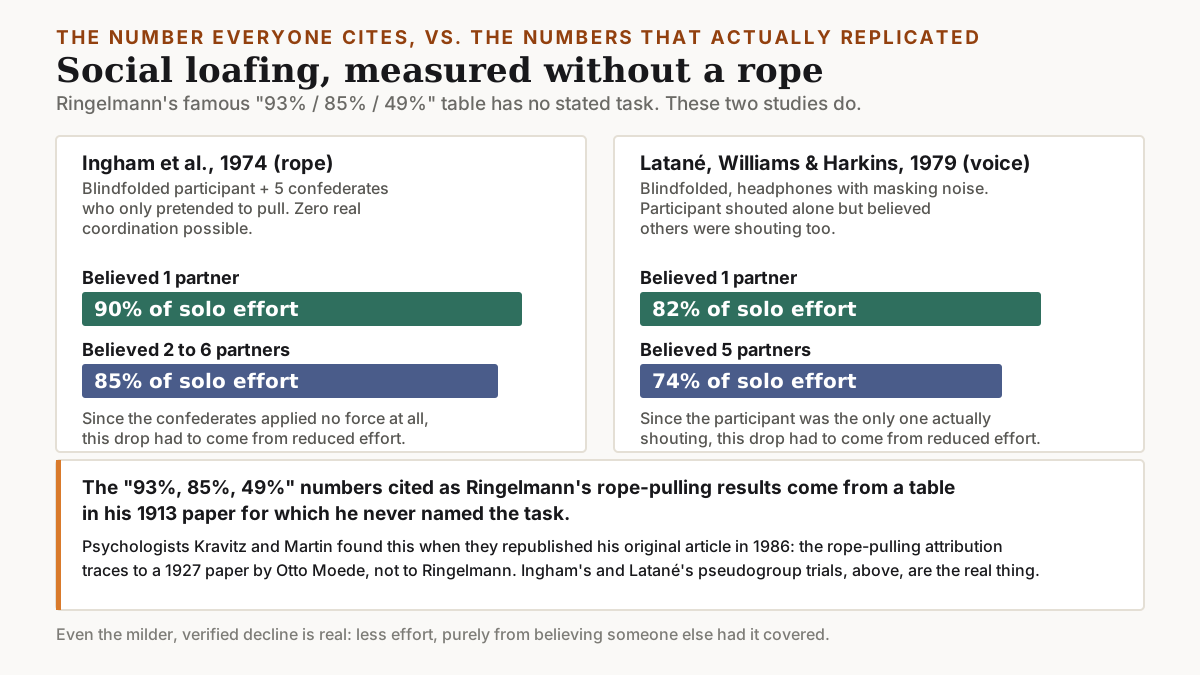
Ringelmann's data really was collected in the 1880s and published in 1913, but his original article went effectively untraceable for the next seven decades; psychologists David Kravitz and Barbara Martin tracked it down and republished it in the Journal of Personality and Social Psychology in 1986. What they found is that the 93%/85%/49%-style percentages come from a table Ringelmann labeled as "summarizing a great number of findings," for which he never stated what task the workers had performed. Kravitz and Martin wrote directly that this is inconsistent with the claim, made by Otto Moede in 1927 and repeated by essentially every writer since, that this specific table was about rope pulling. The task behind those exact numbers is, by Ringelmann's own account, unspecified.
Ringelmann did run an actual controlled rope-and-dynamometer experiment, the one Kravitz and Martin describe in detail, but its numbers look different and less dramatic: across 28 subjects, mean individual pulling force was 85.3 kilograms alone, dropping to 65.0 kilograms per person in seven-person groups and 61.4 kilograms in a fourteen-person group, on the order of a 24 to 28 percent per-person decline rather than the roughly 51 percent drop the popular eight-person figure implies. Ringelmann himself attributed the decline mainly to coordination loss, workers pulling out of sync with each other, though he noted he was also aware of motivational explanations.
The replication that actually used a rope
The rope-and-dynamometer replication that both used a real rope and cleanly separated coordination loss from motivation loss came in 1974, six decades after Ringelmann's 1913 publication, from Alan Ingham and colleagues. Their first experiment had real groups of one to six people pull, and found per-person force fell to 91% in pairs, 82% in trios, and 78% in six-person groups, curving rather than dropping in a straight line.
Their second experiment is the more important one. Ingham's team blindfolded participants and surrounded each one with five confederates who only pretended to pull, contributing no force at all, so there was nothing left for coordination loss to explain. Individuals still pulled at only 90% of their solo effort when they believed one other person was pulling alongside them, and at 85% when they believed anywhere from two to six others were. Because the confederates weren't actually applying any force, the entire drop had to come from the one real participant simply pulling less hard, which is the first clean demonstration that reduced motivation, not physical interference between people, drives most of the effect.
Confirming it beyond rope: the clapping and shouting study
Bibb Latané, Kipling Williams, and Stephen Harkins ran a similar test in 1979, swapping the rope for something with zero equipment to coordinate: clapping and shouting as loudly as possible. In their first experiment, real groups of undergraduates clapped and shouted in full view of each other, and per-person sound output dropped to 71% in pairs, 51% in foursomes, and 40% in six-person groups, closely tracking what Ringelmann's genuine rope data and Ingham's replication had already shown.
Their second experiment borrowed Ingham's pseudogroup logic and made it cheaper to run: rather than hiring confederates, they blindfolded participants, put constant masking noise through their headphones, and on some trials let a participant believe others were shouting with them when that participant was, unknown to them, the only one actually making any sound. In those pseudogroup trials, people shouted at 82% of their solo intensity believing one partner had joined them, and at 74% believing five had, numbers close to Ingham's rope pseudogroup figures. In the real-group trials of the same experiment, output fell further still, to 66% in pairs and 36% in six-person groups, because genuine acoustic and timing interference between real voices, a hidden factor riding along with the effect being measured, was mixed into those numbers too; the researchers' own analysis attributed roughly half of that additional loss to coordination problems and half to reduced effort.
This is also the paper that gave the phenomenon its name: Latané, Williams, and Harkins coined "social loafing" for the drop in individual effort that group presence causes. Their shouting pseudogroups didn't isolate that drop for the first time, Ingham's rope pseudogroups had already done that five years earlier, but they confirmed the same motivational mechanism held for a task with no equipment, and no possibility of physical interference, at all.
Two different reasons people quietly downshift
Later research split the motivational story further into two distinct mechanisms, and they point in opposite directions. The first is the free-rider effect: if the group's outcome doesn't obviously depend on any one person's contribution, that contribution starts to feel dispensable, so why push hard for a result that will happen anyway. It's the same diffusion of responsibility that let a New York Times reporter's account of 38 silent witnesses go unquestioned for four decades: when a task or a duty is spread across a group instead of resting on one person, each individual quietly assumes someone else has it covered.
The second is the "sucker effect," demonstrated by Norbert Kerr in 1983 using a task where participants pumped a rubber bulb to move air as hard as they could for 30 seconds. When paired with a partner they believed was fully capable but deliberately putting in minimal effort, participants sharply cut their own effort too, even on a task where more air genuinely helped the shared outcome. Nobody wants to be the one person doing all the work while a capable partner coasts, so people preemptively downshift to avoid being the sucker, which can produce the exact same low group output that the free-rider mechanism produces for a completely different reason.
The two mechanisms explain the same observable slump through opposite motives, which is worth knowing before assuming you know why a specific teammate has gone quiet. One is "why try, it won't be noticed either way." The other is "why try harder than someone I think isn't trying at all."
What makes it worse, and what makes it disappear
Across the rope, clapping, and shouting studies, a small set of conditions consistently predicts how bad the effect gets. Larger groups loaf more than small ones, individually untraceable output loafs more than individually scored output, and low-stakes or unengaging tasks loaf more than tasks people find personally meaningful. Flip any of those, make individual contributions identifiable, raise the stakes, or make the task itself interesting, and the effect shrinks sharply.
That last part is the most practically useful piece of the whole literature. Social loafing isn't a fixed tax on all group work. It's specifically a tax on group work structured so that no individual's effort is separately visible, which is a design flaw as much as a personality one. The same person who loafs on an anonymous, group-graded assignment will often carry their own weight the moment their individual piece is graded on its own.
It followed everyone into remote meetings
Remote and hybrid work didn't invent this pattern, but it changed how easily it can hide. A 2024 study in Information & Management, by Liu, Zheng, Liu, and Lee, examined what the authors called discrepant visibility contexts in virtual meetings, situations created by mixed camera use where some participants can see others on video while remaining unseen themselves. That asymmetry, being able to watch without being watched, echoes the exact condition Ingham's and Latané's pseudogroup trials engineered on purpose: individual output that can't be checked by the people it should be visible to.
The practical fix mirrors the lab finding. Meetings and projects that assign specific, checkable pieces of output to specific people don't need to fight social loafing directly, because the condition that produces it, untraceable individual contribution, never gets set up in the first place. The ones that assign a task to "the team" with no individual breakdown are the ones where it quietly shows up, on a video call much as it did in Ingham's lab in 1974.