The short version
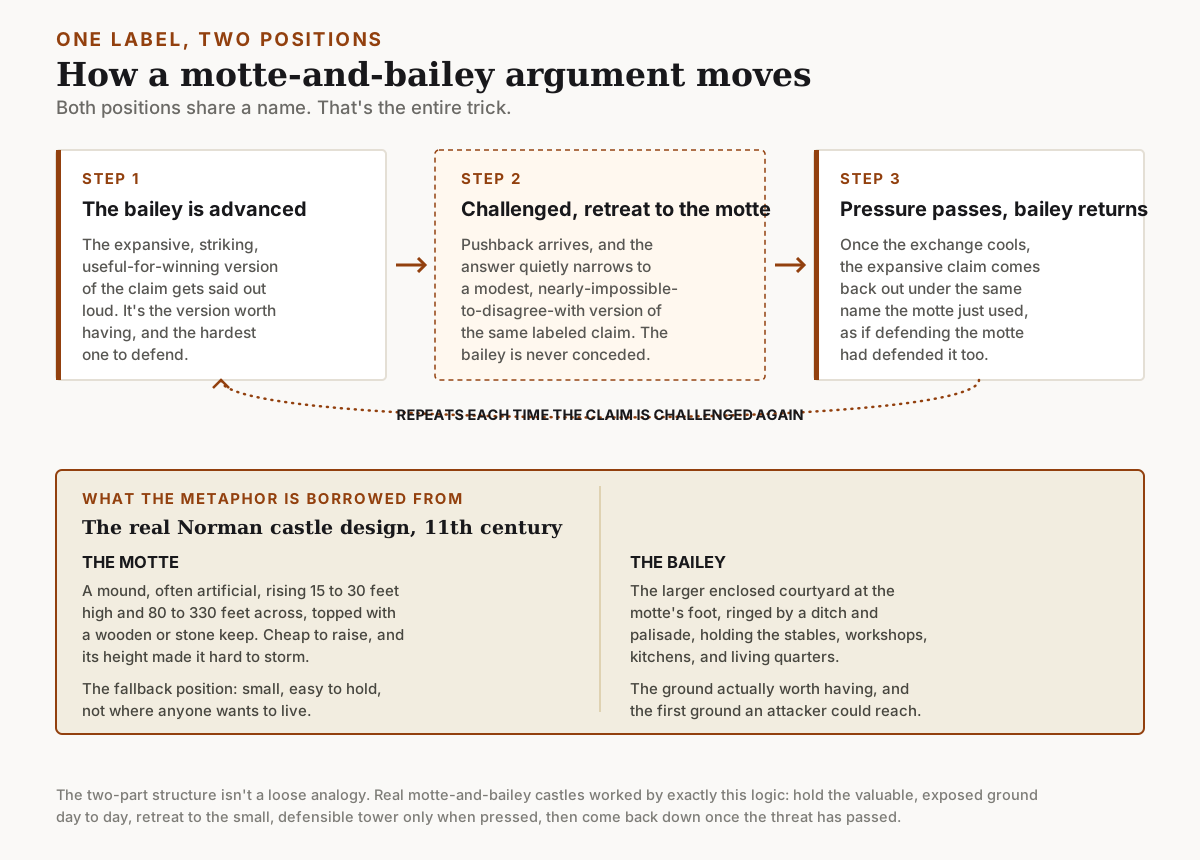
A motte-and-bailey argument runs on two versions of the same claim wearing one name. The bailey is the version worth having: broad, striking, useful for actually winning the argument. The motte is the fallback: narrow, modest, nearly impossible to disagree with. Whoever's making the argument pushes the bailey until someone pushes back, retreats to the motte to survive that pushback, then quietly walks back out to the bailey once the exchange has cooled off.
The trick only works because both versions share a label. Swap in an unrelated word for the motte version and the sleight disappears instantly, since there'd be nothing left connecting the two claims. The whole maneuver depends on one word doing two jobs, and on nobody stopping to ask, out loud, which job it's doing right now.
The castle behind the metaphor
Motte-and-bailey castles were the fast, cheap fortification of choice for the Normans across northern France and Britain through the 11th century. The design has two parts, and the names aren't decorative: the motte is a mound of earth, often built up by hand from the material dug out of the surrounding ditch, typically rising somewhere between 15 and 30 feet high and spanning 80 to 330 feet across, topped with a wooden or, later, stone tower called a keep.
The bailey is the separate, larger enclosure at the motte's base, a courtyard ringed by its own ditch and palisade, holding the stables, workshops, kitchens, and living quarters, the actual working life of the castle. It was bigger, more useful day to day, and considerably harder to defend than the tower on the mound beside it. The two pieces weren't interchangeable and weren't meant to be defended the same way: you lived and worked in the bailey, and you climbed to the motte's tower only when the bailey wall was about to give.
That asymmetry, valuable ground that's easy to lose paired with modest ground that's hard to take, is the entire borrowed structure. Shackel and, later, Alexander weren't reaching for a castle at random. They picked the one design where a strong, exposed position and a weak, defensible one sit right next to each other, connected by the same wall.
Where the label came from
Philosopher Nicholas Shackel introduced the term in "The Vacuity of Postmodernist Methodology," published in Metaphilosophy in 2005. The paper catalogs five rhetorical maneuvers Shackel argued were doing the real work in specific postmodernist academic writing, including work by Michel Foucault, David Bloor, Jean-François Lyotard, and Richard Rorty: alongside the Motte and Bailey Doctrine sit what he called Troll's Truisms, Equivocating Fulcra, the Postmodernist Fox-Trot, and Rankly Relativising Fields.
Shackel's own description of the castle mapping is direct: the bailey stands for a position that's "desirable to its proponent but only lightly defensible," while the motte is "the defensible but undesired position to which one retreats when hard pressed." His target wasn't internet arguments; it was a pattern he saw specific academics using, retreating to a modest epistemological claim under scrutiny, then reoccupying a much stronger relativist claim once the scrutiny passed.
Nine years later, an obscure paper term went viral
The label sat inside academic philosophy largely unnoticed until November 3, 2014, when writer Scott Alexander published "All In All, Another Brick In The Motte" on his blog, Slate Star Codex. Alexander credited Shackel by name, reused the same castle framing almost intact, and applied it broadly to the ideological, religious, and pseudoscientific arguments he saw circulating online, not only to academic texts.
That post is the reason most people who know the term today encountered it through a blog, not a philosophy journal. It got picked up fast in the overlapping rationalist and skeptic blog communities Alexander wrote for, including LessWrong, and from there into the wider vocabulary people reach for when they want to name a specific kind of argumentative dodge, not just a vague sense that someone's being slippery.
What it looks like outside a philosophy journal
A commonly used illustration runs through alternative medicine. Someone asserts the bailey: naturopathy, taken as a whole, is legitimate medicine worth trusting. A critic challenges a specific piece of it: homeopathy, one practice naturopathy commonly includes, has never shown an effect beyond placebo in controlled trials. Instead of defending homeopathy on its own evidence, the reply retreats to the motte: naturopathy also covers things like nutrition and exercise advice, which obviously help, so the challenge gets treated as answered.
Notice what the retreat doesn't do: it doesn't touch homeopathy at all. That's a different move from equivocation, where a single word silently changes meaning mid-argument. Here the word ("naturopathy") never changes meaning; what changes is which part of the thing it labels is currently up for discussion.
Nothing said in that retreat is false. Nutrition advice genuinely helps. But the retreat never touched the claim that was actually challenged, homeopathy's efficacy, and once the exchange ends, "naturopathy is legitimate medicine," homeopathy included, comes back unchallenged as the working claim. The motte (nutrition advice is fine) held up on its own terms. It just wasn't defending the position that was under fire.
Why it's easy to miss, and when it isn't actually this
The maneuver is hard to catch live because the motte and the bailey genuinely are related claims, not two unrelated ones stitched together. Someone who holds a nuanced position with both a strong version and a more modest, qualified version isn't automatically committing this fallacy; people are allowed to hold views with genuine range, and clarifying which part of that range they mean when pressed is normal, honest argument, not a dodge.
Part of why the swap is easy to miss ties to belief perseverance: once the modest motte version has been defended successfully, the impression that the whole position holds up tends to stick, even after the conversation moves back to the far more contentious bailey. Nobody has to be careless for that to happen. A claim that already survived one round of scrutiny doesn't automatically get re-examined, even when the claim that survived wasn't the one currently being advanced.
The actual tell is repetition under pressure specifically: the retreat happens only when challenged, the bailey is never conceded even temporarily, and it reappears unprompted once the exchange has moved on, as though defending the motte had settled the larger claim too. A useful way to check, in the moment, is to ask directly which version is being defended right now, and to hold the other person to that answer for the rest of the exchange, so the label can't drift back to its broader sense once the specific challenge has passed.
That's a different discipline from spotting a thought-terminating cliché, which shuts a conversation down outright. A motte-and-bailey retreat does the opposite: it keeps the conversation open, just on easier ground than the one where it started.