The short version
Conditional probability is the odds of one thing being true given that something else is already known to be true, written P(A|B): "the probability of A, given B." Swap the letters and P(B|A) asks a completely different question, even though it's built from the same two events. Human intuition treats the two directions as interchangeable. They almost never are.
A positive medical test carries one probability. Having the disease carries a different one. Mixing up the two directions, a mistake with a real formal name, a transposed conditional, has produced wrong answers from doctors reading their own specialty's test results and, in at least one well-documented case, helped convict an innocent woman of murder.
Two versions of the same question
"What fraction of women with breast cancer test positive on a mammogram?" and "What fraction of women who test positive actually have breast cancer?" sound like two phrasings of the same fact. They're two different numbers. The first, P(positive test | cancer), is a property of the test itself, how good it is at catching cancer that's really there. The second, P(cancer | positive test), is what a specific result actually tells the specific woman holding it, and it depends on something the first number says nothing about: how rare the cancer was to begin with in the group being tested.
That second, easily-ignored ingredient is called the base rate. A test can be excellent at its job, correctly flagging the great majority of true cases, and still produce a pool of positive results in which most of the people are false alarms, if the condition it's screening for is rare enough that the healthy majority contributes more false positives, in raw numbers, than the small unhealthy minority contributes true ones. The test's accuracy on paper doesn't stop that from happening. It's the same blind spot that shows up whenever a specific description gets judged by how well it fits a category, rather than by how common that category actually is: the category's real size keeps getting left out of the math.
The question 160 gynecologists mostly got wrong
Gerd Gigerenzer and colleagues laid this out with real numbers in a 2007 Psychological Science in the Public Interest paper, drawing on breast-cancer screening statistics originally reported by Kerlikowske, Grady, Barclay, Sickles, and Ernster. The scenario given to 160 practicing gynecologists: a woman gets a positive mammogram. Given the test's known sensitivity and false-positive rate, and the roughly 1% base rate of breast cancer in the screened population, what's the probability she actually has cancer? Four multiple-choice answers were offered, spaced an order of magnitude apart, meant to make the task easier to grade.
The best answer was "about 1 out of every 10 women who test positive actually has breast cancer." Before any intervention, the paper reports, "the majority of them grossly overestimated the probability of cancer, answering '90%' or '81%.'" Individual guesses ranged from 1% to 90%. Only 21% of the 160 gynecologists landed on the right answer, a rate the authors describe as "slightly less than chance" given the four-option format. These were specialists being asked about a test in their own field, not laypeople guessing at an abstract puzzle.
The same numbers, laid out as counts
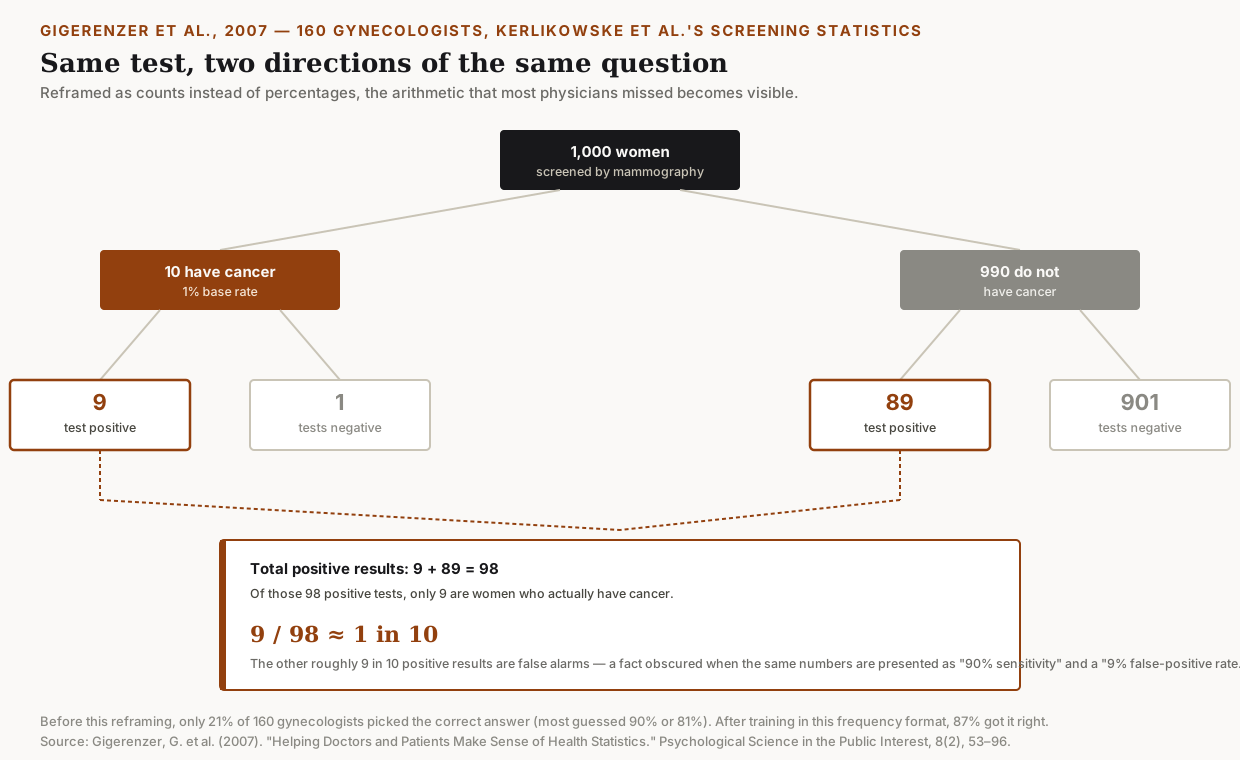
The fix Gigerenzer's team tested was simple: re-present the identical statistics as natural frequencies, plain counts out of a fixed population, the same information formatted as things a reader can actually count. Their translation of the same problem: "Ten out of every 1,000 women have breast cancer. Of these 10 women with breast cancer, 9 test positive. Of the 990 women without cancer, about 89 nevertheless test positive."
Laid out that way, the arithmetic turns countable: 9 true positives plus 89 false positives makes 98 total positive results, and only 9 of those 98, about 1 in 10, actually have cancer. The underlying test never changed between the two framings. What changed is that natural frequencies keep the base rate baked into the numbers themselves, as a headcount the reader never has to separately recall or reintroduce. After training gynecologists to translate conditional-probability statistics into this frequency format, 87% of them arrived at the correct answer, up from 21%. Other researchers found the same pattern independently: Eddy (1982) had already reported that 95 out of 100 physicians overestimated cancer probability after a positive mammogram "by an order of magnitude," and Casscells, Schoenberger, and Grayboys (1978) found only 18% of physicians and medical staff could correctly infer this kind of probability at all.
The same pattern shows up well outside medicine, too. The same 2007 paper cites a study of judges and law professors asked to estimate, from DNA-match statistics presented as conditional probabilities, the odds that a defendant was actually the source of DNA evidence found at a scene. Only 13% reasoned correctly. Given the same statistics reframed as natural frequencies, 68% did.
When the same mix-up reached a jury
On November 9, 1999, a jury at Chester Crown Court convicted solicitor Sally Clark, by a 10-2 majority, of murdering her two infant sons: Christopher, who died at 11 weeks old in December 1996, and Harry, who died at 8 weeks old in January 1998. She was sentenced to two concurrent life terms. At trial, paediatrician Sir Roy Meadow testified that the odds of two natural cot deaths occurring in a family with the Clarks' characteristics were 1 in 73 million, a figure he reached by taking a published rate for a single sudden infant death syndrome case and squaring it.
The Royal Statistical Society issued a formal news release on this specific case on October 23, 2001, and it named the error directly: "This approach is, in general, statistically invalid. It would only be valid if SIDS cases arose independently within families, an assumption that would need to be justified empirically." The Society went further, naming the exact reasoning failure some press coverage had made of the figure: "Some press reports at the time stated that this was the chance that the deaths of Sally Clark's two children were accidental. This (mis-)interpretation is a serious error of logic known as the Prosecutor's Fallacy."
The prosecutor's fallacy is the courtroom name for the same transposed conditional running through the mammography question: mistaking the probability of the evidence, given innocence, for the probability of innocence, given the evidence. A 1-in-73-million estimate for two accidental deaths says nothing on its own about how likely those two deaths were to be murder rather than accident, because it never accounts for how rare double infant murder is too. As the Society put it, the jury needed to weigh the relative likelihood of the two competing explanations against each other, "not just how unlikely they are under one explanation."
A debunked statistic and a conviction are two different things
It would be easy to read the RSS statement as the moment that freed Sally Clark. It wasn't. She remained in prison for well over a year after the Society's public statement, having already lost a first appeal in 2000 that considered the statistical evidence and rejected it as grounds for overturning the conviction. Her conviction was finally quashed on January 29, 2003, at a second appeal, and BMJ legal correspondent Clare Dyer reported the actual basis: her defence team had discovered microbiology results, obtained by Home Office pathologist Alan Williams during his postmortem on Harry, showing Staphylococcus aureus present at eight sites in the baby's body, including his cerebral spinal fluid. Williams had held those results since February 1998 and never disclosed them to police, prosecutors, the defence, or the other doctors involved in the case.
Lord Justice Kay, presiding over the appeal, found that Williams had failed "to share with other doctors investigating the cause of death information that a competent pathologist ought to have appreciated needed to be assessed before any conclusion was reached," and concluded: "We have no doubt that the resulting convictions are, therefore, unsafe and must be quashed." The undisclosed infection, not a retrial of Meadow's statistic, was the legal ground on which Clark went free. The RSS statement mattered. It reshaped how UK courts would treat statistical expert testimony afterward, and the Court of Appeal cited earlier rulings on the same danger in DNA evidence. But it is a mistake to collapse "this number was debunked" and "that debunking is what freed her" into the same fact. They happened more than a year apart, for different institutional reasons.
What to check when a conditional probability shows up
Most people won't be reading a screening study or a court transcript, but the same directional swap shows up anywhere a percentage gets used to argue about risk, guilt, or causation. "X% of people with condition A also show trait B" and "X% of people with trait B have condition A" are different claims, and headlines routinely present the first as if it answered the second. The question worth asking is which direction the number was actually measured in, and whether the direction you care about is the one you were handed. It's a narrower version of the same gap a real statistic can hide once the base rate behind it gets left out of the sentence.
The prosecutor's-fallacy version of that same check applies to any argument that treats "this outcome is really unlikely to have happened by chance" as proof of a specific cause. An unlikely coincidence under one explanation still needs weighing against how unlikely the alternative explanations are, too, on their own terms. And when the underlying statistics are available, translating a percentage into a count out of a fixed group, exactly what Gigerenzer's natural frequencies do, is usually enough to catch a transposed conditional that the percentage version was hiding, the same fix that works for a confidence interval's hidden miss rate or a correlation with an unmeasured variable driving both sides of it: count what the number is actually built from before trusting what it seems to say.