The short definition
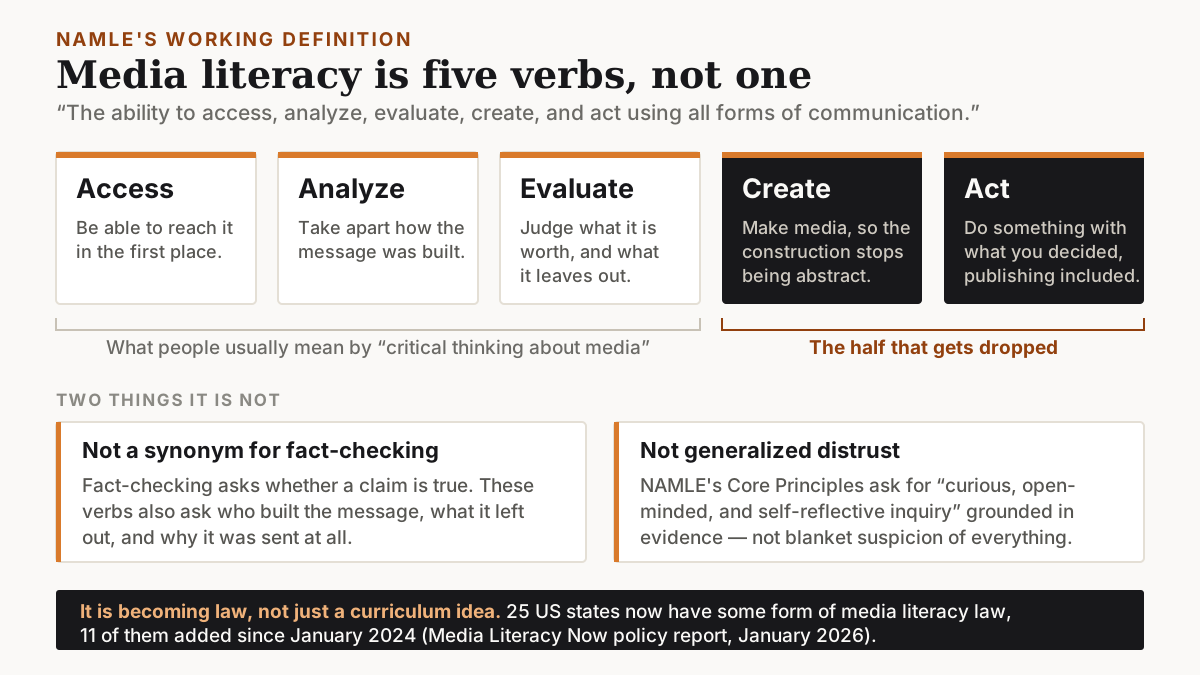
NAMLE, the National Association for Media Literacy Education, defines media literacy in exactly these words: "the ability to access, analyze, evaluate, create, and act using all forms of communication." Notice how much of that five-word verb chain is about doing things (creating, acting), not just consuming media more carefully.
Where the definition comes from
NAMLE is the main US professional body for media literacy education. UNESCO uses the broader term "media and information literacy," describing it as a basis for enhancing access to information and knowledge, freedom of expression, and quality education, with NAMLE partnering on UNESCO's global Media and Information Literacy Week to connect US practice to the wider international conversation.
It's not the same as generalized distrust
A different misconception than the "it's just fact-checking" one (covered in detail in the Five Key Questions explainer) is the idea that media literacy means treating everything you see as probably manipulative. NAMLE's published Core Principles of Media Literacy Education explicitly frame the goal as promoting "curious, open-minded, and self-reflective inquiry" grounded in reason, logic, and evidence, not blanket suspicion. The distinction matters in practice: a reader who assumes everything is a manipulation stops discriminating between a well-sourced report and an anonymous screenshot, which defeats the point as thoroughly as never questioning anything does. The slide toward blanket suspicion is measurable rather than hypothetical, and it shows up as a small side effect in the experimental evidence on what media literacy tips actually do to readers.
Why 'critical thinking' undersells it
Descriptions of media literacy as just "critical thinking about media" miss the create and act parts of NAMLE's definition. The field grew out of media education work that also taught people to make media themselves, on the theory that understanding how something is constructed is easier once you have tried constructing something yourself.
The practical version of all this is a specific framework: the Five Key Questions of media literacy, developed by the Center for Media Literacy and published in its MediaLit Kit in 2002.
What the "create and act" part actually looks like
One concrete example: since 2019, NAMLE has partnered with PBS Education on PBS News Student Reporting Labs, a program where students produce their own video journalism rather than only analyzing professional news coverage. The idea behind pairing "create" with "analyze" is that understanding how a news segment is built, the choices behind a shot, a cut, a caption, tends to stick better once you have tried making one yourself and run into those choices firsthand.
This is also why media literacy education resists being taught purely as a lecture. A curriculum built only around "here's how to spot manipulation" teaches recognition; one that also has students produce something teaches the underlying mechanics that recognition depends on.
It's becoming law, not just a curriculum idea
This isn't only an academic framework anymore. Media Literacy Now's U.S. Media Literacy Policy & Impact Report, published January 2026 and current through data collected as of October 30, 2025, found that 25 states now have some form of media literacy law, with 11 states adding new or expanded legislation since January 2024 alone. The report ties the recent acceleration to state-level debates over student phone use, social media access, and, increasingly, AI-generated content.
That pace is worth noting against the rage bait content this site also covers: lawmakers are moving on media literacy in part because the content problems it's meant to address, engineered outrage among them, aren't slowing down on their own.
A note on scope
This overview draws on NAMLE's and UNESCO's own published definitions and on Media Literacy Now's policy tracking rather than on a single textbook's framing, since the field has multiple overlapping professional bodies rather than one central authority. State-by-state legislative detail changes as sessions convene, so the specific count of states with media literacy laws should be treated as accurate as of the January 2026 report cited above, not as a permanently fixed number.