

Why the number keeps changing
Ask the question and you will get four in one place and fifty-seven in another. The disagreement is not carelessness on anyone's part. Two kinds of framework are in common use, and they sort media along different axes. One asks what a piece of media looks like: printed, broadcast, or online. The other asks who paid for it and who controls the channel it arrived through. Because they are looking for different properties they produce different lists, and a list built for one job answers the other badly.
The format answer: four broad types of media
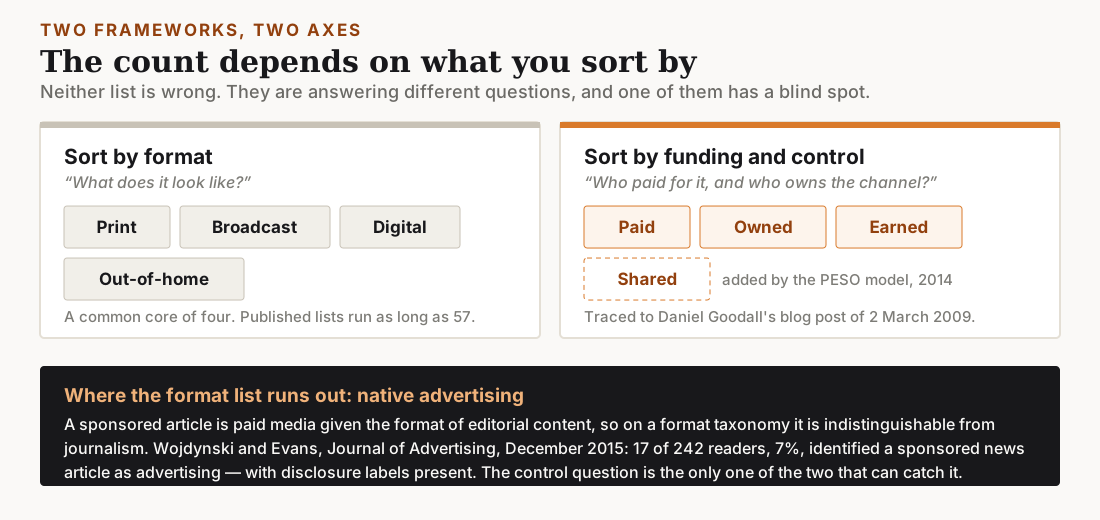
Most sources sort by format, and the common core is four. Print means newspapers, magazines, and usually books. Broadcast is television and radio. Digital is the catch-all for websites, streaming, and social platforms. Out-of-home is what you walk past, mostly billboards, transit advertising, and posters.
Past those four, the count depends on how finely a given source slices. Film can be pulled out of broadcast, direct mail out of print, social media out of digital, and every split adds a row. The business reference site Simplicable publishes a list of 57. No number in that range is wrong, because format categories have no natural floor: any new distribution technology can be argued into a category of its own, and podcasts, newsletters, and short-form video each did exactly that over the past decade. New formats keep arriving, so the lists keep growing.
What a format list cannot tell you is why a particular piece of media reached you. Two articles on the same news site, set in the same typeface at the same length, occupy the same format category whether one was assigned to a reporter or paid for by a company. The taxonomy has no column for that difference.
The three-category answer, and the blog post behind it
The other kind of framework sorts by funding and control rather than appearance, and it has an unusually traceable origin. On March 2, 2009, Daniel Goodall, then a marketing manager at Nokia, published a short post on his personal blog setting out three categories: owned, bought, and earned. He was not floating a theory. He wrote that Nokia had already been using the model for its digital media planning "for about a year," which puts the working version in 2008.
Owned meant the channels the company controlled, starting with its own website. Bought was paid placement, which Goodall noted tends to get overemphasized by agencies earning a percentage of the media spend. The category he was actually interested in was earned: coverage you get because you did "something so cool or interesting" that other people use their own channels to pass it along.
Forrester analyst Sean Corcoran picked the model up in a December 16, 2009 report, No Media Should Stand Alone, which argued the three types do their real work in combination rather than separately. "Bought" gradually became "paid" as the framework spread beyond Nokia, and that three-part version, paid, owned, and earned, is still the standard answer inside marketing and public relations.
Why the framework grew a fourth category
By 2014 the three-part split had an obvious gap: social media did not fit any box cleanly. A brand's own post, published on a platform the brand does not own and redistributed by users nobody paid, is partly owned and partly earned, and becomes partly paid the moment it is boosted. Gini Dietrich, founder of the public relations blog Spin Sucks, handled this by adding a fourth category, shared, and the resulting PESO model launched with her 2014 book of the same name as the blog. Spin Sucks describes shared as the place where a narrative travels and the market answers back, a different function from either publishing something yourself or being written about by someone else.
The revision matters beyond the bookkeeping. A framework that had to grow a category within five years was tracking an environment that kept moving underneath it, and the revisions continued: Spin Sucks published a refreshed version of the model in March 2024. Shared media exists as a category at all because audiences, rather than publishers, now do most of the redistributing, and that same shift is what makes provocation pay on engagement-ranked platforms.
What the people who use the categories say they get wrong
When that 2024 refresh was posted to r/PublicRelations, it drew about 40 upvotes and 23 comments from working communications staff. Very little of the discussion was about whether four is the right number. Most of it was about how much the labels overclaim.
The most upvoted reply in the thread went after "owned," agreeing the term is an oversimplification and suggesting it needs an asterisk. Others pressed the same point from the practical side: a company website sits on hosting and a domain registrar that can withdraw service, so the control the label implies is conditional. One commenter pushed in the opposite direction, arguing podcasts are more owned than the scheme allows, since you hold the raw recording and the published feed cannot be pulled back. Another summarized the general objection in three words: "PESO isn't law."
That is a more useful thing to take away than any particular count. The people applying these categories professionally treat them as a rough sorting device for a client conversation, and anyone using the framework to think with should hold it about that loosely.
The gap where the two frameworks stop agreeing
Native advertising is the clearest illustration of why the sorting axis matters. A sponsored article on a news site is paid media that has been given the format of editorial content. On a format taxonomy it is indistinguishable from journalism, because format is precisely the thing it was built to copy.
Readers perform about as poorly as that suggests. Bartosz Wojdynski and Nathaniel Evans, both then assistant professors at the University of Georgia's Grady College, ran two experiments published in the Journal of Advertising in December 2015. In the first, 17 of 242 participants, 7%, identified a sponsored news article as advertising. In the second, which used eye tracking, 17% did. Disclosure labels were present in the material. Wojdynski said publishers and advertisers tend to assume a label is enough for readers to grasp that they are looking at a paid advertisement: "These results show that's not the case at all, although the design of the disclosure label can make a big difference."
This is the practical reason the choice of framework is not academic. A reader working from a format list has no question available that would catch a native ad, because the ad satisfies every format criterion the list contains. A reader working from the control question has exactly one question to ask, and it is the first one they would reach for. Closing that gap is a large part of what media literacy is actually asking you to do.
Regulators added the category the format list is missing
The US Federal Trade Commission arrived at a similar conclusion the same month that research appeared. On December 22, 2015 it issued an Enforcement Policy Statement on Deceptively Formatted Advertisements alongside a business guide on native advertising. The core position bears directly on the counting question: an advertisement's format can itself be deceptive if it misleads people about the commercial nature of what they are looking at. The statement is explicit that this applies even where the product claims inside the content are truthful and not misleading.
Read as an argument about taxonomy, that is a strong one. The FTC is asserting a real and legally significant difference between two pieces of media that are identical in format, and locating that difference in who paid and whether the audience can tell. A list of print, broadcast, digital, and out-of-home has nowhere to put it.
So how many types of media are there?
For a class, a quiz, or a general definition, the format answer is the one being asked for, and the honest version names its own framework instead of presenting a number as settled: four broad types, running longer depending on how finely a source subdivides. Inside marketing or communications work the answer is three (paid, owned, earned), or four once PESO's shared category is included. Being explicit about which of those you mean is the same discipline that keeps media, digital, and information literacy from collapsing into each other.
Neither list does much for the person on the receiving end, though, and that is the position most readers are actually in. The question worth carrying is who paid for this to reach me, and how would I be able to tell. That sits very close to the questions media literacy keeps returning to, and it is the one thing a format taxonomy structurally cannot ask.