The short version
Hyperbole is exaggeration that both sides already know isn't literally true. "I've told you a million times" isn't a claim about a number. It's emphasis, dressed up as a fact nobody is expected to verify. That built-in wink is what separates hyperbole from an actual lie. A lie wants to get something past you. Hyperbole announces up front that it shouldn't be taken at face value.
Most explainers stop at a definition and a grab-bag of examples pulled from ads and old novels. That skips the more useful question: how do you actually tell the difference between hyperbole and a claim dressed up to look like hyperbole so it can slip past you unchecked? That question has already been tested in federal court, and the answer it produced applies to a lot more than pizza.
Why the law protects some exaggeration and not other exaggeration
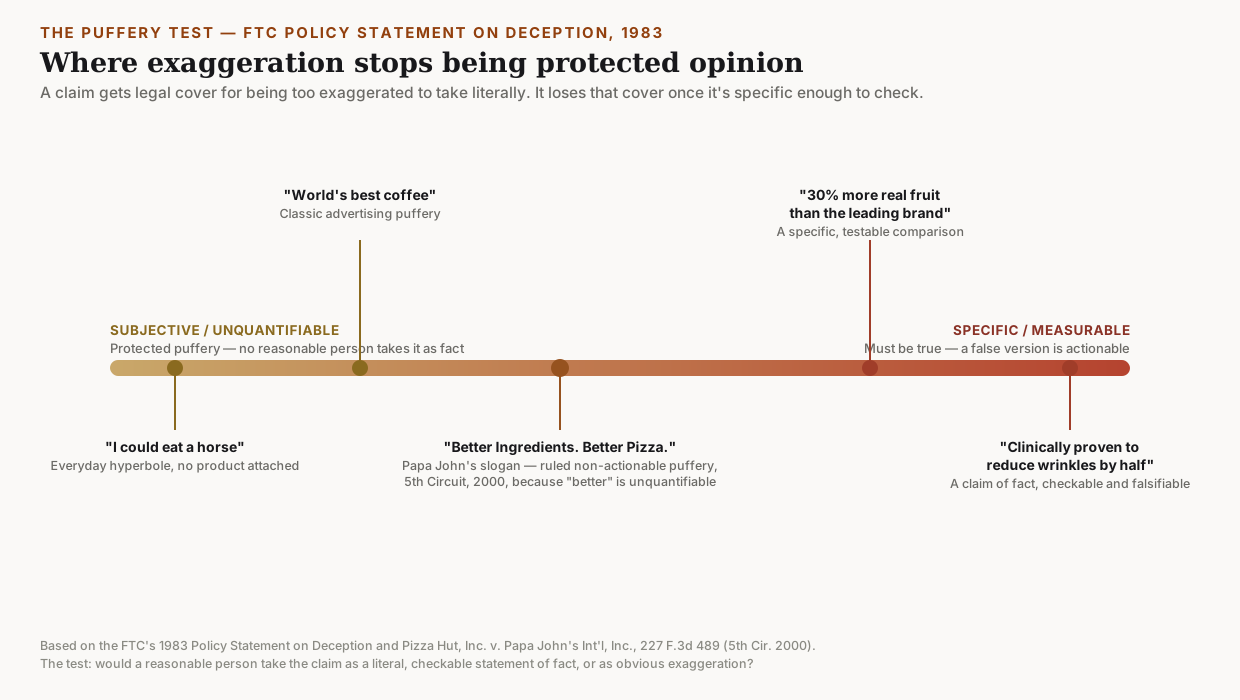
The Federal Trade Commission drew this line formally in its 1983 Policy Statement on Deception, the document that still governs how the agency decides what counts as deceptive advertising. Buried inside its broader definition of deception is a specific carve-out: the FTC "generally will not pursue" cases built around "obviously exaggerated or puffing representations," on the reasoning that ordinary consumers already discount them and don't rely on them as fact.
That carve-out has a name in advertising law: puffery. A claim counts as puffery when it's so subjective, so obviously a matter of opinion or taste, that no reasonable person would treat it as a factual promise. "World's best coffee" is puffery. Nobody can run a controlled test on "best," so nobody is legally entitled to feel deceived when it turns out someone else's coffee exists. The moment a claim becomes specific enough to test, "clinically proven to reduce wrinkles by half," "30% more real fruit than the leading brand," it stops being puffery and starts being a factual claim the advertiser has to be able to back up. That's the whole test, in one sentence: could a reasonable person check this, and would they be right to feel misled if it turned out false?
The pizza slogan that needed a federal appeals court to settle
In August 1998, Pizza Hut sued Papa John's in federal court over four words: "Better Ingredients. Better Pizza." Papa John's had adopted the slogan in 1995, filed for federal trademark registration on it in 1996, and built years of advertising around it, including a comparative campaign that made specific claims about its sauce and dough against unnamed competitors. Pizza Hut argued the slogan itself, backed by that campaign, amounted to false advertising under the Lanham Act.
After a three-week trial, a jury sided with Pizza Hut in November 1999, finding the slogan and its supporting "sauce claims" and "dough claims" false or misleading. The district court agreed that while the bare slogan had been "consistent with the legal definition of non-actionable puffery" from 1995 until May 1997, it became "tainted" by the specific, testable claims Papa John's made around it afterward, and permanently barred Papa John's from using anything like it again.
The Fifth Circuit Court of Appeals reversed that ruling in 2000. Its reasoning went straight back to the FTC's test: "better" is not a word that can be measured. As the court put it, what makes one ingredient "better" than another "is wholly a matter of individual taste or preference not subject to scientific quantification," and combining "better" with "ingredients" or "pizza" doesn't make the phrase any more checkable. The specific sauce and dough claims elsewhere in the campaign might have crossed the line. The four-word slogan, on its own, hadn't. The court reversed the judgment entirely and ordered it entered for Papa John's instead.
What actually tips a claim over the line
The Papa John's case is a useful anchor because it shows the line isn't about how big or how confident a claim sounds. "Better Pizza" is a bigger, bolder-sounding claim than "30% more real fruit than the leading brand," and yet the small, precise-sounding one is the riskier claim to make, because it's the one somebody could actually go check. Vagueness is what protects hyperbole, and specificity is exactly what exposes it.
That filter is useful to carry outside advertising law entirely. When you hit an exaggerated-sounding claim, "everyone knows" or "this changes everything," the FTC's question is the right one to ask: is this too subjective to check, or does it have a number or a named comparison hiding inside it that could actually be verified? A rating that says "life-changing" is an opinion. A rating that says "reduced my costs by 40% in the first month" is a claim, and claims are worth checking before you repeat them.
The same test explains why over-the-top reviews get flagged as fake
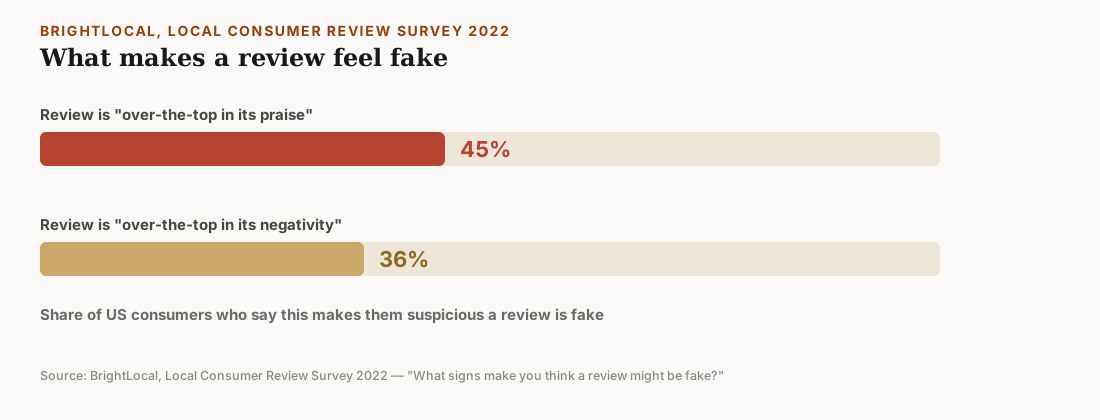
This isn't only a courtroom distinction. BrightLocal's 2022 Local Consumer Review Survey asked US consumers what signs make a review feel fake, and 45% pointed to a review that's "over-the-top in its praise," compared to 36% who said the same about a review that's "over-the-top in its negativity." People already run something close to the FTC's test on their own, without a legal framework to name it: gushing, unquantifiable praise reads as manufactured faster than harsh criticism does, maybe because a specific complaint is easier to imagine actually happening to someone, while sweeping praise with nothing concrete attached has nowhere to anchor.
A 2023 study in the Journal of Business Research by Sergio Román, Isabel P. Riquelme and Dawn Iacobucci found something that fits the same pattern from the other direction. Exaggerated positive reviews were mainly perceived as credible by consumers who already identified strongly with the brand in question; consumers without that existing connection were more skeptical, and that skepticism affected how much they trusted the brand's reputation, their own purchase intentions, and even whether they trusted the review platform itself. Exaggeration mostly travels on whatever trust already existed before someone read it, which is close to what ethos, pathos, and logos calls borrowed credibility rather than argument.
The habit that actually helps
None of this means hyperbole is something to police out of everyday language. "This traffic is killing me" doesn't need a fact-check, and treating every exaggerated sentence as a potential deception would be exhausting and pointless. The habit worth building is narrower: when a claim is meant to persuade you in a review, an ad, or a pitch, ask whether it's the kind of statement a reasonable person could actually verify. If the answer is no ("best," "life-changing"), it's hyperbole, harmless by the same logic that protects "world's best coffee." If the answer is yes (a percentage, a named outcome), it has become a claim of fact, worth exactly as much scrutiny as if it had been stated flatly, without the exaggerated wrapping. Look past the wrapping. Ask what, if anything, is actually underneath it that you could check.
A related lesson shows up with rhetorical questions: the same surface format can cut in opposite directions depending on what's underneath it, sharpening a strong argument and exposing a weak one on a topic you have no stake in, then flipping to do the opposite once the topic is personal. The format itself, exaggerated phrasing or a confident headline, tells you less than what's actually being claimed underneath it. The pizza case took two years and a federal appeals court to resolve. Reading for the difference between an opinion and a checkable claim usually takes about five seconds, once you know to look for it.