

What actually changed, in numbers
The claim that media literacy matters more now is usually made without a measurement attached. There is one available. Pew Research Center has asked Americans the same question about trust in information since 2016, which makes the decade an unusually clean comparison.
In its survey of 5,195 US adults conducted September 8 to 14, 2025, 56% said they had a lot of or some trust in information from national news organizations. Pew describes that as "down 11 percentage points since March 2025 and 20 points since we first asked this question in 2016." Local news organizations held up better at 70%, though they fell too, from 80% in March and 82% in 2016. Republicans and Democrats reported trust in information from social media sites at an identical 37%, which is a figure for each party group rather than a published national total.
The age breakdown bears directly on the next ten years. Pew reports that adults under 30 are "about as likely to say they trust information from national news organizations" (51%) as social media sites (50%). Among older groups the gap between those two is still wide. The decline showed up in both major parties and in every age group measured, which rules out the reading that this is one demographic drifting away from the news.
The same decade, measured globally
The Reuters Institute's Digital News Report 2026 covers 48 markets and reaches the same place from a different direction. Trust in news fell in 29 of those markets this year, taking the average to 37%, which the report calls "the lowest level we have recorded since we started to measure trust in 2015." In the United States the figure is 25%.
Two other series in that report have run long enough to compare against the mid-2010s. News avoidance, meaning people who say they sometimes or often actively avoid news, sits at 42%, against 29% when the question was introduced in 2017. The share of respondents the report classes as casual or passive news users, consuming news about once a week with little interest in it, is now a quarter of the sample, up from 16% in 2021.
Worry has risen alongside the withdrawal. Concern about what is real and fake online went up 4 points to 62% on average. That number is worth separating from anything resembling a skill. Concern about misinformation and the ability to evaluate a specific claim are different things, and the first has been growing considerably faster than there is evidence for the second.
The evaluation work moved
The Reuters Institute recorded a threshold crossing this year. Averaged across its 48 markets, social media and video networks are for the first time the single most used route to online news, reaching 54% of respondents against 51% for news organizations' own websites and apps. The report notes this shift is happening across all age groups rather than being carried by younger users.
A second route is opening behind it. Use of AI chatbots for news reached 10%, up from 7% the previous year, and 16% among under-35s. Growth was uneven: South Korea, Greece, and Spain roughly doubled, while the United States, the United Kingdom, France, and Germany registered no increase at all.
Both changes do the same thing to the reader. A story reached through a publisher's own front page arrived with an editorial decision attached, and that decision did some of the evaluation before anyone read a word. A story surfaced by a ranking system, or summarized by a chatbot, arrives with that layer removed and often with the original publisher hard to identify. The question of who paid for this and who controls the channel it came through used to have an answer sitting at the top of the page.
The same job in 2016 and in 2026
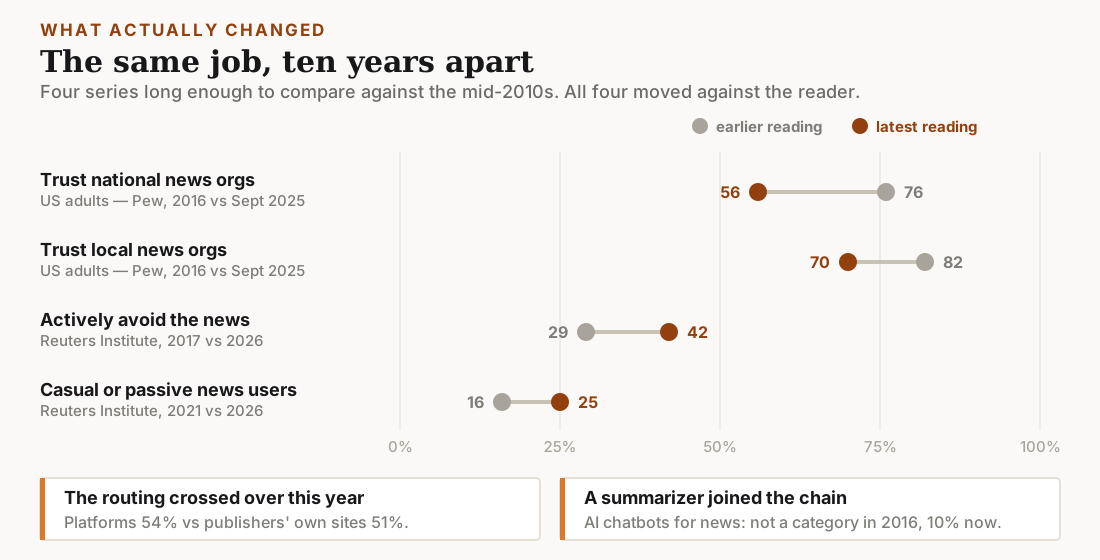
Setting the two years next to each other makes the size of the change legible. In 2016, 76% of US adults extended at least some trust to national news organizations; in September 2025 that was 56%. For local news the same pair is 82% and 70%. Among under-30s in 2025, trust in national news organizations and in social media sites had converged to 51% and 50%, while older age groups still trusted national news organizations by a clear margin.
The routing figures move the same way over a comparable window. News avoidance was 29% when the Reuters Institute began asking in 2017 and is 42% now. Casual or passive news users were 16% of the sample in 2021 and are 25% now. Global trust in news held at 40% for three years before dropping to 37% this year, the lowest the report has recorded since it began measuring in 2015. Reading news online through a publisher's own site was the most common route until this year, when platforms took it 54% to 51%. AI chatbots as a news route did not register as a category in 2016 and are at 10% now, 16% among under-35s.
None of those series measures reading ability, education, or attention span. They measure how much institutional trust is available to spend, how much content arrives without an institution attached, and who decides what a reader sees. All three moved against the reader over ten years.
What media literacy training measurably does
The advocacy case usually stops before this point, which is a shame, because the evidence is better than assertion and more interesting than it is flattering.
The sharpest test available is Guess et al., published in PNAS on June 22, 2020. The authors ran preregistered survey experiments around elections in the United States and India, testing an intervention modeled on the tips distributed by what they call "the world's largest media literacy campaign," which appeared in 14 countries. A preregistered experiment supports a causal claim, which most media literacy research cannot.
It worked. Discernment between mainstream and false headlines improved by 26.5% in a nationally representative US sample and by 17.5% in a highly educated online sample in India. In the US the improvement was still measurable several weeks later. In India it was not, and the authors report "no effects among a representative sample of respondents in a largely rural area" of northern India, where social media use is far lower.
What the tips actually did is stranger than the headline number. They did not teach people to pick out false headlines specifically. In the authors' words, the intervention "reduced the perceived accuracy of both mainstream and false news headlines," with a significantly larger effect on the false ones, and the net of those two movements is what the 26.5% describes. A correction PNAS issued on January 24, 2023 restated the mainstream side precisely: ratings of mainstream news as accurate "decreased only from 57 to 55% in wave 1 and 59 to 57% in wave 2." That cost is small next to the benefit, but it is not zero, and any honest account of what media literacy training buys has to include it.
The objection that lands
In October 2021, three media literacy educators, Elis Estrada of PBS NewsHour Student Reporting Labs, Yonty Friesem of the Media Education Lab, and Abby Kiesa, held an AMA on r/IAmA that drew about 1,600 upvotes and nearly 600 comments. The most upvoted questions were not requests for tips.
One commenter, born in 1985, described being taught in school that a good student questions source material, concluded that the general population cannot carry out that task against the volume of information now available, and asked directly whether the situation is basically hopeless. That comment drew around 120 upvotes. A reply at roughly 50 upvotes gave the structural version of the objection, saying media literacy experts were trying to "teach us how to rearrange deck chairs on the Titanic," and that treating this as an education problem masks the money moving through politics.
The objection is correct about what media literacy cannot do. Reader skill does not alter the incentives that make provocation profitable, and it substitutes for no regulation or platform design change. What it can do is narrower and still useful: it changes what happens between one reader and one piece of content, thousands of times a year. The PNAS numbers measure exactly that narrow thing, which is why advocates overstate them and skeptics dismiss them.
What the decade changed about the skill itself
In 2016 the practical job was evaluating a limited set of sources that mostly had identifiable publishers, at a moment when 76% of Americans still extended at least some trust to national news organizations. The work was manageable per item, and institutional reputation absorbed a fair share of it.
The 2026 job asks for the same thing against a much larger and much less labelled set. A growing share of it arrives with no institutional backing, the route it takes to a reader is decided by ranking systems, and a rising number of items pass through a summarizer before anyone sees them. Meanwhile the reader has less trust available to spend on any of it, so the shortcut of deferring to a masthead is both less appealing and less often applicable.
That points to a specific adjustment. A per-item research habit does not scale to a set that size. What scales is a small number of questions cheap enough to ask reflexively, which is the design logic behind the five questions media literacy education keeps returning to and the reason the definition of media literacy has stayed deliberately broad. Two of the changes driving that are measured above: trust fell about 20 points, and the most used route to online news became a ranking system rather than a publisher. The third, a summarizer sitting between reader and source, is at 10% and rising.