Key takeaways
Twelve of the 53 statistics below, one from each major source and category, for anyone who wants the shape of this page without reading all nine sections.
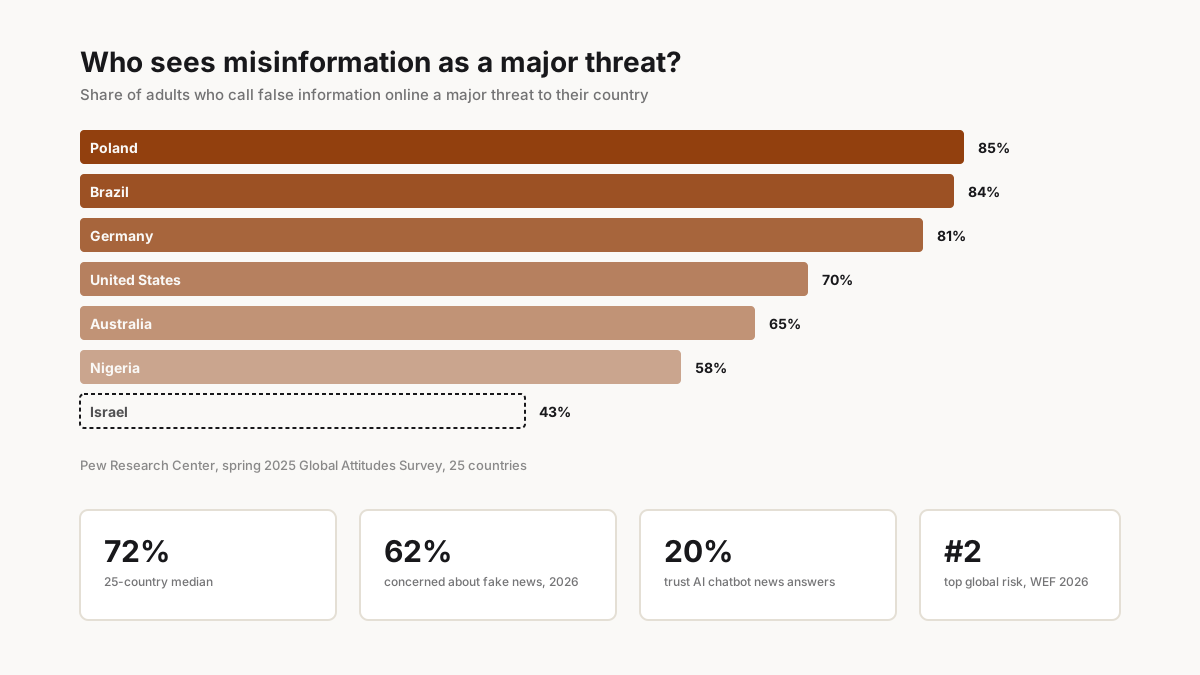
- 72% of adults across 25 countries call false information online a major threat to their nation, the top-rated concern of five issues Pew tested. Pew Research Center, p. 5.
- Poland: 85%, the highest national share recorded; Israel: 43%, the only country below a majority. Pew Research Center, p. 10.
- Misinformation outranks the global economy (70%), terrorism (69%), climate change (67%), and infectious disease (60%) as a perceived threat. Pew Research Center, p. 13, 17, 21, 24.
- 62% of people worldwide are concerned about fake news in 2026, up 4 points in a year. Reuters Institute for the Study of Journalism, June 16, 2026.
- Brazil is the only one of 48 news markets where concern about misinformation fell this year. Reuters Institute, June 16, 2026.
- US liberals (82%) are 22 points more likely than conservatives (60%) to call false information online a major threat. Pew Research Center, p. 12.
- 37% global trust in news overall, the lowest level recorded since tracking began in 2015. Reuters Institute, June 16, 2026.
- Only 20% of people trust the answers AI chatbots give to news questions, versus 37% for news overall. Reuters Institute, June 16, 2026.
- 10% of people now use AI chatbots for news weekly, up from 7% a year earlier. Reuters Institute, June 16, 2026.
- Misinformation and disinformation rank #2 among global risks over the next two years, behind only geoeconomic confrontation. World Economic Forum, Jan. 14, 2026.
- Over 1,100 experts from 136 countries rank mis- and disinformation among the risks governments feel least prepared to address. UN Development Coordination Office, Aug. 20, 2025.
- More than 80% of those experts say the harms of mis- and disinformation are already happening, not a future risk. UN Development Coordination Office, Aug. 20, 2025.
How many people worldwide see misinformation as a major threat?
Pew Research Center surveyed adults in 25 countries in spring 2025 and asked them to rate five potential threats to their nation. False information online topped the list, which lines up with how researchers define media literacy in the first place: the ability to tell what's reliable from what isn't.
- 72%: the median share of adults across 25 countries who call the spread of false information online a major threat to their country, the highest-rated concern among the five global issues Pew Research Center asked about in its spring 2025 survey. Another 21% call it a minor threat and 5% say it isn't a threat at all. Pew Research Center, "International Opinion on Global Threats," Aug. 19, 2025, p. 5.
- 24 of 25 countries surveyed have majorities who call false information online a major threat. Pew Research Center, p. 10.
- 7 countries (Germany, the Netherlands, Poland, Sweden, the UK, the US, and South Korea) rate the spread of false information as the single biggest threat of the five Pew asked about, ahead of terrorism, the economy, climate change, and disease. Pew Research Center, p. 6.
- 28,333: the number of adults Pew surveyed outside the US for this report, across 24 countries, by phone or face-to-face between Jan. 8 and April 26, 2025; a separate 3,605-person US panel was surveyed March 24–30, 2025. Pew Research Center, p. 2–3.
Which countries worry the most about misinformation, and which the least?
Concern ranges from 85% in Poland to 43% in Israel, the only country in Pew's survey where a majority does not call false information online a major threat. Each country's number tends to track its own biggest worry, whether that's terrorism, the economy, or something else entirely.
- Poland: 85% say false information online is a major threat to their country, the highest share of any country surveyed. Pew Research Center, p. 10.
- Brazil: 84% say the same, the second-highest share recorded. Pew Research Center, p. 10.
- South Korea: 82% call it a major threat. Pew Research Center, p. 10.
- Germany: 81% call it a major threat. Pew Research Center, p. 10.
- France: 80% call it a major threat. Pew Research Center, p. 10.
- Kenya: 75% call it a major threat. Pew Research Center, p. 10.
- United Kingdom: 73% call it a major threat. Pew Research Center, p. 10.
- Canada: 71% call it a major threat. Pew Research Center, p. 10.
- United States: 70% call it a major threat, with a further 24% calling it a minor threat. Pew Research Center, p. 10.
- India: 70% call it a major threat. Pew Research Center, p. 10.
- Turkey: 66% call it a major threat. Pew Research Center, p. 10.
- Australia: 65% call it a major threat. Pew Research Center, p. 10.
- Nigeria: 58% call it a major threat, the second-lowest share recorded. Pew Research Center, p. 10.
- Argentina: 73% call it a major threat. Pew Research Center, p. 10.
- Israel: 43%: the only country surveyed where fewer than half of adults call false information online a major threat. A further 27% call it a minor threat, and 20% say it isn't a threat at all, the highest share recorded for that last answer. The survey was fielded roughly a year and a half after Hamas's Oct. 7, 2023 attack, and Israelis rank terrorism, not misinformation, as their top concern of the five issues asked about. Pew Research Center, p. 10, 17.
Is concern about misinformation rising or falling?
Rising in most places, according to both Pew's multi-year country tracking and the Reuters Institute's 2026 survey, with one clear exception in each dataset.
- +4 percentage points: global average concern about "fake news" rose to 62% in the Reuters Institute's 2026 survey of 48 news markets, up from 58% the year before. Reuters Institute for the Study of Journalism, "Overview and key findings of the 2026 Digital News Report," June 16, 2026.
- 11 markets saw concern about fake news rise by more than 5 percentage points in the 2026 Digital News Report. Reuters Institute, June 16, 2026.
- Brazil was the only one of the 48 markets Reuters Institute surveyed where concern about misinformation fell year over year, down 3 percentage points. Reuters Institute, June 16, 2026.
- Worry about fake news is highest in Nigeria and Kenya, followed by the UK, Australia, and Portugal, according to the Reuters Institute's 2026 survey. Reuters Institute, June 16, 2026.
- Every Western European market in the 2026 Digital News Report saw concern about fake news rise by at least 4 percentage points, with the steepest increases in Belgium (+9pp), the Netherlands (+8pp), and Norway (+7pp). Reuters Institute, June 16, 2026.
- Poland: +20 percentage points: the largest rise in concern about false information online among the 16 countries Pew tracked over time, from 2022 to 2025. Pew Research Center, p. 11.
- Sweden (+10), Hungary (+9), and France and Germany (+6 each) also saw statistically significant rises in concern about false information online between 2022 and 2025. Pew Research Center, p. 11.
- Greece: −7 percentage points: the only country among Pew's 16-country trend where concern about false information online fell, from 79% in 2022 to 72% in 2025. Pew Research Center, p. 11.
- Among nine advanced economies Pew has tracked since the COVID-19 pandemic, the share who see infectious disease as a major threat fell from 74% in 2020 to 50% in 2025, even as concern about false information online rose over the same stretch. Pew Research Center, p. 8.
How does misinformation rank against other global threats?
Pew asked the same 25 countries about four other issues. False information online outranked all of them.
- 70%: the median share of adults across the same 25 countries who call the condition of the global economy a major threat, the second-highest-rated concern Pew asked about. Pew Research Center, p. 13.
- 69% call terrorism a major threat, the third-highest of the five issues. Pew Research Center, p. 17.
- 67% call global climate change a major threat. Pew Research Center, p. 21.
- 60% call the spread of infectious diseases a major threat, the lowest-rated of the five issues. Pew Research Center, p. 24.
Does political ideology change how people see the threat?
In most countries, people on the political left are more concerned than those on the right, but the pattern reverses in at least two places.
- In the United States, 82% of self-identified liberals call false information online a major threat, compared with 60% of conservatives, a 22-point gap. Pew Research Center, p. 12.
- In Germany, 89% of people with an unfavorable view of the Alternative for Germany (AfD) party call false information online a major threat, compared with 55% of AfD supporters. Pew Research Center, p. 12.
- In Spain, supporters of the left-leaning populist party Podemos are more concerned about false information online than nonsupporters, 83% versus 71%, the reverse of the pattern found among right-wing populist parties elsewhere in Europe. Pew Research Center, p. 12.
- Israel is the only country Pew surveyed where people on the ideological right are more likely than those on the left to call false information online a major threat. Pew Research Center, p. 12.
How much do people trust the news itself?
Trust in news generally is falling at the same time concern about misinformation is rising, and the Reuters Institute's 2026 report ties the two together directly.
- 37%: global average trust in news overall in 2026, the lowest level the Reuters Institute has recorded since it began tracking trust in 2015. Reuters Institute, June 16, 2026.
- Trust in news fell in 29 of the 48 markets the Reuters Institute surveyed in 2026, and by 5 percentage points or more in 19 of them. Reuters Institute, June 16, 2026.
- In the United States, only 25% of people say they trust the news most of the time, per the 2026 Digital News Report. Reuters Institute, June 16, 2026.
- Serbia and Slovakia are among the five markets with the lowest overall trust in news in the 2026 Digital News Report. Reuters Institute, June 16, 2026.
- Trust in news consumed on social media sits at 22% globally, well below the 37% trust average for news overall, a gap the Reuters Institute calls the industry's "trust gap." Reuters Institute, June 16, 2026.
Do people trust AI chatbots and AI-generated news content?
Less than they trust news overall. The gap is wide, even as AI chatbot use for news keeps growing, and it tracks a broader problem: people are getting worse at spotting AI-made fakes on sight, so lower trust in an AI answer doesn't always translate into catching what's wrong with it.
- 20%: global trust in the answers AI chatbots give to news questions, compared with 37% trust in news overall. Reuters Institute, June 16, 2026.
- In the United Kingdom, trust in AI chatbot news answers is just 6%, the lowest of any market the Reuters Institute surveyed. Reuters Institute, June 16, 2026.
- 10% of people globally now use AI chatbots such as ChatGPT, Perplexity, or Google Gemini for news weekly, up from 7% the year before. Reuters Institute, June 16, 2026.
- Weekly AI-chatbot news use is higher among people under 35 (16%) than the 10% global average. Reuters Institute, June 16, 2026.
- People who use AI chatbots for news are disproportionately heavy news consumers: 38% qualify as Reuters Institute's "news lover" segment, compared with 22% of respondents overall. Reuters Institute, June 16, 2026.
How do global-risk experts rank misinformation against other threats?
The World Economic Forum's Global Risks Report 2026 puts misinformation and disinformation second only to geoeconomic confrontation on its two-year outlook.
- Misinformation and disinformation rank #2 among the risks the world's business, government, and civil-society leaders judge most likely to cause a global crisis over the next two years, behind only geoeconomic confrontation. World Economic Forum, Global Risks Report 2026, published Jan. 14, 2026.
- Cyber insecurity ranks #6 on the same two-year outlook in the Global Risks Report 2026. World Economic Forum, Jan. 14, 2026.
- The Global Risks Report 2026, now in its 21st edition, draws on its Global Risks Perception Survey of more than 1,300 experts worldwide. World Economic Forum, Jan. 14, 2026.
- Geoeconomic confrontation (the risk ranked just above misinformation and disinformation) was picked by 18% of surveyed experts as the single risk most likely to trigger a material global crisis in 2026. World Economic Forum, Jan. 14, 2026.
- "Adverse outcomes of AI," a separate risk category from misinformation and disinformation, is the Global Risks Report 2026's fastest-rising risk, jumping from #30 on the two-year outlook to #5 on the ten-year outlook. World Economic Forum, Jan. 14, 2026.
What does the United Nations say about the misinformation threat?
The UN Development Coordination Office frames it as a threat governments are especially unprepared to counter.
- Citing global risk-survey data, the United Nations Development Coordination Office writes that mis- and disinformation is "not only a top global threat — it's the one countries feel least prepared to address," with over 1,100 experts from 136 countries ranking it among the gravest risks they assessed. United Nations Development Coordination Office, "Disinformation Is a Global Risk. So Why Are We Still Treating It Like a Tech Problem?", Aug. 20, 2025.
- Of those experts, more than 80% said mis- and disinformation's harms are "already happening," not a future risk. UN Development Coordination Office, Aug. 20, 2025.
How this page was put together
Every figure above comes from one of four primary sources: Pew Research Center, the Reuters Institute for the Study of Journalism, the World Economic Forum, or the UN Development Coordination Office. None of it is copied from a secondhand roundup. Each statistic links to the original report, and the Pew figures name the specific page. Before publishing, every source URL was checked directly and every number was confirmed against the text of the original document, not copied from a press release or a chart caption alone.
This is a curated index, not original polling. Where two sources define "misinformation" differently, or survey different sets of countries, that's noted in the statistic itself rather than smoothed over. Pew's country-level figures come from its spring 2025 Global Attitudes Survey; the Reuters Institute's 2026 figures come from a separate, more recent survey of news consumers across 48 markets. The two aren't directly comparable numbers for the same question, which is why they're kept in separate sections above.
Cite this
Hollowvane Editorial, “Misinformation Statistics 2026,” Hollowvane, published September 13, 2026, https://hollowvane.com/misinformation-statistics-2026/.
Download all 53 statistics (CSV, with source and link for each row)
Last verified: September 13, 2026.