How a belief survives its own evidence
Belief perseverance is what happens when a belief keeps standing after the specific fact it was built on gets knocked out from under it. It is not stubbornness. The belief usually survives because you never just held the original fact by itself. You built things on top of it: reasons the claim made sense, a story about why it happened, a memory of how convinced you already were before you had time to doubt it. Take away the original fact, and none of that scaffolding automatically falls down with it, because nobody goes back and checks the scaffolding. They only checked the one fact that got disproven.
This isn't just a description of ordinary stubbornness. It has been demonstrated under controlled conditions. In a 1975 Stanford study, Lee Ross, Mark Lepper and Michael Hubbard had participants try to tell real suicide notes apart from ones the researchers had written themselves, then gave everyone fake feedback: some were told they had a real talent for the task, others that they had done badly. Afterward, the researchers explicitly and thoroughly debriefed every participant, telling them the feedback had been assigned at random from the start and had nothing to do with how they had performed on the task. Participants who had been told they did well still rated their own social sensitivity higher afterward than participants who had been told they did badly. The belief about their own ability outlived the "evidence" it was built on, even after that evidence was pulled out from under them, explicitly, on the spot.
Cognitive dissonance runs on the discomfort of having already acted a certain way, and it resolves by updating the belief to match the action. Belief perseverance skips the action step entirely. You were simply told something, and the reasons you built around it outlive the telling, whether you ever did anything about it or not. It's a near neighbor of source amnesia, too: both describe a belief that keeps standing after the specific thing that justified it, a fact or a source, has gone missing from memory.
The most famous field example just failed its own fact-check
The example almost everyone reaches for to prove belief perseverance happens outside a lab is a 1956 book called When Prophecy Fails. Leon Festinger, Henry Riecken and Stanley Schachter infiltrated a small Chicago-area group led by a woman the book calls "Mrs. Keech" (her real name was Dorothy Martin), who said she had learned from aliens that a flood would destroy North America on December 21, 1954, and that her followers would be rescued by flying saucers the night before. When neither the flood nor the saucers arrived, the book's central claim was that the group did not just keep believing. It doubled down and started proselytizing harder than before, exactly the pattern the authors needed to argue for a new psychological mechanism they named cognitive dissonance. The book became the textbook case, cited for seventy years across psychology, sociology and religious studies as proof that a failed prophecy can make belief stronger instead of weaker.
In 2026, a paper by independent scholar Thomas Kelly, drawing on a box of Festinger's own papers recently unsealed at the University of Michigan's Bentley Historical Library, laid out a very different account. Both When Prophecy Fails and Festinger's 1957 follow-up book on the theory describe the group's proselytizing before the failed prophecy as minimal, just two press releases and a few public talks in August and September 1954. Kelly's paper shows recruiting messages going out as early as May 1954, months earlier than either book lets on. And the psychic message that supposedly proved the group's prayers had saved the world, the book's central piece of evidence that faith had strengthened after the failure, was not spontaneous. Kelly's paper shows that Henry Riecken, one of the book's three authors, had spent months building himself up inside the group as a spiritual figure the members called "Brother Henry," and that he was the one who produced that message. Riecken's own contemporaneous notes describe how he "precipitated what seems to have been quite a scene inside of the house" that night.
The ending did not match the book either. Within weeks, Dorothy Martin told the UFO magazine The Saucerian that she "really didn't expect to be picked up physically" by the aliens. Charles Laughead, another prominent member, backed off the same way, suggesting maybe it was their spirits that had been lifted, not their bodies. The group dissolved. None of that fits the book's own 1956 verdict that believers "passed through this period of disconfirmation and its aftermath with their faith firm, unshaken and lasting."
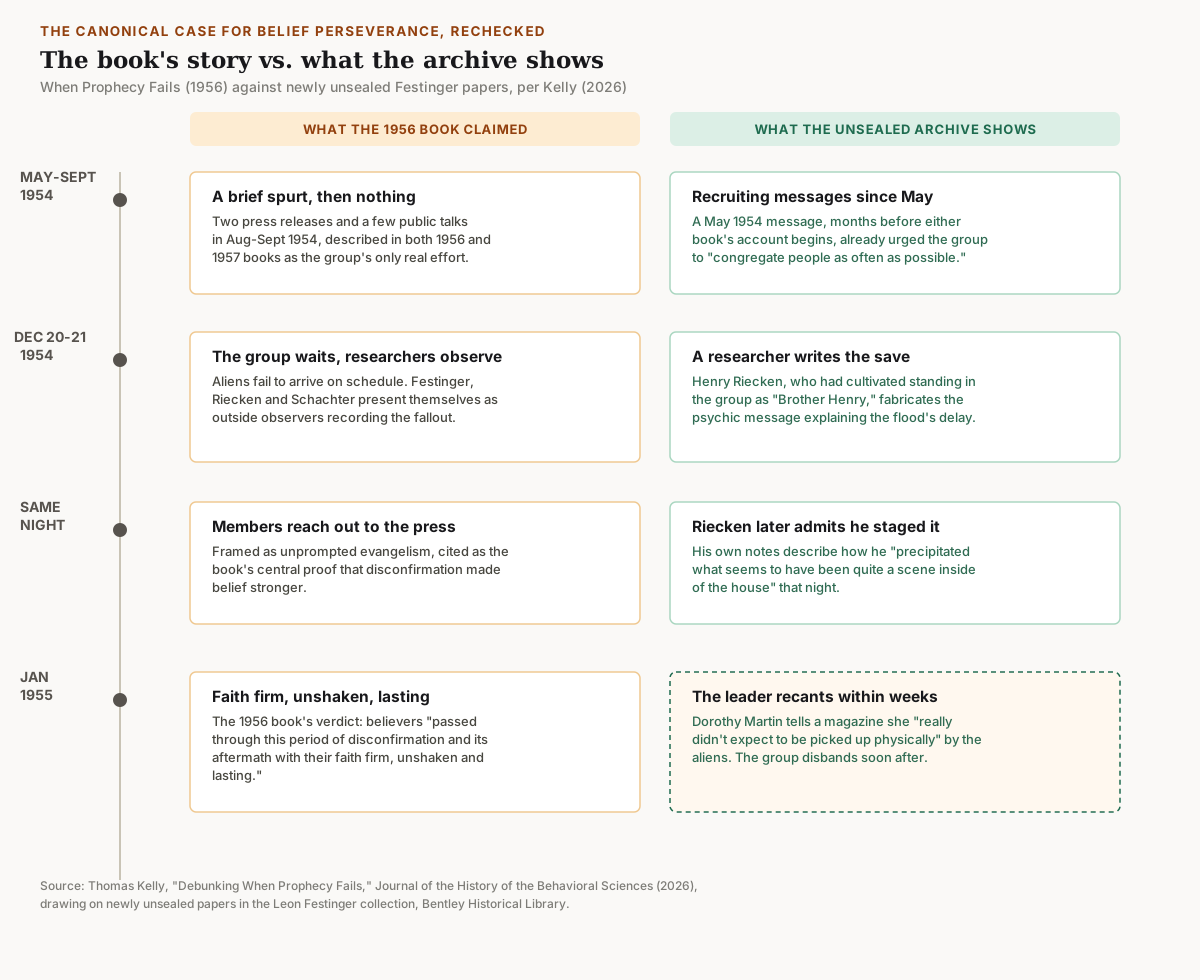
The proof was staged. The phenomenon was not.
Belief perseverance itself is still real; the lab result above still holds. What went wrong is that the single most-repeated illustration of it in the wild ran unchecked for seventy years, cited by later researchers, retold in textbooks, even adapted into a Pulitzer Prize-winning novel, because it was too good a story to send anyone back to the primary sources. Sit with that before you repeat any "textbook example," psychological or otherwise. A claim does not earn its citations by being famous. It earns them by holding up when someone finally goes and checks. The Mandela effect also produces confident, specific claims that turn out wrong, but through ordinary memory reconstruction, nobody there set out to fool anyone. What happened here was not a memory gap. One researcher built the story on purpose, and everyone who read the book repeated it as fact without checking the file it came from.
Don't confuse this with the backfire effect
Belief perseverance is often mixed up with a related but separate claim: the "backfire effect," the idea that correcting someone's misinformation can make them believe it even more. That idea comes from a specific 2010 study by Brendan Nyhan and Jason Reifler, who found that conservative readers shown a factual correction about Iraq's weapons programs became more convinced, not less, that the weapons had been found. It is a catchy, alarming finding, and it got repeated everywhere as a reason corrections do not work.
It mostly hasn't held up. In 2019, Thomas Wood and Ethan Porter ran the largest attempt yet to reproduce it: five experiments, more than 10,100 participants, 52 different politically charged claims. None of the 52 produced a backfire effect. Corrections, on average, moved people's beliefs toward the facts, not away from them. The backfire effect turned out to be a much narrower, harder-to-trigger phenomenon than the original study suggested, not the general rule people had turned it into.
That is a different claim from belief perseverance, not a restatement of it. Belief perseverance says a correction that only removes the original fact often leaves the rest of the belief standing, because nobody goes after the scaffolding. The backfire effect claims a correction can make things actively worse. The evidence for the first is solid. The evidence for the second mostly evaporated once people tested it at scale. If someone tells you a claim is safe because "everyone already checked it," that is the same unchecked-scaffolding problem in a different outfit, just applied to a citation instead of a correction.
What knocks a belief loose
There is a more useful, evidence-backed answer to what does work, from a 2007 replication of the original Stanford study by Cathy McFarland, Alina Cheam and Roger Buehler. They found that the standard kind of debriefing, telling someone their specific feedback was fake, was not enough to remove the effect, matching what Ross, Lepper and Hubbard had already shown decades earlier. But a fuller kind of debriefing did work: one that also told participants the entire task itself had no real, meaningful skill being measured at all. Correcting the data point was not enough. Correcting the framework that made the data point feel meaningful in the first place was.
That's the habit to build. When a claim gets corrected, whether it's a statistic, a quote, or a whole textbook case study, ask whether the correction removed the scaffolding or just the one detail everyone was arguing about. A prediction with a specific date, a rescue mechanism, and a built-in explanation for why it did not happen the first time is not more credible for having all those moving parts. Each added detail is one more piece of scaffolding a single fact-check will not automatically clear away. Checking the parts nobody got around to checking, the parts everyone assumed someone else already verified, is usually where the real correction is waiting.
Watch, too, for the mirror-image move: instead of the belief quietly outliving disconfirming evidence, the standard for what would have counted as disconfirming evidence quietly shifts after the fact. A 2012 test of two psychics at Goldsmiths, University of London is the clearest documented case of moving the goalposts in real time, and it's worth reading alongside this one, because both track what actually happens, on the record, once a specific prediction fails.