The short version
Loaded language is word choice that hands you a verdict before you've looked at any evidence yourself. Call the same crowd "protesters" or "rioters," the same tax change "relief" or "a giveaway," the same government "the regime" or "the administration," and you haven't added a single new fact. You've told the reader what to conclude about the facts that are already there.
That's the whole mechanism, and it's why loaded language is harder to catch than an outright lie. Every word in a loaded sentence can be, individually, accurate. The manipulation isn't in the word being false. It's in which true word got picked, out of several that would have described the same event.
A trick with a two-hundred-year paper trail
Jeremy Bentham named this move in 1824, in The Book of Fallacies, a catalog of the rhetorical tricks he'd watched British politicians use to shut down reform without ever engaging the argument. He called it a "question-begging epithet": the unwarranted use of a "eulogistic" (praising) or "dislogistic" (condemning) label to smuggle in a value judgment that should have been proven, not assumed. Calling a proposed law "reckless" instead of "untested" does the arguing before anyone's made an actual case.
S.I. Hayakawa landed on nearly the same insight over a century later, from a different direction. His 1949 book Language in Thought and Action, a revision of his 1941 Language in Action, described "snarl-words and purr-words": phrases that report almost nothing about the world and almost everything about the speaker's feelings toward it. His own examples, "You dirty sneak!" and "The filthy scum!" as snarl-words, "She's the sweetest little girl in all the world!" as a purr-word, are blunt enough to notice immediately. The harder version is the one dressed as a plain, neutral description, which is most of how loaded language actually shows up.
Two writers, working roughly 125 years apart on completely different problems (Bentham was picking apart parliamentary debate, Hayakawa was teaching general semantics to college students), kept arriving at the same underlying claim: the word a person reaches for to "just describe" something usually already contains their verdict on it.
Watching the mechanism happen in real time
Most discussions of loaded language use single-sentence examples, which makes the technique feel like something that happens instantly, in one word choice. What actually happens inside a newsroom covering a fast-moving event is closer to a series of small decisions, made under deadline, that compound over hours.
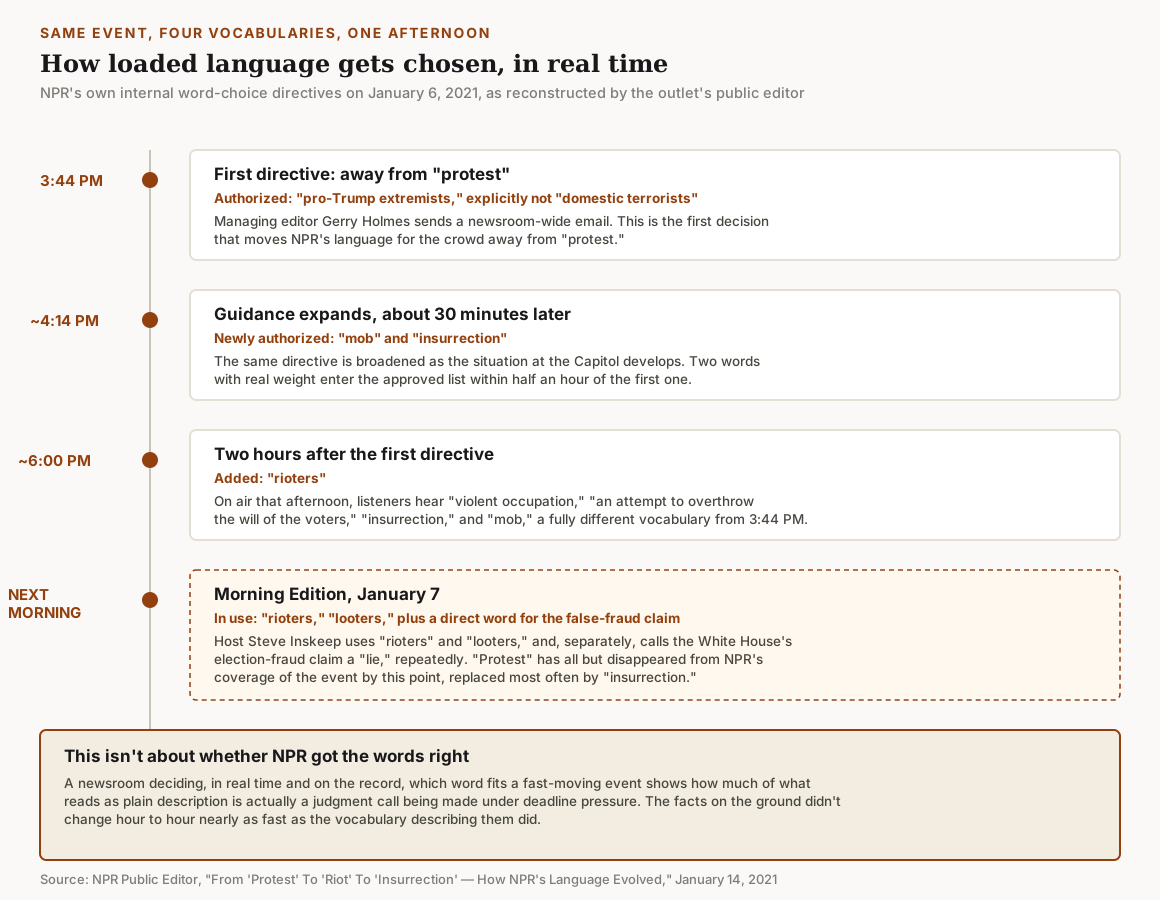
NPR's own public editor reconstructed exactly that sequence for January 6, 2021. At 3:44 PM, managing editor Gerry Holmes sent a newsroom-wide directive: call the crowd at the Capitol "pro-Trump extremists," not "domestic terrorists," a decision that had already moved the outlet's language away from "protest." About thirty minutes later, that guidance widened to authorize "mob" and "insurrection." Roughly two hours after the first directive, "rioters" was added to the approved list. By the next morning's Morning Edition, hosts were using "rioters" and "looters," and, separately, calling the White House's election-fraud claim a "lie," without hedging.
The "riot" vs. "protest" fight isn't new, and it isn't random
The specific pair NPR was navigating, riot versus protest, has been studied well beyond one newsroom's internal emails. AllSides analyzed headline data from Media Cloud and found right-leaning outlets used "riot" in headlines noticeably more often than left-leaning outlets, who reached for "protest" far more often for the same underlying events, a split that visibly flipped for both sides during the January 6 coverage itself. TIME's own reporting on the George Floyd protests made the same point from the newsroom side: describing someone holding a sign as a "rioter" is exactly as misleading, in the other direction, as describing someone setting a car on fire as a "protester." Neither word is the neutral one. Both carry a verdict.
There's a sharper pattern underneath the partisan one. A peer-reviewed study in the Journal of Race, Ethnicity, and Politics found that protests raising grievances about police violence produced measurably more fear- and anger-coded language in news coverage when the protesters were non-white, a pattern that did not hold for otherwise comparable protests by white demonstrators. That's a single outlet's own word choice shifting based on who's standing in the crowd, not two outlets that simply prefer different words, and it's a much harder pattern to defend as honest description.
A word tested in advance, not chosen under deadline
NPR's shifting vocabulary on January 6 was reactive: decisions made hour by hour as a story none of them had planned for kept developing. Some loaded language runs the opposite way. It's chosen deliberately, in advance, and tested for maximum effect before anyone in the audience ever hears it.
The clearest documented case is the U.S. federal estate tax. In the 1990s, Republican pollster Frank Luntz ran focus groups comparing two labels for the identical policy: "estate tax," the government's own name for it, and "death tax," the term he was testing as a replacement. Luntz's own explanation of why the swap worked: "Nobody really knows what an estate is, but they certainly know what it means to be taxed when you die." Both phrases describe the same tax, applying at the time to only a small share of the largest estates. "Estate tax" sounds like something that touches other people's money. "Death tax" sounds like something that touches yours, on the worst day of your life. That's the reaction Luntz was measuring for, and "death tax" spread through Republican messaging in the years afterward.
The actual test for catching it
Stop asking whether a word carries emotion. Almost all of them do, and hunting for one that's perfectly neutral is a losing game. Ask this instead: would a different, equally accurate word for the same specific facts have handed you a different verdict? If "rioters" and "protesters" describe the identical set of actions on the ground, and only one of them keeps showing up, that gap is the signal. Not the word by itself.
That test holds up past news headlines. It's the same move behind "death tax" instead of "estate tax." It's the same move behind a rhetorical question that answers itself before you've had a chance to think it through. Loaded language is doing pathos's job while dressed up as logos: it reads like a plain description, but the verdict is already built in. A rage bait headline runs the same play, getting you to react before you've checked what actually happened, so the word has already won by the time you catch up.
It's worth telling apart from a close relative, the equivocation fallacy: loaded language picks one word out of several equally accurate options to smuggle in a verdict on a fixed set of facts, while equivocation lets a single word quietly change what it refers to partway through an argument. Different mechanisms, same underlying trick of making a word do an argument's work instead of the evidence.
The habit that actually helps: when a word snags you, swap it out. Drop in the flattest alternative you can think of, and check whether the underlying facts still hold up without the charge attached to them. If they do, the word wasn't describing anything. It was arguing.