The short version
"Reasonable doubt" has a specific job: it's the bar a prosecutor has to clear before a jury can convict someone of a crime. It doesn't mean any doubt at all, and it doesn't mean total, mathematical certainty either. It means a juror, after actually looking at the evidence, still isn't firmly convinced. That doubt has to come from somewhere real, the facts presented or the facts missing, not from a hunch.
The same two words also get used loosely outside a courtroom, and that looser use is where things get slippery. Businesses and interest groups have a long, documented history of manufacturing public doubt about settled questions, on purpose, and dressing it up in the same reasonable, careful-sounding language a juror is supposed to use. Knowing what the real legal standard requires is what makes the copy easy to spot.
What a juror is actually told
Courts don't leave "reasonable doubt" to a juror's gut feeling. The Ninth Circuit's own model jury instruction spells it out: "Proof beyond a reasonable doubt is proof that leaves you firmly convinced the defendant is guilty. It is not required that the government prove guilt beyond all possible doubt. A reasonable doubt is a doubt based upon reason and common sense and is not based purely on speculation. It may arise from a careful and impartial consideration of all the evidence, or from lack of evidence." Two things stand out in that wording. First, the doubt has to be tied to reason, not to a vague feeling that something's off. Second, an absence of evidence counts as a legitimate source of doubt, not just contradictory evidence.
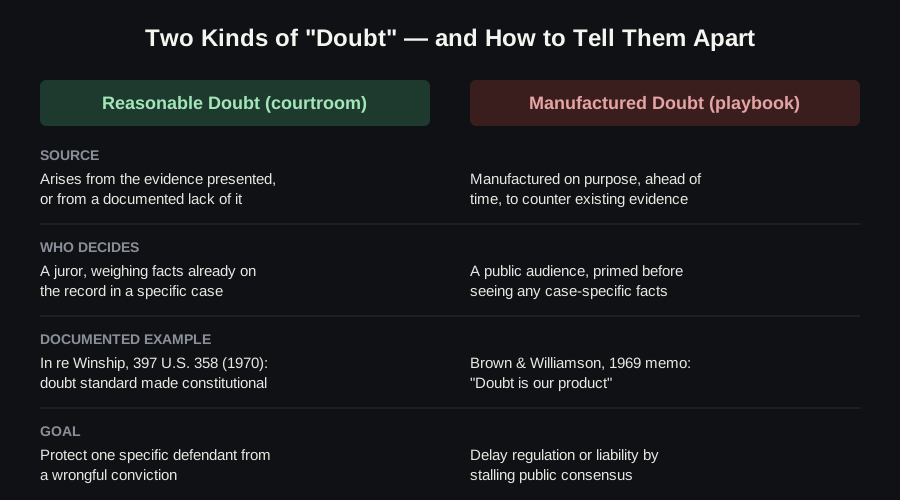
That standard is also a constitutional floor, not just a courtroom custom. In In re Winship, 397 U.S. 358 (1970), the Supreme Court ruled 5-3 that the Fourteenth Amendment's Due Process Clause requires proof beyond a reasonable doubt for every element of a criminal charge, a rule the Court extended to juvenile proceedings as well as adult criminal trials. Before Winship, some juvenile courts used the lower "preponderance of the evidence" standard used in civil cases. After it, no U.S. court could convict anyone of a crime, adult or juvenile, on anything less than reasonable doubt.
The principle underneath the standard is older than the phrase
The exact courtroom phrasing of "reasonable doubt" developed gradually through English and American case law, but the reasoning behind setting the bar that high was stated plainly by the English jurist William Blackstone in his Commentaries on the Laws of England, published across the 1760s: "the law holds that it is better that ten guilty persons escape than that one innocent suffer." Legal scholars call this asymmetry Blackstone's ratio, and Blackstone wasn't the first to state a version of it. Roughly a century earlier, English judge Matthew Hale had written that it's "better five guilty persons should escape unpunished, than one innocent person should die," and English jurist John Fortescue, writing around 1470, put the same idea at twenty to one.
The number attached to the ratio changed from writer to writer, but the underlying logic didn't: wrongly convicting an innocent person and wrongly acquitting a guilty one are not equally bad mistakes, so the system should be built to fail toward the second one. That's the actual reason the standard is set as high as "reasonable doubt" rather than something looser like "more likely than not," which is the standard used in civil lawsuits over money instead of someone's liberty.
When "doubt" left the courtroom
The word's legal meaning is specific to one setting: a juror weighing evidence about one defendant in one case. Outside that setting, companies have also turned "doubt" into a deliberate public-relations product, and the clearest documented case is the tobacco industry's response to mounting evidence linking smoking to cancer. A 1969 internal memo from tobacco company Brown & Williamson, later made public through litigation, states the strategy without euphemism: "Doubt is our product since it is the best means of competing with the 'body of fact' that exists in the minds of the general public. It is also the means of establishing a controversy." Public health researcher David Michaels documented how that same playbook, paying scientists to keep every study looking contested, spread to other industries in his 2008 book Doubt Is Their Product.
That kind of doubt works on a different logic than a juror's reasoned hesitation about one specific case. It gets manufactured in advance, aimed at millions of people who'll never see the underlying research, and built to survive regardless of what the evidence actually shows. It borrows the vocabulary of careful, reasonable skepticism, exactly the loaded language trick of using a word that sounds neutral to do the arguing for you, while doing something close to the opposite of what reasonable doubt is supposed to do in a courtroom.
The same split, a different industry, decades later
The tobacco memo isn't an isolated relic. A 2017 peer-reviewed study in Environmental Research Letters by Geoffrey Supran and Naomi Oreskes analyzed 187 climate change communications from ExxonMobil and its predecessor companies spanning 1977 to 2014, comparing internal documents and peer-reviewed papers written by company scientists against "advertorials," paid opinion-style advertisements the company placed in the New York Times between 1989 and 2004. The pattern was consistent: the internal and peer-reviewed material largely treated climate change as real, human-caused, and serious, while the advertorials aimed at the public overwhelmingly expressed doubt on all three points.
That's the same structure as the tobacco memo, decades later and in a different industry: doubt calibrated for a public audience that runs opposite to what the company's own scientists were writing for each other. Neither case is about a company getting the science wrong internally. Both are about a gap between what an organization knew and what it told the people who couldn't check.
The question that actually tells them apart
Both kinds of doubt get described with the same reasonable-sounding language, which is exactly why the distinction matters. What actually tells them apart has nothing to do with how careful or measured the doubt sounds. It comes down to where the doubt came from and who it was built for.
Ask two things. Is this doubt following the evidence, or was it produced ahead of the evidence to compete with it? A juror's doubt exists because of what's in front of them in one specific case. Manufactured doubt exists because an organization decided, in advance, that uncertainty served its interests better than the settled science did. And who is the doubt actually protecting? Reasonable doubt in a courtroom protects one person from a wrongful conviction. The tobacco and ExxonMobil cases weren't protecting any specific individual from anything. They were protecting a company's position from a conclusion its own scientists had already reached by reasoning from the evidence. That's the tell. Genuine reasonable doubt gets weaker as more evidence comes in. Manufactured doubt is built to survive it.
A fixed standard is also what separates a fair trial from moving the goalposts: a juror's threshold for reasonable doubt is set before the verdict, not adjusted afterward to fit whichever outcome someone wanted. The 2012 Goldsmiths psychic test shows what it looks like when the standard for proof moves only after the evidence comes in, which is a different failure than doubt that was never reasonable to begin with.