The short version
A syllogism is a three-line argument: two premises and a conclusion. "All men are mortal. Socrates is a man. Therefore, Socrates is mortal" is the textbook version, and it has been the textbook version for well over 2,300 years, since Aristotle formalized the structure in the Prior Analytics around 350 BCE.
What makes it a syllogism specifically, not just any two-sentence argument, is that it runs on exactly three terms: a major term (the broadest category, "mortal"), a minor term (the specific case, "Socrates"), and a middle term ("man") that shows up in both premises to connect them, then disappears from the conclusion entirely. Whether the whole thing is valid comes down to whether that middle term is actually doing the connecting work it is being asked to do.
Aristotle's rulebook, and why most of it is about the middle term
Aristotle's Prior Analytics laid out three possible figures, sorted by where the middle term sits in each premise, and worked out which combinations of universal and particular statements inside those figures actually produce a valid conclusion. His original system found 14 valid moods. Medieval logicians later added a fourth figure, and the traditional system that resulted settles on 24 valid forms out of 256 total combinations, once every possible pairing of statement type (all/some/no/some-not) across every figure gets counted.
That is a lot of scaffolding built around one question: does the middle term actually link the other two terms, or does it just resemble a link? Validity, in this system, is a property of the structure alone. It says nothing about whether the statements plugged into that structure are true. The site's piece on deductive vs. inductive reasoning covers the more common way that gap gets exploited: a structurally sound syllogism resting on one false premise nobody said out loud. A syllogism can also fail the opposite way, with every premise true and the structure itself broken. That second failure is specific to categorical syllogisms, and it has a name.
The specific way it breaks: the undistributed middle
A term is "distributed" in a statement if that statement makes a claim about every single member of the category, not just some of them. "All extremists oppose this policy" distributes "extremists," since it is a claim about all of them, but it does not distribute "oppose this policy." That phrase is the predicate of a universal statement, which only tells you that extremists are among the people who oppose the policy, not that everyone who opposes it is an extremist.
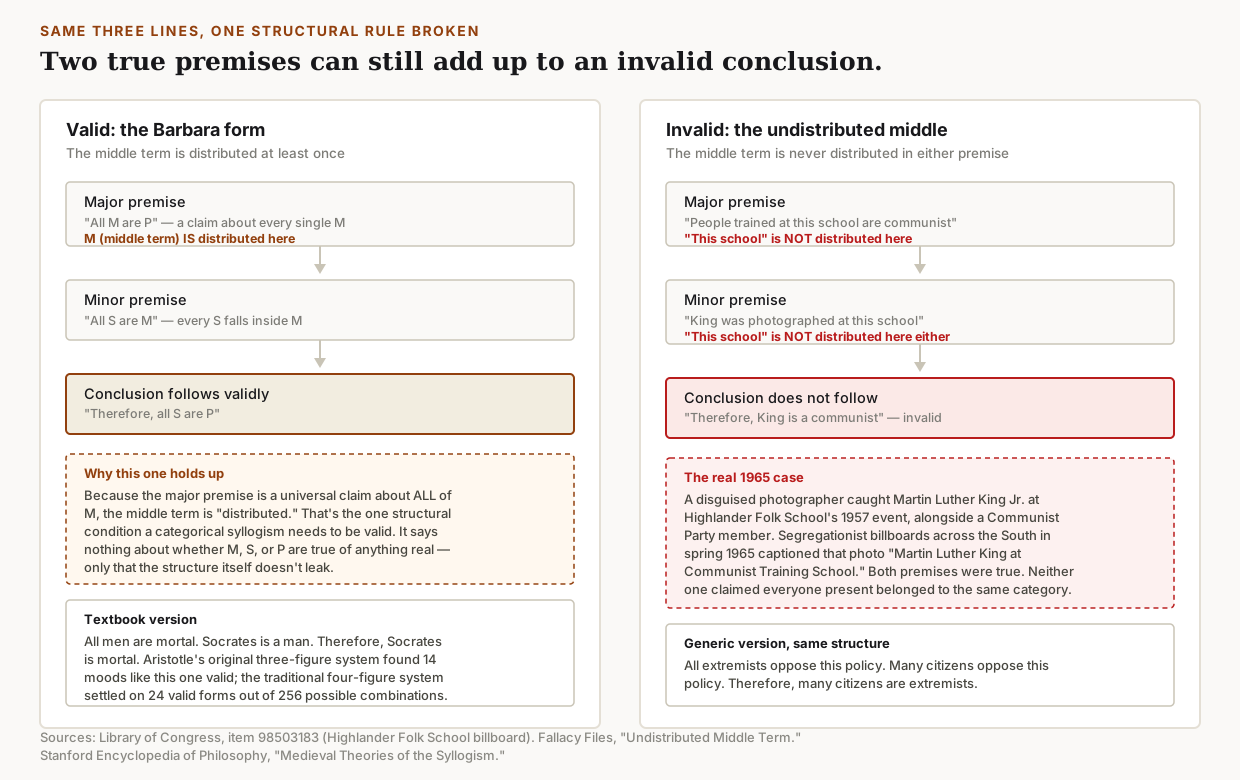
Take that same phrase and run it as the middle term of a syllogism: "All extremists oppose this policy. Many citizens oppose this policy. Therefore, many citizens are extremists." Both premises can be entirely true. The conclusion still does not follow, because "oppose this policy" never gets distributed in either premise. It links the two groups only on the surface, the way two strangers who both happen to shop at the same grocery store aren't necessarily friends. Compare that to the valid Barbara form from the last section: "All M are P. All S are M." The first premise is a universal claim about every single M, which distributes M. That one distribution is the entire structural difference between an argument that holds up and one that only looks like it does.
The real case: a photograph, a billboard, and a category that was never established
In 1957, the Georgia Commission on Education, a state agency dedicated to fighting school integration, sent photographer Ed Friend to the 25th anniversary celebration of the Highlander Folk School in Monteagle, Tennessee, a school that trained Southern civil rights organizers. Posing as a vacationing freelancer, Friend photographed Martin Luther King Jr. seated in a crowd that also included Abner W. Berry, a Communist Party USA Central Committee member and journalist. Both men were at the same event. That much is documented in the photograph itself, held today by the Library of Congress and by Stanford's Bob Fitch Photography Archive.
In the spring of 1965, that photograph resurfaced on hundreds of billboards across the American South, captioned "Martin Luther King at Communist Training School." The argument the billboards asked viewers to complete runs as a syllogism: people trained at this Communist-linked school are communists; King was photographed at this school; therefore King is a communist. The middle term, presence at that specific event, never gets distributed in either premise. The major premise never claims that every single person present was a trainee or a Party member. Berry's attendance doesn't establish that category for the room, let alone for King. Both individual facts checked out: King really was in that photograph, and Berry really was a Communist Party member. What the billboard wanted viewers to draw from those two true facts was a structurally invalid syllogism, not a documented finding.
Why two true premises don't save it
This is the part that makes the undistributed middle a persuasion tool rather than just a logic-class exercise. An argument built on a false premise can be checked by fact-checking the premise. An argument that fails on distribution passes every individual fact-check and still doesn't hold together, because the problem is in how the categories relate to each other, not in whether any single statement is accurate. It works the same way as a logos appeal built entirely from individually true facts: nothing in it is false, but the category boundary between two of those facts is smaller than the argument needs it to be.
The shape repeats outside politics too. "This company shares a supplier with a company that went bankrupt. Therefore, this company is at risk of bankruptcy" runs on the same undistributed middle: sharing a supplier is the category, and it is never established that every company sharing that supplier faces the same risk. The tell is the same in every version: look for the phrase doing the connecting work between the two outer claims, and check whether either premise actually makes a claim about all of it, not just some of it.
How to actually check one
Name the three terms first: what's the broad category in the conclusion's predicate, what's the specific case in the conclusion's subject, and what's the term that shows up in both premises but not in the conclusion at all. That third one is the middle term, and it's doing all the connecting.
Then check whether either premise makes a claim about every member of that middle term's category, not just some. If neither premise does, the syllogism is structurally invalid no matter how true each individual premise turns out to be, and no amount of additional fact-checking on the premises themselves will fix it. That check is a narrower, form-specific version of the five questions that apply to any claim: who's doing the connecting between these two facts, and does that connection still hold once it's written out as a rule for the whole category, not just this one case?