The short version
A thought-terminating cliché is a short, ready-made phrase that closes a conversation instead of continuing it. It sounds like it settled something. Usually it settled nothing. It just ended the exchange before anyone had to defend a position.
You've heard dozens of these without the label attached: "it is what it is," "let's agree to disagree," "it's not that deep." None of them are dishonest by nature. What makes one thought-terminating is how it gets used, dropped into an argument at the exact moment a real answer was due, doing the work of ending the discussion instead of the work of settling it.
Where the term comes from
The phrase was coined by psychiatrist Robert Jay Lifton in his 1961 book Thought Reform and the Psychology of Totalism, a study of what was then popularly called brainwashing. His research started years earlier, in 1953, with a series of interviews: 25 American servicemen who had been held captive during the Korean War, and 15 Chinese citizens who had fled their homeland after being subjected to indoctrination in Chinese universities. Some of those interviews continued regularly for over a year.
Lifton wrote: "The language of the totalist environment is characterized by the thought-terminating cliché. The most far-reaching and complex of human problems are compressed into brief, highly reductive, definitive-sounding phrases, easily memorized, and easily expressed. They become the start and finish of any ideological analysis." That line comes from Chapter 22, "Ideological Totalism."
One of eight, not a standalone trick
Lifton didn't present the thought-terminating cliché as an isolated tactic. It sits inside a list of eight criteria he identified for totalist thought reform, alongside milieu control (controlling communication in and out of an environment) and the demand for purity (dividing the world sharply into pure and impure). The sixth criterion is titled "Loading the Language," and the cliché is one specific tool inside that broader habit of a group reshaping vocabulary so words carry a verdict before anyone gets to think about them.
Loaded language works one word at a time, tilting a description by which word gets chosen. A thought-terminating cliché works at the level of a whole sentence, aimed at shutting a topic down rather than coloring it.
One phrase, two different jobs
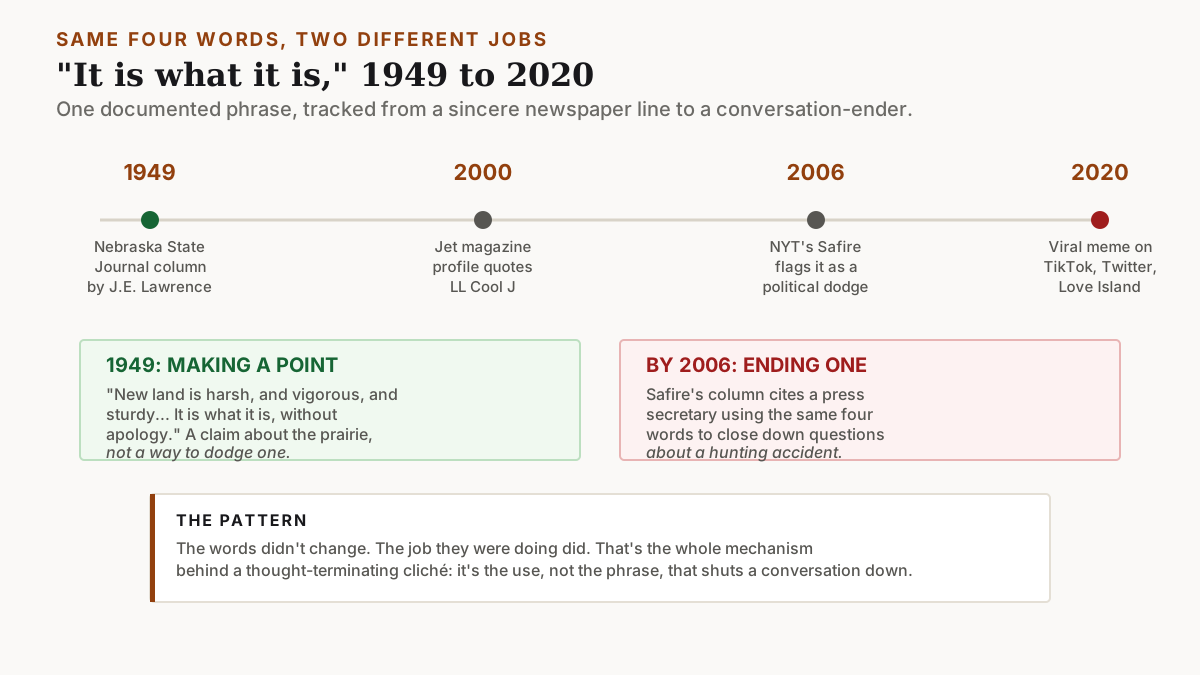
The clearest illustration of how this works comes from an ordinary phrase, not a cult slogan: "it is what it is." The earliest documented use traces to 1949, when Nebraska State Journal columnist J.E. Lawrence wrote about the American prairie: "New land is harsh, and vigorous, and sturdy. It scorns evidence of weakness. There is nothing of sham or hypocrisy in it. It is what it is, without apology." That's a claim being made and defended in the same breath, not a way to dodge one.
New York Times language columnist William Safire surfaced that 1949 citation in a 2006 "On Language" column, after concluding he could find no earlier, more definite origin for the saying. A 2008 Slate retrospective on Safire's reporting independently confirms the detail and adds another: Safire's own column was tracking the phrase's new political use at the same time, noting that White House press secretary Scott McClellan had reached for it to characterize both the administration's domestic surveillance program and Vice President Dick Cheney's hunting accident. By 2020, the phrase was a fixture of TikTok and Twitter memes and a recurring line on the reality show Love Island, according to Vice's reporting on its history, which also traces an intermediate 2000 appearance: linguist Dave Wilton, of Word Origins.org, found an early recorded instance in a Jet magazine profile where LL Cool J used the phrase as a shrug about a new record.
Same four words the whole time. Lawrence used them to make an argument. Within about sixty years, the standard reference point for the phrase was a politician's press secretary using it to close one down. Even the words "it is what it is" themselves aren't unique to this idiom: Slate's piece notes that philosopher John Locke used a version of the same clause in an entirely different sense in the same 1690 essay where he named the appeal to ignorance fallacy, defining essence as "the very being of any thing, whereby it is, what it is." That's a coincidence. Locke was doing metaphysics, not making small talk, but it's a reminder that identical words carry no fixed job on their own.
Why it works on you
Part of what makes a thought-terminating cliché effective is a plain asymmetry in cost. Saying "it is what it is" takes no effort and commits you to nothing. Actually explaining why a policy failed, or why an argument doesn't hold up, takes real work and opens you to follow-up questions. The cliché lets someone exit the harder path without looking like they refused to answer.
The other half is that these phrases borrow the shape of wisdom without doing the work of it. "It is what it is" sounds like acceptance. "Let's agree to disagree" sounds like fairness. Both can be genuine. The tell is whether it shows up right when a real answer was owed, standing in for one instead of leading into one.
From thought-reform camps to your group chat
Lifton was describing a totalist environment, but the mechanism doesn't need a labor camp to function. Researchers studying high-control groups document the same category of phrase working as an internal control device, lines like "doubt is from the enemy" that redirect a member's own uncertainty back outward, onto whoever raised it. ICSA's summary of Lifton's criteria notes that this kind of language works partly because members absorb it as their own vocabulary rather than experiencing it as something imposed from outside.
Outside of cults, the same shape shows up as ordinary conversational habit: dismissing a complaint with "there are worse things to worry about," or shutting down criticism of something popular with "let people enjoy things." Neither is a formal logical fallacy. Both do the job Lifton described in 1961: compress a real question into something "brief, highly reductive, definitive-sounding," then treat it as finished.
The actual test
Before letting a familiar phrase settle an argument, ask what it actually resolved. A phrase that names a specific reason moves a conversation forward, even a short one: "that doesn't hold up because X." A phrase that names nothing but still ends the exchange is doing the other job, whatever its content happens to be.
This isn't the only rhetorical move built to make a position hard to actually contest. Moving the goalposts does something related by changing what would count as proof partway through an argument, instead of shutting the argument down outright. Both let someone avoid ever being pinned to a testable claim. Naming which one is happening is most of the work of not falling for it.