The short version
Moving the goalposts is what happens when someone sets a bar for what would count as proof, you clear it, and the bar moves anyway, usually higher or in a new direction, so your evidence stops counting. Not because anyone found a flaw in the evidence itself. Because the standard changed after it arrived.
That's the detail that separates this from ordinary, healthy skepticism. Standards get revised for real reasons all the time; that's not automatically a trick. What makes it a fallacy is the timing and the target: the new requirement shows up right after this specific evidence, sized to exclude exactly what was just handed over, with no independent reason offered for the change.
The metaphor used to be literal
The phrase is British in origin, a metaphor from association football: literally moving the goal while a match is underway would make scoring arbitrary, since players are aiming at a target that no longer exists where they last saw it. Wikipedia's entry on the phrase and the Phrases.org.uk dictionary of idiom origins both trace it to that same sporting image: shift the target after the play has started, and fairness goes with it.
American football took the metaphor and, for one stretch, made it literal. In 1927, both the NFL and college football moved their goalposts back ten yards, from the goal line to the back of the end zone, specifically to make field goals harder and push scoring toward touchdowns instead of kicks, a rule change documented in detail by the sports-history site Football Archaeology. It didn't stick. Sports Illustrated's history of NFL goalposts reports the league moved them back to the goal line before the 1933 season, worried that scoring had dropped too far and too many games were ending in ties.
That real history is worth sitting with, because it's also the clearest contrast case. The 1927 move wasn't the fallacy. It was an announced rule, applied to every team equally, in effect before a single game was played under it. What the rhetorical version borrows is only the image, a target that relocates. What it drops is everything that made the football version fair: advance notice, and the same rule for everyone.
What the fallacy actually requires, step by step
Strip out the sports metaphor and the mechanism has three parts. First, a standard exists, stated outright or clearly implied: this much evidence, or this kind, would settle the question. Second, someone produces evidence that meets it. Third, the standard changes, but only after that evidence shows up, and only in a way that happens to exclude it.
What's missing in the fallacious version is any reason for the change that doesn't depend on the evidence itself. A standard that shifts because of new information, a discovered flaw in the testing method, a documented reason to distrust this particular source, isn't goalpost-moving. A standard that shifts for no stated reason except that the old one just got satisfied, and that would likely shift again if satisfied a second time, is.
A test that was agreed to, then reopened
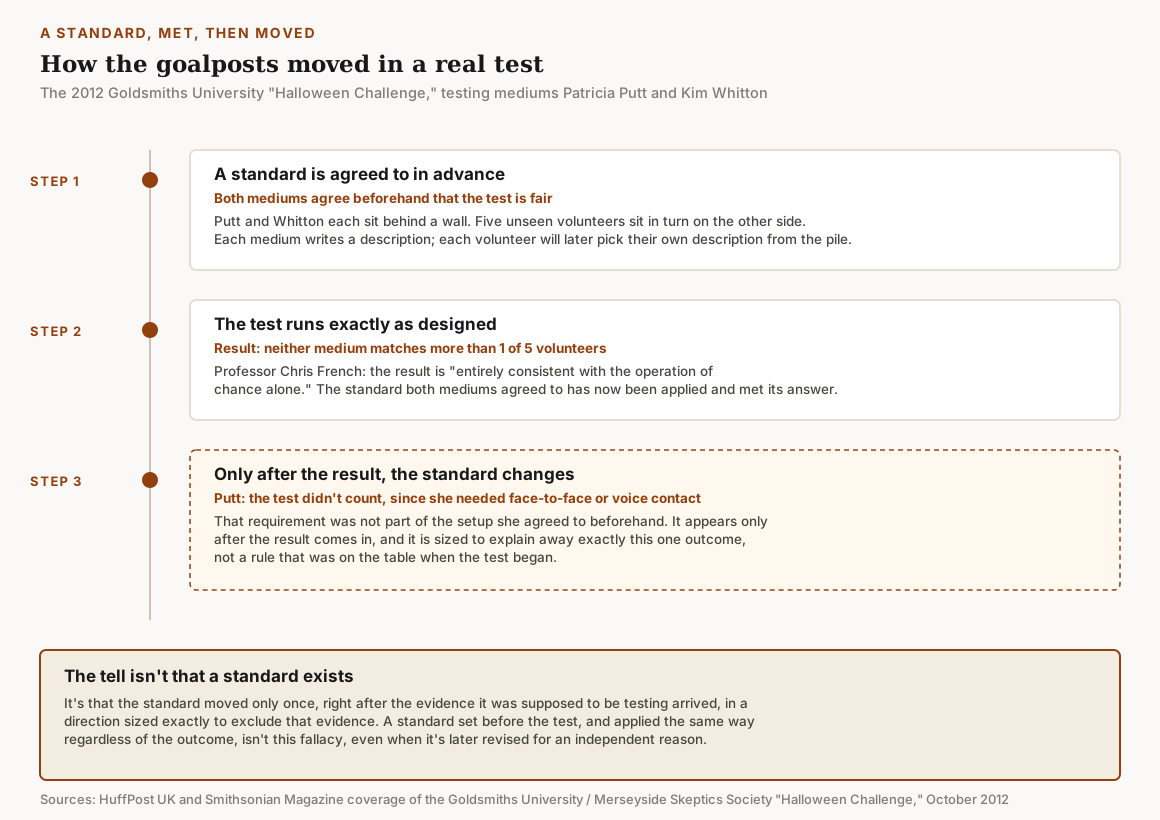
The clearest documented case of this happening in real time isn't a political debate. It's a 2012 test of two working mediums, run by researchers at Goldsmiths, University of London, in collaboration with the Merseyside Skeptics Society, as part of an annual event called the Halloween Challenge.
Patricia Putt and Kim Whitton, both professional mediums, agreed beforehand that the test was a fair assessment of their abilities, according to reporting on the event. The setup: each medium sat behind a wall while five volunteers, unseen and previously unmet, sat in turn on the other side. Each medium wrote down characteristics meant to describe the volunteer in front of them. Afterward, each volunteer looked through the pile of anonymized descriptions and picked the one that best matched them, checking whether the medium's reading had actually landed on the right person.
Neither medium matched more than one of the five correctly. Smithsonian Magazine's coverage quotes Professor Chris French describing the result as "entirely consistent with the operation of chance alone." Only after that result came in did Putt say the test hadn't captured her real ability, telling reporters she needed to work face-to-face with someone, or at least hear their voice, to form a "connection," and that her success rate under normal conditions was usually much higher. That requirement was not part of the test she had agreed to beforehand. It appeared afterward, and it was sized exactly to explain away this one result.
Not every changed standard is this fallacy
This is the part worth being honest about: a standard changing is not, on its own, proof of the trick. The best-known example of a standard that sounds like it might be moving the goalposts, but usually isn't, is "extraordinary claims require extraordinary evidence." Carl Sagan popularized the phrase in the 1980 television series Cosmos, though the Quote Investigator project traces the wording back further, to sociologist Marcello Truzzi's use of a near-identical line in the 1970s.
That standard is legitimate when what counts as "extraordinary" is specified before the evidence shows up, and applied the same way to every claim in that category. It slides into the fallacy exactly where a critical-thinking resource explaining the phrase points out: when nobody ever says what would actually count as extraordinary enough, and each new piece of evidence just gets declared insufficient, with the bar receding again before the next attempt. Asking for independent replication of a single study isn't goalpost-moving either, for the same underlying reason. Replication is a standard decided in advance and applied to everyone's claims, not one invented on the spot for this result.
The question that actually sorts a legitimate standard from the fallacy is the one from the section above: was this requirement on the table before the evidence arrived, or did it appear because of it?
The three questions that catch it
In practice, three questions do most of the work. Was this standard stated, or clearly implied, before the evidence showed up, or did it surface right after? Would it apply the same way to evidence on the other side of the argument, or only to this side? And if this new, harder standard gets met too, is there any sign the bar will hold, or will it move again?
The mechanism shows up alongside other tactics on this site because it rarely works alone. Dismissing the source instead of the standard is ad hominem. Picking a word that delivers the verdict before the evidence is even weighed is loaded language. Holding onto a belief after the specific evidence for it has been debunked, which is close to the mirror image of demanding ever more evidence before ever conceding a point, is belief perseverance. Moving the goalposts is the version that shows up when someone has run out of reasons to reject a claim, but hasn't run out of will to reject it anyway.