The short version
Brandolini's law says the energy it takes to refute nonsense is an order of magnitude bigger than the energy it took to produce it. Making something up is fast. Correcting it is slow, and the gap between the two isn't small.
You've felt this yourself. Someone drops a claim into a group chat in one line. Proving it wrong takes a paragraph, a source, and usually someone accusing you of overreacting to a joke.
Where the name actually comes from
Italian programmer Alberto Brandolini posted the idea to what was then Twitter on January 11, 2013, at 7:29 a.m.: "The bullshit asimmetry: the amount of energy needed to refute bullshit is an order of magnitude bigger than to produce it." The typo in "asimmetry" is his, still visible in the original post. He later said the line came to him after reading Daniel Kahneman's Thinking, Fast and Slow, right before watching an Italian political talk show featuring former prime minister Silvio Berlusconi and journalist Marco Travaglio.
That origin matters for calibrating what kind of claim this is. Brandolini wasn't publishing research. He was tweeting an observation that happened to be sharp enough to stick, and it stuck hard enough that Italian blogger Uriel Fanelli's related 2010 line, "an idiot can create more bullshit than you could ever hope to refute," now gets cited as an earlier formulation of the same idea rather than a separate one, including in University of Washington professors Carl Bergstrom and Jevin West's 2020 book Calling Bullshit.
People kept noticing the same thing for three centuries
What makes the asymmetry more than an internet-age complaint is how far back the same shape goes. In 1710, Jonathan Swift wrote in The Examiner that "falsehood flies, and truth comes limping after it; so that when men come to be undeceived, it is too late, the jest is over, and the tale has had its effect." A century later, an 1820 issue of Maine's Portland Gazette put it more plainly: "Falsehood will fly from Maine to Georgia, while truth is pulling her boots on," an early print appearance of a line now usually misattributed to Mark Twain or Winston Churchill, neither of whom said it.
French economist Frédéric Bastiat made the same point about argument itself in 1845: "our adversaries have a marked advantage over us in the discussion. In very few words they can announce a half-truth; and in order to demonstrate that it is incomplete, we are obliged to have recourse to long and dry dissertations." Three writers, three countries, three centuries apart, and none of them had a platform algorithm to blame. That repetition is itself evidence the imbalance is a structural feature of argument, not a symptom social media invented.
What the imbalance actually costs, in real numbers
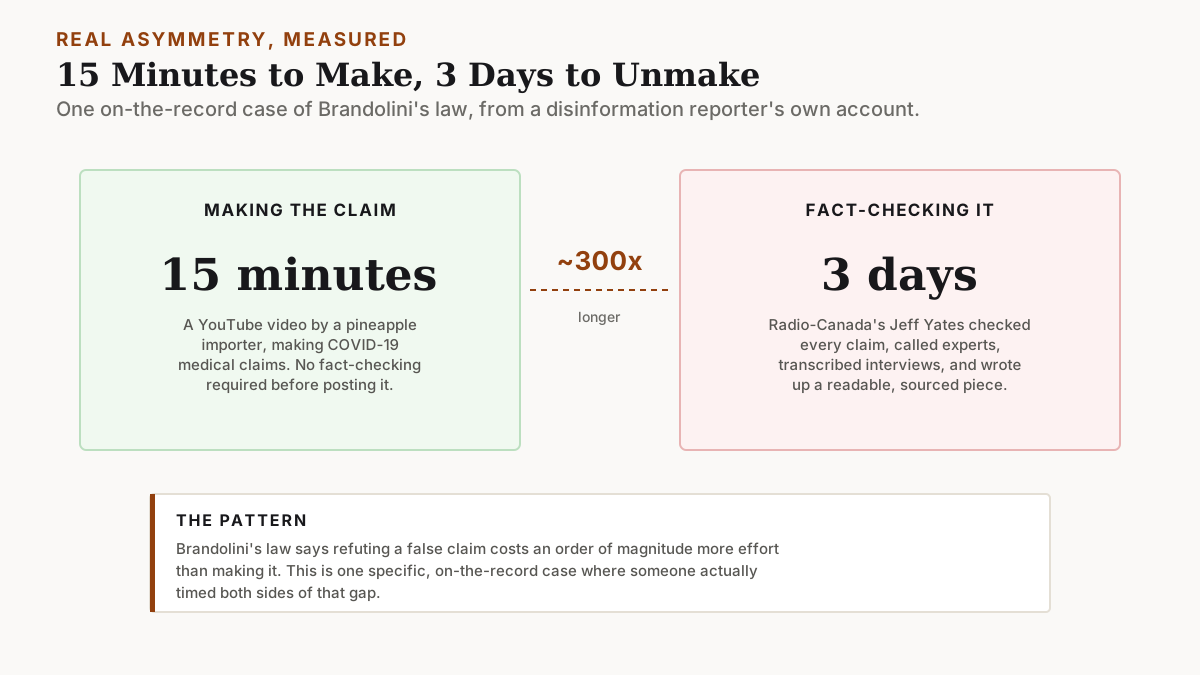
One on-the-record case makes the ratio concrete instead of abstract. Jeff Yates, a disinformation reporter on Radio-Canada's Décrypteurs team, described fact-checking a COVID-era YouTube video made by a Canadian pineapple importer pushing medical claims: "He makes all kinds of different claims. I had to check every single one of them. I had to call relevant experts and talk to them. I had to transcribe those interviews. I had to write a text that is legible and interesting to read. It's madness. It took this guy 15 minutes to make his video and it took me three days to fact-check." Fifteen minutes against three days works out to roughly 300 to one, in one specific case with a name and a job title attached to it.
Andrew Wakefield's fraudulent 1998 paper claiming a link between the MMR vaccine and autism took far less effort than what came after it. The Lancet formally retracted the paper on February 2, 2010, and Britain's General Medical Council revoked Wakefield's medical license three and a half months later, on May 24, 2010, after finding him guilty of serious professional misconduct. Twelve years of investigation and a formal retraction still didn't finish the job: the false vaccine-autism link keeps surviving its own retraction and contributing to vaccine hesitancy decades on.
A lower-stakes case shows the same math at a smaller scale. In 2017, an anesthesiologist in Reykjavik posted a joking tweet suggesting a spike in Icelandic births exactly nine months after Iceland's upset win over England at Euro 2016. The BBC, Newsweek, the Telegraph, Foreign Policy, and RT all covered it as real. A peer-reviewed analysis by Grech and Masukume found no such birth spike, and Iceland's own public broadcaster RÚV had to run a correction. One joke, several major outlets amplifying it, and a national broadcaster spending real air time undoing it.
The same imbalance, but the source is a machine now
Hirotoshi Yamaguchi, who runs a company called Guardrail Ops, described a version of this that doesn't involve anyone spreading a claim on purpose. He ran an automated pipeline that published close to 700 pages to a news site he owns. The marginal human time per page was close to zero, and nobody read a single one before it went live. Search traffic never arrived, and finding out why wasn't as simple as reading the pages: individually, they looked fine, with correct grammar and sensible headings.
Reading all 700 by hand was the obvious check, and he rejected it. He estimated several days of full-time work, and didn't trust the result anyway, reasoning that his own judgment would drift over that many pages, scoring page 400 more leniently than page 40 with no way to know by how much. So he built a second pipeline just to audit the first one, scoring every page on word count, duplication against the rest of the corpus, whether it had been indexed, and internal link structure. Over 90% turned out to be thin, templated, and worthless. Four were worth keeping as they stood, about 90 were salvageable if rewritten, and roughly 250 of the thinnest were pulled from indexing entirely.
The part that lines up most directly with Brandolini's law is what the audit caught that a human skim never would have. On some pages, the delivery platform's own optimization feature was silently rewriting a character in the body text, and that rewrite was corrupting the title. Those pages had been live, wrong, and readable for weeks, because a reader checks whether a title reads correctly, not whether it matches what was actually written. Creating 700 pages cost almost nothing. Working out which of them were worth keeping cost a second system, built after the fact, for that purpose alone, and Yamaguchi now runs a fixed scoring rubric on everything before publication, indefinitely, because a one-off cleanup doesn't hold.
Why the correction can't just match the claim
Bergstrom and West's Calling Bullshit lays out roughly what an effective correction requires: be correct, be charitable about the other person's intent instead of assuming malice, be clear, and be willing to admit your own mistakes. A false claim clears none of those bars to do its work. It only has to sound plausible for the three seconds it takes someone to hit share, while whoever answers it is stuck doing all four.
A 2020 study by John Petrocelli and colleagues in Social Psychology found something that makes the gap worse, not just wider: people get measurably less able to detect nonsense, and more likely to produce it themselves, exactly when they have fewer self-regulatory resources available, meaning tired, distracted, or otherwise stretched thin. The asymmetry doesn't hold steady. It grows precisely when people are least equipped to notice it growing.
Even a technically successful correction is competing against how memory actually works, not just against the original claim. People tend to retain a claim longer than they retain who said it, which is part of why a retraction rarely erases what it retracted. And because the original claim didn't have to prove anything to spread, while any answer to it has to do actual proving, the two sides were never fighting on the same terms to begin with.
What actually helps
One piece of Bergstrom and West's advice matters more than the rest: an effective correction usually has to hand someone a replacement explanation, not just a denial. "No, that's false" leaves a gap the original claim still fills in someone's memory. "No, here's what actually happened" fills the same gap with something else.
Psychologists Jon Roozenbeek and Sander van der Linden's cross-cultural research on inoculation theory points at a cheaper alternative to correcting claims one at a time: warning people about a specific manipulation technique before they run into a real example of it measurably reduces how much that technique works on them later. It spends the cost once, up front, instead of paying it again for every new claim built on the same trick.
The math in the pineapple-importer case isn't a fluke you can out-argue your way around: fifteen minutes to make something up, three days to take it apart. Nobody wins that race one claim at a time. The version of this that actually pays off is spending the effort before the claim lands, not scrambling to match it after.