The short version
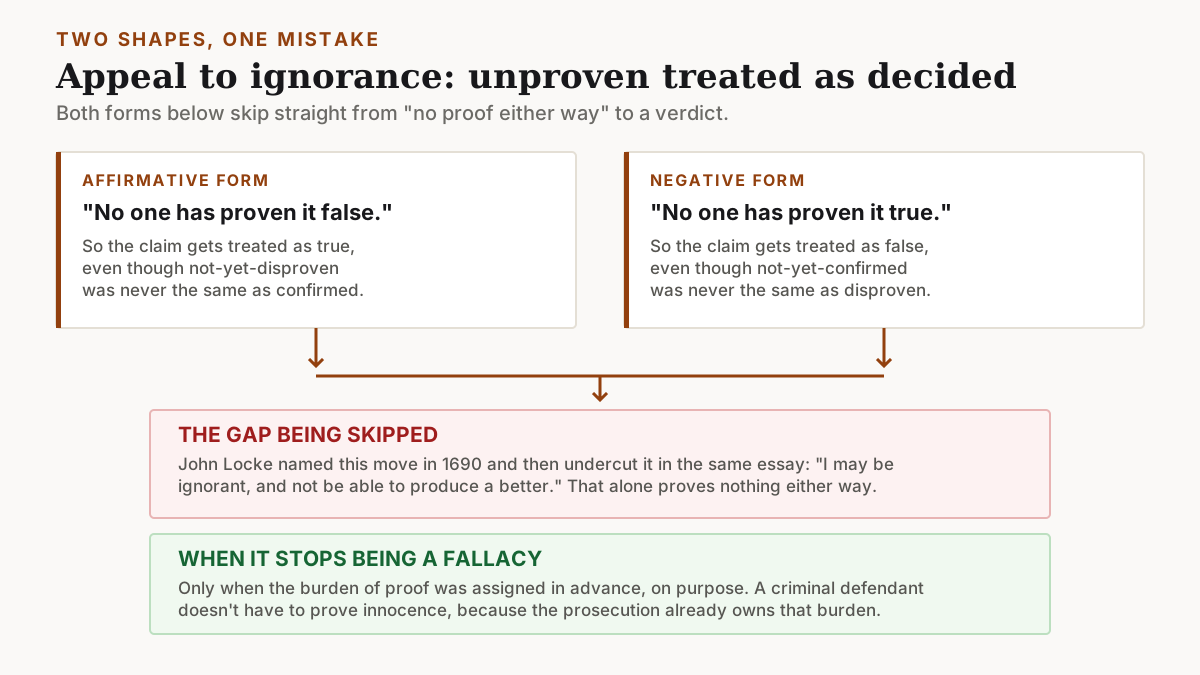
Appeal to ignorance is what happens when "nobody has proven this wrong" gets treated as if it were the same thing as "this is true." It comes in a mirror-image form too: "nobody has proven this right" getting treated as "this is false." Both versions skip the same step. Not being disproven and being confirmed are two different states, and the fallacy is what happens when you collapse them into one.
You run into this constantly without the label attached. A claim survives online for years, nobody's managed to debunk it convincingly, and that survival itself starts getting cited as evidence the claim must hold up. It doesn't. Silence isn't a verdict. It's just silence.
Locke named it one section before ad hominem, and the two terms have different origins
John Locke's 1690 An Essay Concerning Human Understanding lays out four ways people try to force an opponent's agreement in an argument, back to back, in Book IV, Chapter XVII. The second of the four is this one: "Another way that men ordinarily use to drive others, and force them to submit their judgments, and receive the opinion in debate, is to require the adversary to admit what they allege as a proof, or to assign a better. And this I call argumentum ad ignorantiam."
The very next section names argumentum ad hominem, and the wording Locke uses for each term is worth noticing side by side. For ad ignorantiam, he writes "this I call," the closest thing in the essay to a claim of coinage. For ad hominem, one paragraph later, he writes it "is already known under the name of argumentum ad hominem," pointedly crediting existing usage rather than claiming it. Two terms defined back to back in the same short passage, and Locke draws that line on purpose: one he presents as his own label, the other he is simply recording.
Locke undercuts his own category two sections later
Locke doesn't leave the fallacy standing unchallenged. Section 22 of the same chapter walks through why none of his first three argument types, ad verecundiam, ad ignorantiam, ad hominem, actually settle anything, and his line about the ignorantiam move in particular still holds up as a plain statement of the whole problem: "It proves not another man to be in the right way, nor that I ought to take the same with him, because I know not a better... I may be ignorant, and not be able to produce a better: I may be in an error, and another may show me that I am so."
That's the fallacy's entire failure mode in one sentence, written by the same man who'd just named it two sections earlier. Not being able to out-argue someone might make you go quiet. It says nothing about whether they were right.
The teapot: who actually holds the burden of proof
Philosopher Bertrand Russell wrote his clearest statement on where the burden of proof belongs in an essay called "Is There a God?" The magazine Illustrated commissioned it in 1952 and, for reasons that were never publicly explained, chose not to run it. The essay sat unpublished until 1997, 27 years after Russell died in 1970, when it finally appeared in his Collected Papers.
In it, Russell wrote: "If I were to suggest that between the Earth and Mars there is a china teapot revolving about the sun in an elliptical orbit, nobody would be able to disprove my assertion provided I were careful to add that the teapot is too small to be revealed even by our most powerful telescopes. But if I were to go on to say that, since my assertion cannot be disproved, it is intolerable presumption on the part of human reason to doubt it, I should rightly be thought to be talking nonsense." His point wasn't about teapots. An unfalsifiable claim doesn't earn credibility from being unfalsifiable. The burden sits with whoever made the claim, not with whoever is skeptical of it.
That's not a settled matter among philosophers, though. Responding directly to how biologist Richard Dawkins had used the teapot against religious belief, philosopher Paul Chamberlain argued in a 2011 book that it's a mistake to treat only positive claims as carrying a burden of proof: "every truth claim, whether positive or negative, has a burden of proof." Chamberlain's objection doesn't rescue the appeal to ignorance itself. It just means deciding who owes proof in a given argument takes more than sorting claims into positive and negative piles.
The one place it's not a fallacy
There's a well-known exception, and it's worth being precise about why it's an exception rather than a loophole. In American criminal law, a defendant doesn't have to prove innocence. The prosecution has to prove guilt, and if it fails, the correct verdict is not guilty, regardless of whether the defense ever offered a shred of evidence in its own favor. Reasoning "the prosecution hasn't proven guilt, therefore not guilty" looks exactly like an appeal to ignorance on the surface. It isn't one, because the burden of proof was never on the defense to begin with. Nobody skipped a step: the system assigned that burden in advance, on purpose. The mechanics of how that standard actually works in a courtroom, and how the same word gets borrowed for very different purposes outside one, is covered in more depth in what reasonable doubt actually requires.
That's the test for telling a legitimate case apart from the fallacy: not whether a claim went unproven, but whether the burden of proving it was ever assigned to the side being asked to disprove it. Most everyday claims never had that assignment made explicit, which is exactly the gap the fallacy exploits.
Why it works on you
Part of what makes this fallacy durable is a plain asymmetry in effort. Making an unfalsifiable claim costs almost nothing. Disproving one, especially one built to dodge every check (too small for a telescope is the whole design, as Russell's teapot shows), can cost real time, and sometimes there's no check available at all. When you can't produce a disproof on the spot, that failure feels like it means something, even though Locke's own math on the point still holds: you being unable to out-argue someone tells you about your effort, not about their claim.
The other half is that "nobody's disproven it" quietly borrows the weight of "it's been checked and held up," and those read as roughly the same thing at a glance. They're not. One means an idea survived scrutiny. The other means it may never have been scrutinized at all.
The actual test for catching it
Before letting "no one's proven it wrong" count as evidence, ask a narrower question: who actually holds the burden of proof here, and was that assignment made on purpose, or did it just default to whoever happens to be skeptical? If nobody assigned it, the absence of a disproof is not a point in the claim's favor. It's just an absence.
This fallacy shares a birth certificate with two others already covered here. It's one of the same four categories Locke listed alongside ad hominem in 1690, and it shares a family resemblance with the equivocation fallacy: both let something other than an actual proof do the work a real argument would have to do, one by trading on an unassigned burden, the other by quietly swapping a word's meaning mid-argument. Spotting either one starts with the same habit: naming exactly what's standing in for the missing proof.