The short version
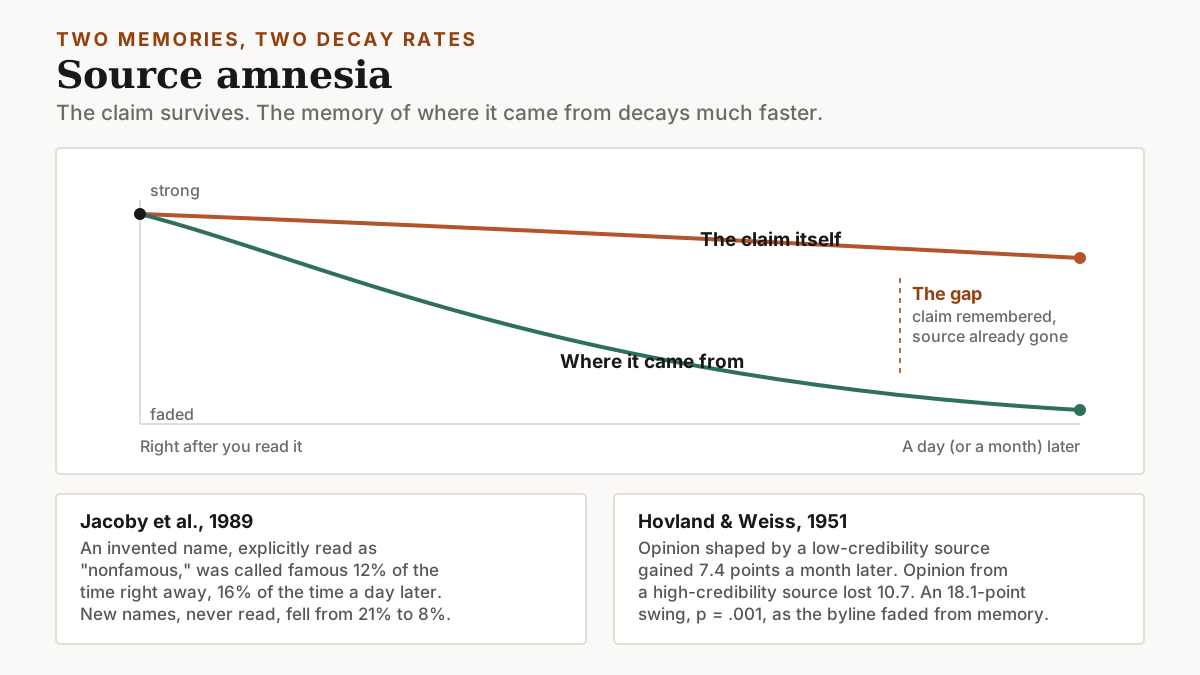
Source amnesia is keeping the fact and losing the story of where you got it. The claim stays put. The context you'd use to decide whether to trust it is gone.
That gap is why something you'd have dismissed outright, if you remembered exactly who was saying it, can quietly turn into something you half-believe.
The name that became famous overnight
Psychologists Larry Jacoby, Colleen Kelley, Judith Brown, and Jennifer Jasechko ran a strange, deceptively simple experiment in 1989. People read a list of made-up names, explicitly labeled nonfamous, names like Sebastian Weisdorf, pulled from a phone book and matched to a set of real famous names on length, sex, and nationality of origin. Right after reading the list, subjects could say with confidence that Sebastian Weisdorf was not famous. They had just read his name minutes earlier.
Wait 24 hours and ask the same question, and the numbers flip. Read once and tested immediately, an invented name got called famous only 12% of the time, less often than a name from the list nobody had ever seen (21%), because the memory of just having read it was still doing its job. Tested a day later, the same once-read names got called famous 16% of the time, edging past the 8% rate for genuinely new names. As the 1989 paper puts it in its own title: Becoming Famous Overnight.
Nothing about Sebastian Weisdorf changed in those 24 hours. What changed is that the memory of reading his name on a list of nonfamous names decayed faster than the vague sense of familiarity that reading it had left behind. The list itself was forgotten. The name it had made familiar was not.
Why your memory splits like this
Psychologists distinguish two things that get lumped together as memory: familiarity, a fluent, automatic sense that something is easy to process, and recollection, the deliberate act of placing that thing in a specific past moment. Jacoby and his co-authors argued that fluency gets misread as meaning all sorts of things, that a name is famous, that a statement is true, that an argument fits, unless someone does the separate, effortful work of recollecting where that ease actually came from.
That second step is not automatic. Jacoby's team found this directly: when they required subjects to also judge whether each name had appeared on the earlier list, not just whether it was famous, doing both jobs at once slowed people down and required real, separate attention. Left to their own devices, without being told to check, most people simply did not run that check, and fluency alone decided the answer.
Persuasion researchers found the same gap decades earlier
Jacoby's team was not the first to notice this pattern. In 1951, Yale psychologists Carl Hovland and Walter Weiss ran a study on 223 college students, handing them identical articles on topics like anti-histamine drugs and atomic submarines, with the byline swapped between a high-credibility source, like physicist Robert Oppenheimer, and a low-credibility one, like the Soviet paper Pravda. Right after reading, students shifted their opinion toward the article's position far more when Oppenheimer's name was attached than when Pravda's was.
A month later, Hovland and Weiss asked the same students the same questions again. Opinion shaped by the high-credibility source had faded, dropping an average of 10.7 percentage points. Opinion shaped by the low-credibility source had grown, gaining 7.4 points, an 18.1-point swing (p = .001). Hovland and Weiss designed the study to test a hypothesis an earlier research team, Hovland, Lumsdaine, and Sheffield, had proposed for this exact pattern: that subjects might come to "remember and accept what was communicated but not remember who communicated it." Their results fit that hypothesis, though Hovland and Weiss were careful to note in their own discussion that the effect might not strictly require forgetting the source, only a fading tendency to spontaneously connect the message back to it and reject it on those grounds. Either way, they called the pattern a sleeper effect, and Jacoby's team borrowed the same term 38 years later to describe invented names becoming famous overnight, arguing it is the same underlying gap whether the thing being evaluated is a claim about atomic submarines or a name on a list.
Why a correction does not erase the claim
A 2012 review in Psychological Science in the Public Interest, led by cognitive scientist Stephan Lewandowsky, found that even a clear, credible correction of a false claim reliably reduces how much people rely on it afterward, but essentially never eliminates that reliance. Some residue survives the correction, the same way some familiarity survived the memory of reading a name off a list.
A 2023 Memory & Cognition study by Victoria Westbrook, Duane Wegener, and Mark Susmann helps explain where that residue lives. Correcting a false claim works partly by changing how trustworthy people judge its original source to be, and belief in the claim tracks that changed judgment of the source. The correction's protection is only as durable as the memory linking the discredited claim to its discredited source, and that is exactly the kind of source-tagged memory Jacoby's subjects lost within 24 hours. Once a claim outlives its own debunking in someone's head, believing something once seen retracted starts to look like belief perseverance: the specific evidence is gone, but the conclusion built on it never got the memo.
What actually helps: going after the source, not just the claim
If forgetting the source is the mechanism, attacking the source directly should be one of the more reliable fixes, and a 2024 study in Cognitive Research: Principles and Implications, led by Ullrich Ecker, tested exactly that. Pointing out that a source had a conflict of interest, or a poor track record, measurably reduced how much people relied on that source's misinformation afterward. It worked less well on its own than directly correcting the false claim itself, but combining a correction of the claim with a discrediting of the source outperformed either one alone.
That fits the pattern from every study above. The claim by itself is nearly impossible to un-remember. What is fragile is the link between the claim and where it came from, so a fix that reinforces that link, instead of just repeating the correct facts, has something real to work with.
Catching it in yourself
Before repeating something, ask where you actually got it and whether you still trust that source specifically. Whether the claim itself sounds true is a weaker starting question, because a claim can sound true precisely because its source has already faded from memory.
It gets easier to lose the source when there was barely one to begin with. A claim that arrives through a crowded, anonymous comment section, or gets pushed by a bot farm faking the appearance of a busy consensus, never had a specific, checkable origin attached to it in the first place, so there is nothing left to forget once someone real repeats it. The same underlying gap between a familiar feeling and its actual origin is what makes a shared false memory feel so confidently remembered by thousands of people who never compared notes. Familiarity that outlives its source does not announce itself as uncertain. It just feels like knowing.
D.B. Cooper's name is source amnesia at the scale of a single, traceable fact: a reporter's guess on a bad phone line is where "D.B. Cooper" actually came from, but the name outran the memory of that specific call within days, and decades of retellings never bothered reattaching it to its source.