The short version
Defamation is the umbrella term. It splits into libel, which covers written or recorded statements, and slander, which covers spoken ones. Someone yelling "that's slander!" about a tweet or a Yelp review is already using the wrong word, since a written complaint would be libel.
But the word mix-up is the smaller problem. Most of what gets called slander or libel online doesn't clear the actual legal bar at all, which matters more than which of the two words someone reaches for.
What actually separates libel from slander
Cornell Law School's Legal Information Institute defines defamation as "a statement that injures a third party's reputation," splitting it into libel — "a method of defamation expressed by print, writing, pictures, signs, effigies, or any communication embodied in physical form" — and slander — "a false statement, usually made orally, which defames another person."
The distinction isn't just about the format. Cornell's own entry on slander notes that, unlike libel, damages from slander "are not presumed, and must be proven by the party suing." A libel plaintiff can often recover for reputational harm without itemizing a dollar figure. A slander plaintiff generally has to show specific, provable financial loss, unless the statement falls into one of four narrow exceptions that skip that requirement entirely.
"Slander per se": the four exceptions where damages don't have to be proven
Common law recognizes four categories where a spoken statement is treated as automatically damaging, no proof of financial loss required: accusing someone of a serious crime, imputing a contagious or "loathsome" disease (courts have limited this to things like sexually transmitted infections), alleging sexual impropriety, or saying something incompatible with a person's trade or profession.
That last category has a real, often-cited example: calling a banker an embezzler. It works as slander per se not because embezzlement is uniquely bad, but because the accusation strikes directly at the specific trust a banker's profession depends on, the kind of claim law firm Minc Law describes as automatically actionable because the professional harm is presumed rather than needing separate proof.
"It's just my opinion" doesn't automatically save you
A common assumption is that prefacing a claim with "I think" or "in my opinion" makes it legally untouchable. The Supreme Court closed that door in Milkovich v. Lorain Journal Co., a case argued in April 1990 and decided that June 21st by a 7-2 vote. The Court held the First Amendment doesn't require a separate "opinion" privilege. If a statement implies an underlying fact that's provably false, calling it an opinion doesn't protect it.
The practical effect: "In my opinion, Jones is an embezzler" isn't automatically safer to say than "Jones is an embezzler," if the statement implies you know of specific facts that would prove it. Pure rhetorical opinion — the kind that can't be checked against any fact, like "I think that restaurant is boring" — is still protected. The label alone just stopped doing the work people assume it does.
When "that's defamation!" becomes the manipulation, not the defense
The same misunderstanding runs in the opposite direction, too: threatening a defamation lawsuit as a way to make a critic stop talking, regardless of whether the underlying claim would survive in court. This has its own name, a SLAPP, or strategic lawsuit against public participation, and its own countermeasure. The Reporters Committee for Freedom of the Press describes these suits as intended "to censor, intimidate, and silence critics by burdening them with the cost of a legal defense" rather than to win on the merits. Thirty-two states plus D.C. have passed anti-SLAPP statutes letting defendants get these cases dismissed quickly, and in the more aggressive versions, recover their legal fees from the person who sued them.
That's a legal-system version of the same move a thought-terminating cliché does in a conversation — the goal isn't to win the underlying argument, it's to make continuing the argument cost more than the other side is willing to pay.
Public figures face a much higher bar
If the person suing is a public official or public figure, the standard gets substantially harder to meet. New York Times Co. v. Sullivan (1964) established that public officials must prove "actual malice" — knowledge that a statement was false, or reckless disregard for whether it was — not just that it was false and damaging. Later rulings extended that standard to public figures generally.
It's also a harder bar to prove. In Anderson v. Liberty Lobby (1986), the Supreme Court held that actual malice has to be shown by "clear and convincing evidence," a heightened civil standard above the ordinary "more likely than not" threshold most lawsuits use. It still isn't "beyond a reasonable doubt," a standard unique to criminal trials, but it sits well above the bar a private citizen suing over a false statement about them generally has to clear.
What an actual, decided case looks like
Most online arguments about defamation never see a courtroom. Depp v. Heard did, and the numbers are on the record. On June 1, 2022, a Virginia jury found Amber Heard liable for defaming Johnny Depp in a 2018 Washington Post op-ed, awarding him $10 million in compensatory damages and $5 million in punitive damages — reduced to $350,000 under Virginia's statutory cap, for a total of $10.35 million, per CNN's reporting on the verdict. The same jury found Depp had defamed Heard through one statement his attorney made, awarding her $2 million with no punitive damages.
Both sides filed appeals, then dropped them: in December 2022, Heard agreed to pay Depp $1 million to settle, far less than the $8.35 million she owed him net of her own $2 million award once the two judgments were offset against each other, according to Variety's reporting on the settlement. The case involved libel, not slander, since the underlying statements were written, but it's one of the few instances where the full legal process, jury included, actually ran its course in public.
The five-part test, put back together
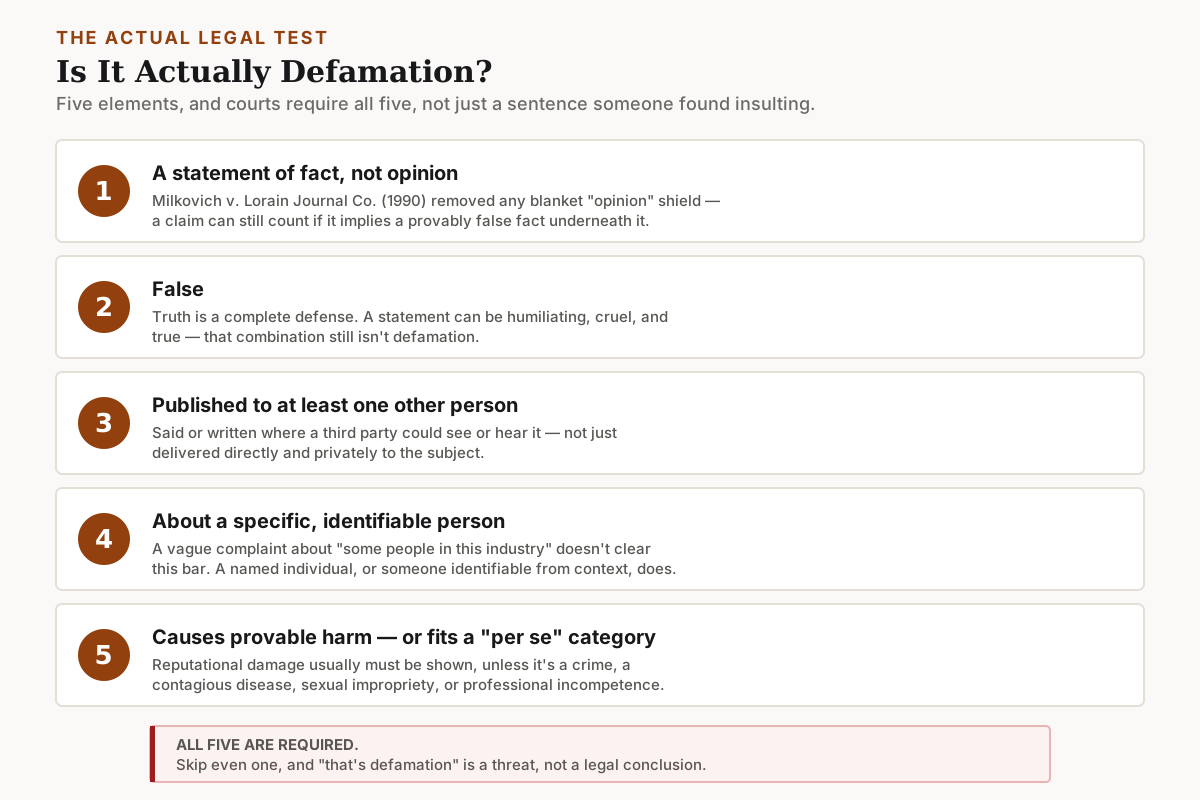
Strip out the courtroom names and dates, and what's left is a five-part checklist: the statement has to be presented as fact rather than pure opinion, it has to be false, it has to reach at least one other person, it has to be about a specific identifiable person, and it has to cause provable harm, unless it lands in one of the four per se categories that skip that last step. A statement can fail on any one of the five and the whole claim collapses, regardless of how upsetting it was to hear.
That's the gap between the legal definition and the way "that's defamation" gets used in an argument. Someone invoking the phrase is usually reacting to point five — feeling harmed — without having checked the other four. A true, cruel statement fails on point two. A vague dig at "people like that" fails on point four. Knowing which one is actually missing is the difference between a real claim and a threat meant to end the conversation.