The short version
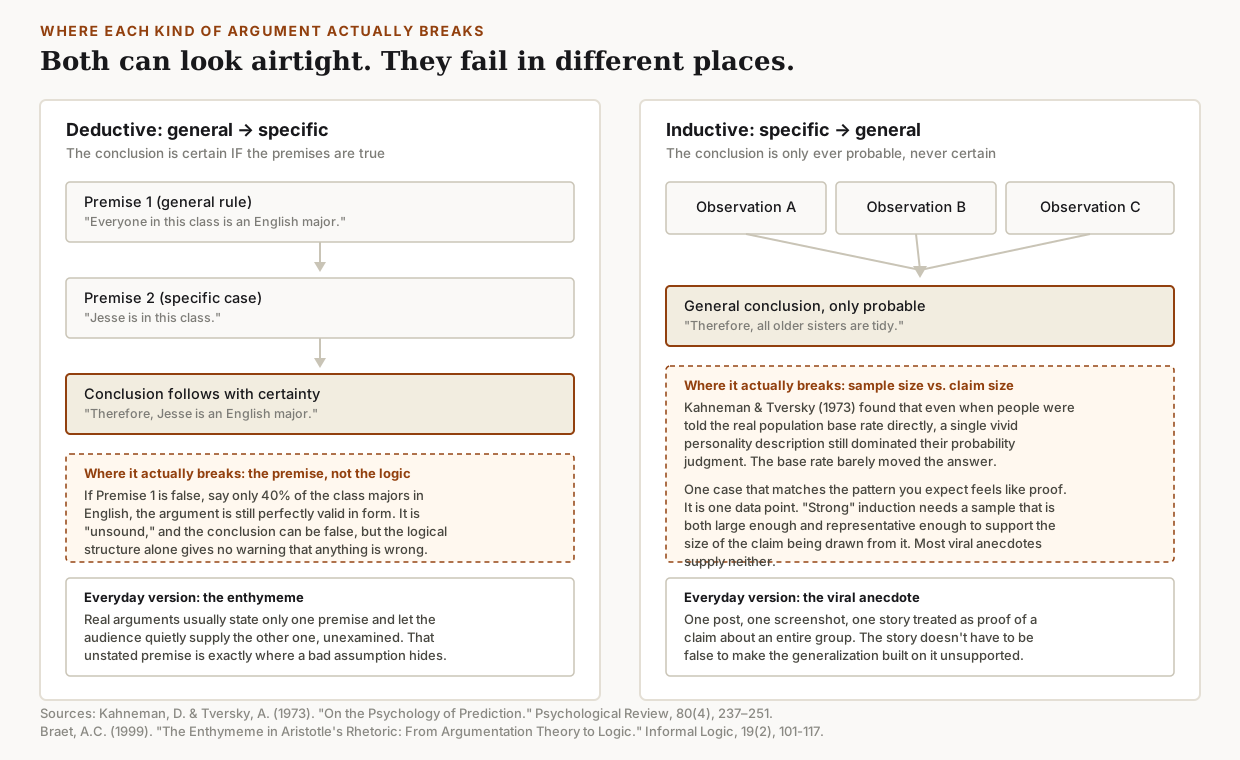
Deductive reasoning runs from a general rule to a specific case: "Everyone in this class is an English major. Jesse is in this class. Therefore, Jesse is an English major." If both premises are true, the conclusion has to be true too. Inductive reasoning runs the other direction, from specific cases to a general rule: "My sister, my friend's sister, and my mom's sister are all tidy. Therefore, older sisters are tidy." No number of specific cases can make that conclusion certain, only more or less probable.
That direction is the textbook distinction, and it's also the least useful part for spotting a bad argument. The part worth remembering is where each kind actually fails when someone uses it to convince you of something. Deduction fails on a false premise dressed up as an obvious one. Induction fails on a sample too small or too skewed to support the size of the claim resting on it. Both are the machinery underneath a logos appeal: a post that leans on "the facts speak for themselves" is really leaning on one of these two structures, and it only speaks for itself if the structure holds up.
Valid is not the same word as true
A deductive argument is "valid" if the conclusion follows logically from the premises, full stop. It says nothing about whether the premises are actually true. An argument is "sound" only when it's both valid and built on true premises. Swap "everyone in this class is an English major" for a false premise, say only 40% of the class actually majors in English, and the argument about Jesse stays exactly as valid as before. The logical structure gives no warning that anything is wrong. It never checks its own premises; it only checks whether the conclusion follows from them.
That gap is where most persuasive arguments actually live, because almost nobody states both premises out loud. Aristotle called an argument with an unstated premise an enthymeme, and treated it as the working unit of rhetorical persuasion rather than a shortcut or a flaw. The audience is left to supply the missing premise themselves, usually without noticing they did it, which means they also skip the step where they'd normally ask whether that premise is true.
A worked example of the missing premise
"This company laid off 200 people the same month it announced record profits, so obviously they just don't care about workers." Stated in full, that argument needs two premises: (1) a company that lays off workers in a profitable month doesn't care about workers, and (2) this company laid off workers in a profitable month. Only the second premise gets said. The first one, the actual moral claim doing all the work, arrives pre-installed in the reader's head and never gets examined. Maybe it's true. Maybe the layoffs were in a division being sold off entirely unrelated to profitability. Whether or not the conclusion happens to be correct, the argument's logical form can't tell you either way, because the premise carrying the actual weight was never put up for inspection.
That's a useful habit to import into anything that reads like a tight, closed argument: find the premise that was never stated, and check that one first. The stated premise is usually just a fact. The unstated one is usually the value judgment or generalization the whole argument depends on.
Where induction actually fails: sample size versus claim size
How convincing an example feels has nothing to do with how much inductive weight it can actually carry. What decides that is whether the sample behind the conclusion is large enough and representative enough to support a claim of that size. The three sisters in "all older sisters are tidy" might genuinely all be tidy, so that's not where the argument breaks. It breaks on scale: three cases can't carry a claim about every older sister who has ever existed, no matter how true each one is.
In 1973, Daniel Kahneman and Amos Tversky ran an experiment that shows exactly how badly people judge that gap. They gave participants a personality sketch supposedly drawn at random from a pool of 100 professionals: "Jack is a 45-year-old man. He is married and has four children. He is generally conservative, careful, and ambitious. He shows no interest in political and social issues and spends most of his free time on his many hobbies which include home carpentry, sailing, and mathematical puzzles." One group of participants was told the pool was 70% engineers and 30% lawyers; another group was told the reverse, 30% engineers and 70% lawyers. Both groups then estimated the probability that Jack was an engineer. The median estimate came out to 0.50 in both groups. The stated base rate made essentially no difference to the answer. People judged probability almost entirely by how well the description matched their mental stereotype of an engineer, a pattern Kahneman and Tversky named the representativeness heuristic, and the base rate they'd just been handed got treated as close to irrelevant.
Why this is the actual engine behind a viral anecdote
That same mechanism is what lets a single anecdote outweigh a statistic sitting in the same post. A vivid story that matches the shape of a claim you already suspect feels like strong evidence for it, the same way Jack's description felt like strong evidence he was an engineer, independent of how many engineers were actually in the room. The base rate doesn't get argued against. It just doesn't compete, because representativeness is doing the judging instead of frequency.
This is the same failure that let a single, badly reported 1964 incident calcify into a supposed law of human behavior. The Kitty Genovese case became the textbook example of universal "bystander apathy" based on a New York Times account that overstated both the number of witnesses and what they actually saw, and the exaggerated version kept getting taught as settled fact for decades after researchers traced the errors. One case, however dramatic, is a sample size of one. It can illustrate a pattern that's independently established elsewhere. It can't establish the pattern by itself, no matter how well it seems to fit.
Two questions to actually ask
For anything built like a tight deductive argument, ask what premise you were never shown, and whether it would survive being said out loud. A claim that only works while one of its premises stays unstated is usually leaning on that premise being unexamined, not on it being true.
For anything built like an inductive generalization, an anecdote, a screenshot, a single story standing in for a whole group, ask what the actual sample size is and whether it's remotely close to the size of the claim being drawn from it. Those two questions are a narrower version of the five questions that apply to any claim: who produced this argument, what did they leave unstated, and would it survive someone actually filling in the gap.