_-_Palazzo_Nuovo_-_Musei_Capitolini_-_Rome_2016.jpg)
The short version
A rhetorical question is a question asked to make a point, not to get an answer. "Who doesn't want a better deal?" isn't a request for a show of hands. It's a claim dressed up as a question, and it's harder to argue with, because arguing with a question feels strange even when the claim hiding inside it is exactly the kind of thing you'd normally push back on.
Most explainers stop there, with a definition and a handful of examples from Shakespeare and advertising copy. That's fine as far as it goes, but it skips the more useful question: what does a rhetorical question actually do to the person reading it? Persuasion researchers have tested that directly since the early 1980s, and the answer isn't "it persuades you." It's closer to "it makes you think harder about whatever claim it's attached to," which turns out to be a much more double-edged effect than a simple persuasion boost.
What a rhetorical question actually does to your thinking
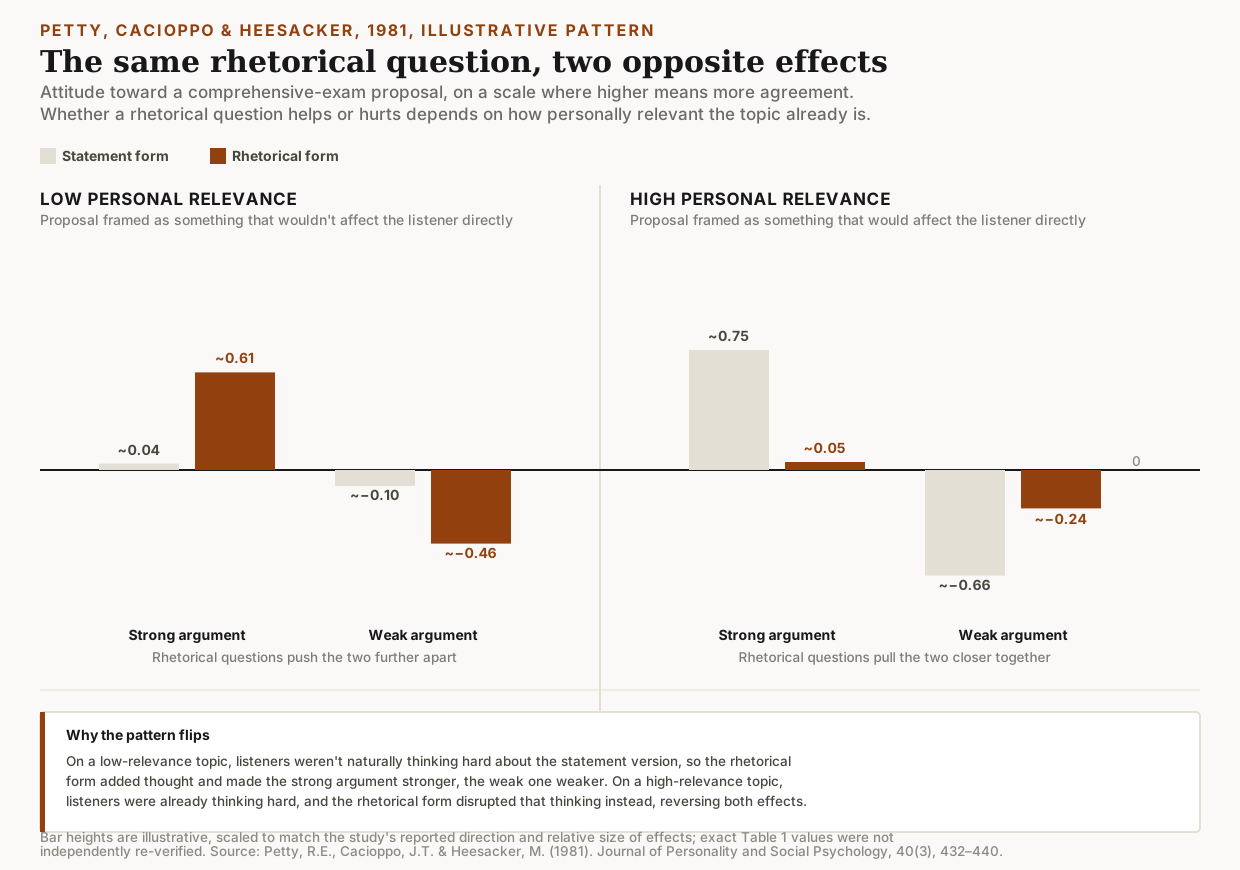
In 1981, psychologists Richard Petty, John Cacioppo and Martin Heesacker ran the study that's still the starting point for this research. 160 college students listened to a radio editorial arguing that seniors should have to pass a comprehensive exam in their major before graduating. Three things were varied at once: whether the argument was strong or weak, whether it was worded as declarative statements or converted into rhetorical questions, and how personally relevant the proposal was made to feel, framed as something that would directly affect the listener (high personal relevance) or something that wouldn't (low personal relevance).
When the proposal was low-relevance, easy to shrug off because it wouldn't affect anyone in the room, rhetorical questions worked the way most explainers describe: they increased how much people thought about the message, which made the strong argument more persuasive and the weak argument less persuasive than the identical points stated flatly. But when the proposal was high-relevance, students already motivated to think hard about a rule that could apply to them, the same rhetorical questions had the opposite effect. Instead of adding thought, they disrupted the thinking students were already doing, and the pattern reversed: the strong argument became less persuasive and the weak argument became more persuasive than the plain-statement version. Petty, Cacioppo and Heesacker report this as a single three-way interaction, not two separate stories: a rhetorical question doesn't have one effect on persuasion. It has two opposite effects, and which one shows up depends on whether the topic already matters to the person hearing it.
Why noticing the trick doesn't always cancel it out
That 1981 result held up over time, but it wasn't the whole story. In 2004, Rohini Ahluwalia and Robert Burnkrant, writing in the Journal of Consumer Research, added a condition that matters for anyone reading rhetorical questions in an ad or a pitch rather than a lab handout: how obvious it is that the question is rhetorical. When the rhetorical framing is subtle, the amplifying effect works the way Petty, Cacioppo and Heesacker described, pulling attention toward the argument itself. When the rhetorical framing is obvious and the source clearly has something to gain, a company selling something, in most of their experiments, attention shifts away from the argument and onto the source's motive instead. That shift in attention, toward "why is this company asking me this," can cancel out the amplification effect almost entirely.
A second complication comes from a 2006 study by Kevin Blankenship and Traci Craig in the Journal of Language and Social Psychology. They found that rhetorical questions increased not just message processing but counterargument generation too, meaning some of that extra thinking is aimed at picking the argument apart, not only absorbing it. Their second study found something more durable: once a message using rhetorical questions succeeded in shifting an attitude, that attitude proved more resistant to a later counter-message than an attitude formed from the plain-statement version. The extra thinking a rhetorical question provokes doesn't only move you in the moment, borrowing weight the same way an argument built on ethos, pathos, and logos does. If it works, the effect tends to stick.
The headline version of the same trick
The same tension shows up in the format most people run into rhetorical questions today: headlines. A 2024 study by Jingyi Qiu and Russell Golman, published in Applied Cognitive Psychology, analyzed over 100,000 WeChat news articles and found people were more likely to click through to a story when its headline raised a salient question, often signaled by a literal question mark. That tracks with the curiosity-gap logic behind a lot of rage bait headlines: an unanswered question creates a small itch, and clicking is one way to scratch it.
A separate line of research complicates that finding rather than contradicting it. In a 2016 lab study of 2,057 U.S. adults, the Engaging News Project at the University of Texas at Austin's Center for Media Engagement tested traditional, forward-referencing, and question-based headlines against each other. Question-based headlines produced significantly more negative overall reactions than the other two formats on a nine-item measure that included a credibility rating as one of its dimensions, and separately predicted significantly fewer anticipated engagement behaviors, reading, sharing, commenting, than traditional headlines did. Put that next to the WeChat finding above and the two studies agree rather than conflict: a question-mark headline pulls curiosity, which is what drove the click-through effect Qiu and Golman measured, while simultaneously reading as less trustworthy and less worth engaging with once someone actually stops to think about it, which is what the Engaging News Project measured. It's the research-backed version of a much older piece of newsroom folklore, Betteridge's Law of Headlines, the tongue-in-cheek rule that any headline phrased as a question can usually be answered "no," pointing at the same mismatch between a headline's confidence and its actual evidence.
What this means when you're the one reading it
None of this makes a rhetorical question inherently manipulative. Most of the ones you'll read today are just rhetorical flourish, a livelier way to make a point that would sound duller as a flat statement. The signal worth paying attention to is placement, and how much the topic already matters to you personally. On a topic you don't have much stake in, a rhetorical question right after a thin claim is doing a specific job: it borrows the extra thinking it provokes to expose that the claim doesn't hold up, per the 1981 finding, which is a reason to trust that reaction, not override it. On a topic you already care about, the same finding says the opposite reaction is worth watching for in yourself: your own motivated thinking can get disrupted by the question format, making a weak claim feel more persuasive than it would if someone had just stated it plainly.
The headline case is the most practical one to apply day to day. A headline phrased as a question is doing real work on your curiosity, and that part of the mechanism works on you whether you clock it or not. What your gut is also picking up on, per the credibility research above, is that the format itself carries less information than a stated headline would, and the same research found people report being less inclined to actually engage with it once they think about it. Both reactions are correct at the same time. The useful habit isn't refusing to click. It's noticing that the click was earned by curiosity rather than by the headline actually telling you anything, and adjusting how much weight you give the piece once you're in it. A different question-as-pressure format already covered on this site, the "rage bait questions" relationship trend, works on a related but distinct principle worth telling apart: those are loaded traps built so no answer looks good, not rhetorical questions with an implied answer built in.