The short version
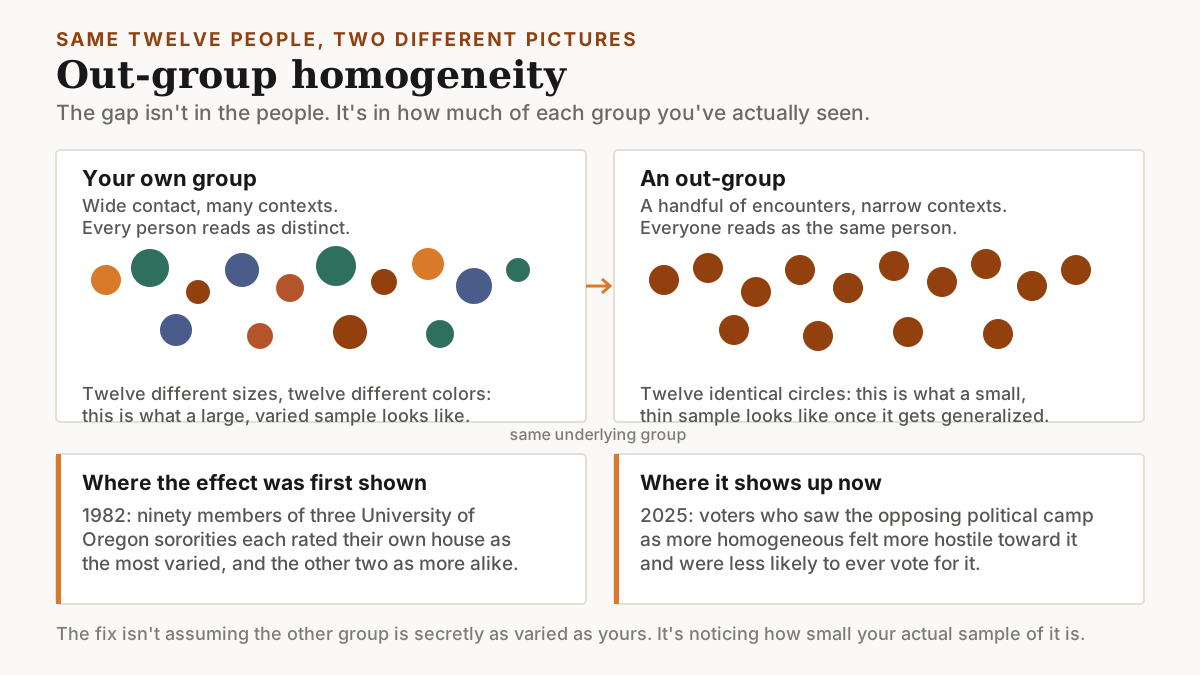
Your own group looks like a room full of individuals. Every other group looks like one type of person, repeated. That gap has a name: out-group homogeneity, and it says more about how closely you've watched each group than about the groups themselves.
It doesn't require any actual conflict to kick in. It shows up toward groups you have no grievance with at all, which is the part that gives it away as a perception problem rather than an informed judgment.
The 1982 study that gave it a name
Park and Rothbart weren't the first to notice this. Psychologists George Quattrone and Edward Jones had documented a version of it two years earlier, showing rival Princeton and Rutgers students a videotaped decision and finding each side predicted the decision would generalize more broadly among the rival school's students than among their own. What Bernadette Park and Myron Rothbart added in 1982, using three sororities at the University of Oregon, was a cleaner, more detailed design that made the effect the field still cites most.
Ninety students, thirty from each house, rated their own sorority and the other two on ten traits: how studious they were, how physically attractive, how much they partied, how cohesive the group felt, and several more, each on a seven-point scale. Then they separately rated how similar the members within each house were to one another.
Every house showed the same pattern. Members rated their own sorority as the most varied, with people who differed from each other on most of the ten traits. They rated the other two houses as noticeably more alike, all three houses, symmetrically, about each other. No sorority in the study was actually more internally diverse than the others: the effect tracked which side of the comparison a person was standing on, nothing else.
Why your head does this
The leading explanation is a sampling problem, not a judgment problem. You interact with people in your own group across more situations and over more time, so you accumulate specific, contradicting memories of them: the studious one who also parties hard, the strict one who's actually easygoing one-on-one. Out-group members you typically encounter in a handful of narrow contexts, if you interact with them individually at all. A small, narrow sample naturally looks more uniform than a large, varied one, whether or not the underlying group actually is.
That produces the familiar shorthand: they're all like that, we're all different, a distortion built from how much data you happened to collect on each side rather than any real difference between them, the same kind of self-serving gap in perception that shows up in cognitive dissonance.
It shapes who you're willing to vote for
Political scientist Felix Grünewald tested whether this same mechanism operates on left-right political camps, publishing the results in West European Politics in April 2025. Using cross-national data from the Comparative Study of Electoral Systems alongside a German panel study (the German Longitudinal Election Study) that could track the same voters over time, Grünewald found that people consistently rate the opposing political camp as more homogeneous than their own camp.
That perception wasn't just a side note to policy disagreement. It independently predicted more negative feelings toward the other camp and a lower likelihood of ever voting for it, holding actual issue positions constant. Some of that hostility toward an opposing camp has less to do with what its members actually believe than with how uniform those beliefs look from outside, which makes the whole camp easier to dismiss with an ad hominem aimed at "them" than to argue with as a group of individuals you might occasionally agree with.
The bias splits differently for minority groups
A 2025 Journal of Personality and Social Psychology paper by Stephanie Tepper and Thomas Gilovich complicates the simple in-group/out-group story. Across nine studies (with four more reported in supplemental materials), they found that both majority-group and minority-group participants rated members of different, unrelated minority groups, say, Black Americans and Latino Americans, as more similar to each other than majority-group members were rated to one another. That's a different comparison than Park and Rothbart's sororities made: homogeneity spreading across separate out-groups, not just one out-group flattened relative to the in-group doing the rating.
Tepper and Gilovich traced the effect to a specific belief: that minority groups share a common fate, some overlapping history of marginalization or shared political interest. When the researchers experimentally undercut that belief, telling participants information designed to make minority groups seem less connected to one another, the effect weakened. That's a useful clue about the underlying mechanism generally: out-group homogeneity doesn't just track how much contact you've had with a group. It also tracks what story you already believe connects that group's members to each other, whether or not that story is accurate for any specific person in it.
How to catch yourself doing it
The tell is usually a sentence that starts with "they're all" about a group you don't interact with much individually. Ask how many actual people from that group you've talked with recently, not seen posts from or arguments about, actually talked with. The number is often smaller than the confidence of the generalization suggests.
A quick test: try to name three specific ways members of that group disagree with each other. If you can't, that's a sign your impression is running on a thin, secondhand sample rather than real familiarity, the same gap that made Park and Rothbart's sorority members so sure about houses they'd barely spent time in.
Online arguments make this worse by design, not by accident. A handful of the loudest, most extreme posts from an out-group get amplified well past what a calmer, chronological feed would show, and that small, unrepresentative sample is what most people's sense of "the other side" actually gets built from. Remember that before treating one viral post as a fair sample of a group of millions.