The short version
Cognitive dissonance is what happens when two things you believe, or one thing you believe and one thing you just did, don't fit together. You feel it as discomfort, not as a thought. And your mind doesn't sit with that discomfort for long. It resolves it, almost always, by changing what you believe rather than by undoing what you did. That direction is the whole trick. You'd expect your actions to follow your beliefs. Cognitive dissonance runs the wire the other way.
The classic demonstration of this is stranger than most explainers make it sound. In 1959, two Stanford psychologists paid people to lie, then asked them afterward what they actually believed. The people paid less ended up believing the lie more. Not despite the smaller payment. Because of it.
The experiment that actually proved it
Leon Festinger and James Carlsmith recruited 71 male Stanford students for what they were told was a two-hour study of "measures of performance." Each student spent an hour on two deliberately tedious tasks: loading and unloading a tray of spools by hand, then turning 48 pegs a quarter-turn clockwise, over and over. Afterward, the experimenter explained, almost as an aside, that the next student was supposed to walk in already expecting the tasks to be fun, so the study could compare that group to students who got no such setup. Then came the actual point of the experiment, dressed up as a favor. The person normally hired to deliver that setup, the experimenter said, hadn't shown up. Would the student do it instead, for a fee: one dollar for some students, twenty dollars for others? A third group, the control condition, was never asked to lie at all.
Every paid student walked into the waiting room and told the next "subject," actually a confederate hired for the role, that the boring tasks were interesting and enjoyable. Afterward, a separate interviewer who didn't know which condition anyone was in asked each student to rate the tasks honestly, from -5 to +5. Eleven of the 71 were dropped from the analysis (a few admitted they'd figured out the real point, a couple refused the money), leaving 20 students in each of the three groups.
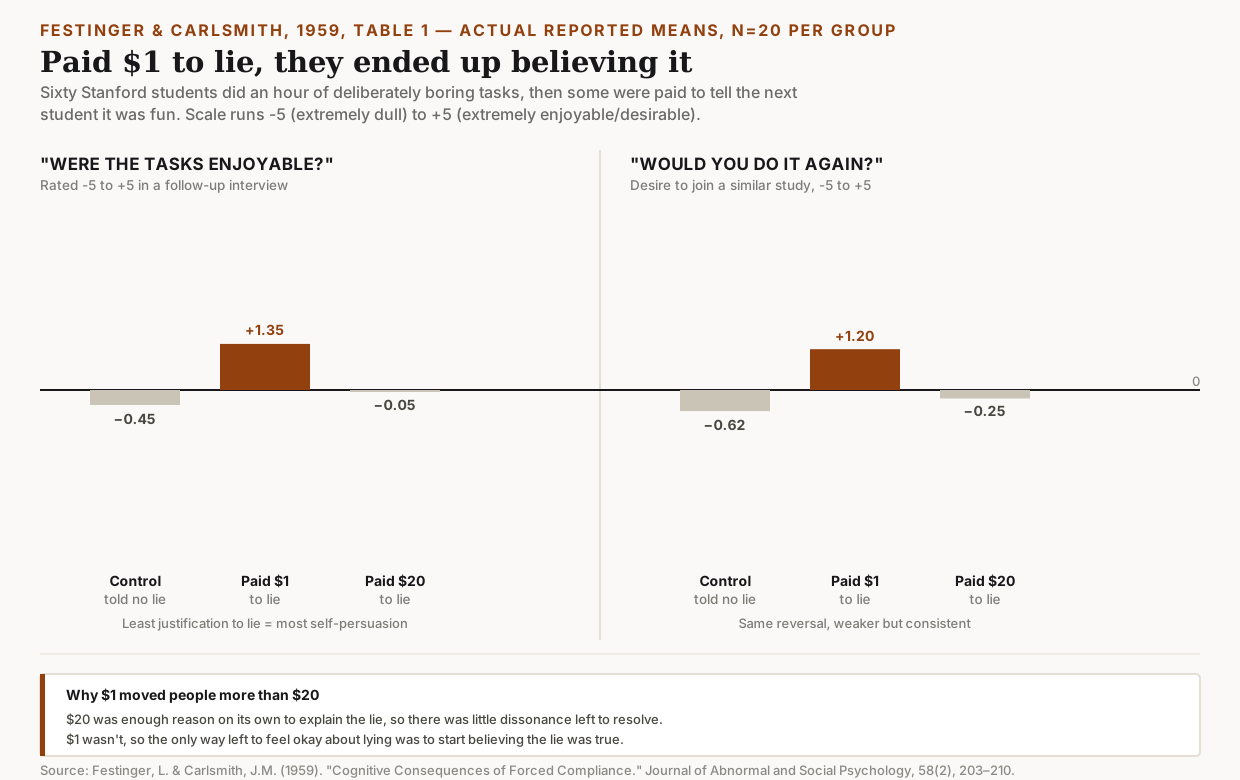
The students paid $20 rated the tasks at -0.05, barely different from the control group who never lied at all, who landed at -0.45. Their large payment gave them all the justification they needed to lie without it touching what they actually believed. The students paid $1 rated the same tasks at +1.35, solidly positive. With only a dollar to point to, lying to the confederate created more discomfort than it resolved, and the fastest way to make that discomfort go away was to start believing the lie. A second question later in the same interview, asking how much they'd want to join a similar study again, moved the same way: control -0.62, $20 group -0.25, $1 group +1.20. The smaller the reward, the more a person's stated opinion had to bend to match what they'd already said out loud.
The same trick works with effort instead of money
Around the same time, two other researchers, working with Festinger's direct encouragement, tested whether the same logic held for effort and embarrassment instead of cash. Elliot Aronson, at Stanford, and Judson Mills recruited 63 college women to join a discussion group on the psychology of sex. Some were admitted with no screening at all, the control group. Others had to pass an "embarrassment test" first: the mild condition read five words related to sex, but not obscene, aloud to the experimenter; the severe condition read twelve genuinely obscene words aloud, plus two graphic passages from novels. Every woman then listened to the same recording, a deliberately dull, halting discussion by three supposed group members full of false starts and non sequiturs, and rated the discussion and its participants on 17 scales.
The initiation itself wasn't the point. What happened to people's opinion of a boring group afterward was. Women in the severe condition rated the discussion and its participants significantly higher than the control group did, 195.3 versus 166.7 on the combined scale, and higher than the mild group too, 171.1. The mild group, whose "initiation" barely registered as unpleasant, rated the group almost identically to women who'd gone through no initiation at all. Only real discomfort, severe enough that it couldn't be shrugged off or reframed as no big deal, produced the effect. If getting in had been easy, there was nothing that needed justifying, so nobody bothered inflating their opinion of a discussion that, by design, had nothing to recommend it.
That's the mechanism underneath every hazing ritual, every boot camp gate, every initiation designed to hurt a little before it lets you in. The unpleasantness isn't a side effect of screening for commitment. Structured this way, it manufactures the commitment directly: the harder membership was to get, the more a person's own mind will insist, afterward, that it was worth getting.
The pyramid: how two people who start the same end up certain of opposite things
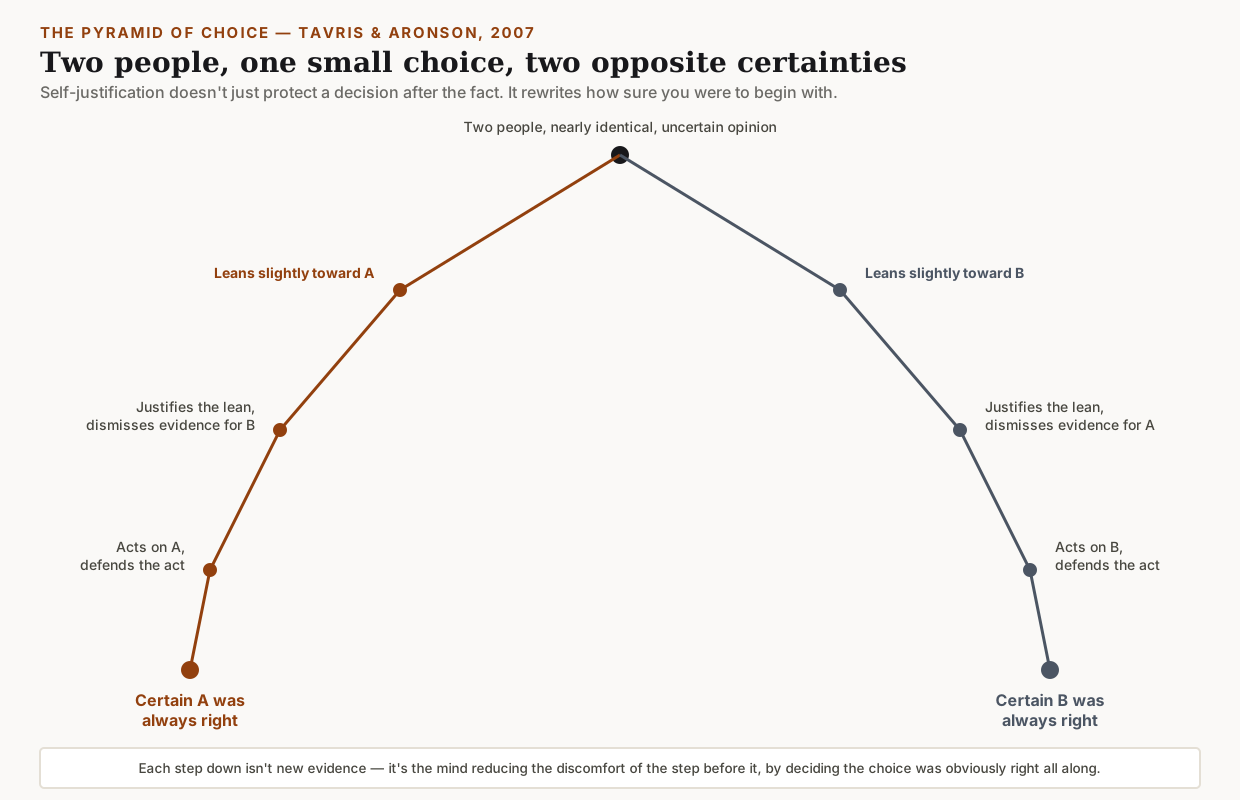
Decades later, that same Elliot Aronson, writing with Carol Tavris, described a version of this that doesn't need a lab at all, just an ordinary decision. Picture two people who start out close to the middle on some ambiguous question, barely leaning one way or the other. Each makes one small, almost arbitrary choice in opposite directions. From that point on, the dissonance-reduction machinery Festinger described kicks in on both of them at once: each starts noticing evidence that supports their side and discounting evidence against it, not because the evidence changed, but because their own choice needs defending. Make one more small choice in the same direction, defend that one too, and repeat. Tavris and Aronson call the result the Pyramid of Choice: two people who started an inch apart at the top end up on opposite sides of the base, each one certain, in hindsight, that they were never really undecided at all.
That last part is what makes the pyramid hard to catch from the inside. Tavris and Aronson's broader argument, laid out across law, medicine, and politics in their book Mistakes Were Made (But Not by Me), is that people don't just defend a past choice going forward. They edit the memory of how sure they felt before they made it, so the choice looks obvious in hindsight. That's a different mechanism from the pattern-completion errors behind the Mandela Effect, but the two share something worth noticing: a confidently remembered past isn't the same thing as an accurately remembered one.
Once two people have drifted to opposite ends of the pyramid, out-group homogeneity is often what their view of each other looks like from the outside: each side rating the other camp as a single, uniform block, less because the other camp is actually uniform and more because defending a chosen position needs an opponent simple enough to argue against.
This gets aimed at you on purpose
None of this requires a psychology lab to work. Anyone who gets you to make one small, freely chosen commitment, sign a card, post a testimonial, invite a friend, put down a deposit, has just started building your side of the pyramid for you. The commitment doesn't need to be big. Festinger's data says the opposite: the smaller and less externally justified the first step, the more your own beliefs have to move to make sense of it. High-control groups and multi-level-marketing programs both lean on this directly. They ask for public statements of belief early, before anyone has real evidence to justify them, then let the discomfort of holding an unsupported public position do the work of turning it into a genuinely held one.
Emily Lynn Paulson, who spent nearly seven years as a top earner in a multi-level-marketing skincare company before leaving, described that arc from the inside in a 2025 essay: reaching the top 3% of the company, and extensively recruiting friends and family along the way, before recognizing the harm and walking away. She doesn't frame her own account in terms of effort justification. But the pattern fits: the same mechanism that made $1 feel more convincing than $20 in Festinger's lab, and a severe initiation feel more worth it than a mild one in Aronson and Mills's, would make a business someone has already put years, money, and relationships into feel harder to walk away from than one they could still leave cheaply, which is close to backward from how a cold cost-benefit decision should run.
It also shows up somewhere much more everyday than a cult or a company: right after an ordinary purchase. A 1957 study by Danuta Ehrlich and colleagues found that people who'd just bought a new car read advertisements for the car they'd actually chosen more often than ads for the models they'd considered and passed on, well before there was any real evidence the choice had paid off. A dealership that mails buyers a congratulations letter a week later, or a subscription service that surfaces glowing reviews right after signup, isn't correcting a mistake. It's supplying exactly the kind of consonant information Ehrlich's buyers were already seeking out on their own, which nudges the dissonance toward resolving in the seller's favor instead of toward a return.
Romance scams run on a version of the same logic covered in why people keep believing a catfish long after the signs show up: each payment sent is a commitment that has to be justified, so believing the relationship is real becomes easier than accepting how much has already been lost. Prolonged, inescapable pressure can push belief in the same direction by a harsher route, which is part of what's being described in our piece on why the Stockholm syndrome diagnosis never actually held up clinically: a mind finding some way to make peace with a situation it can't leave.
Dr. Julian-Pascal Saadi, a psychologist working with individuals, couples, and organizations, described a workplace version where the pressure to rationalize came from outside as much as from within. A manager had promised him a spot on a training program if he split the cost, then withdrew the offer after he'd already paid. Raising it directly got him labeled the problem: he was told he was being aggressive and causing conflict, with no acknowledgment that a commitment had been broken. The effect was the same machinery Festinger described, just aimed by someone else instead of running on its own. Calling out the unfairness had been reframed as the actual offense, which left rationalizing the loss looking like the only way back to being seen as reasonable.
The one habit that actually catches it
None of this means cognitive dissonance is something to eliminate. Believing your own decisions were reasonable is often just reasonable, and relitigating every choice you make would be its own kind of exhausting dysfunction. What's worth building is a narrower habit: when you notice yourself defending a decision, a purchase, a relationship, a group you joined, ask whether the reasons showed up before you committed or after. Reasons that came first are just reasons. Reasons that showed up right after you'd already acted, especially if the act was small, cheap, or embarrassing to reverse, are worth treating as suspect, not because they're necessarily wrong, but because you know exactly which direction the pressure on them was pushing. That's the one thing Festinger's $1 subjects couldn't do for themselves in the moment. It's the one thing you can do for yourself, if you ask the question before the justification finishes writing itself.