The short version
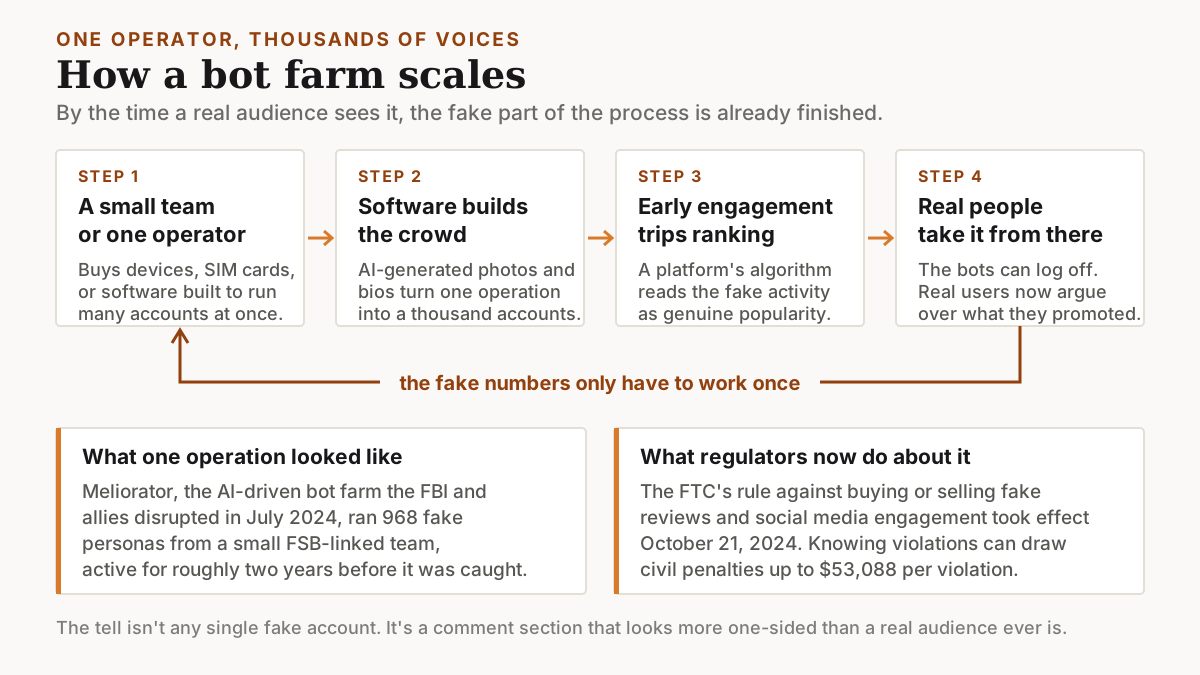
A bot farm is a room, or a network, built to make a small number of people look like thousands. Sometimes that means racks of smartphones wired to a central dashboard, each one running its own fake account. Sometimes it's cheaper: a warehouse of workers paid a few cents per like or comment. Either way, the goal is the same. Make a product, a post, or a political message look like it has organic support it doesn't actually have.
The word "farm" isn't a coincidence. Operators talk about "growing" accounts and "harvesting" engagement the same way a factory farm talks about output, because that's what the accounts are: inventory, not people.
Inside an actual bot farm
In April 2022, agents of Russia's Federal Security Service (FSB) bought the infrastructure for a bot farm, including domain names from a U.S.-based provider, according to a joint statement from the FBI and allied governments. In early 2023, an FSB officer set up a private organization, staffed with employees from the Kremlin-linked outlet RT, to run it.
The software was called Meliorator, described by investigators as "a covert artificial intelligence enhanced software package." It used an open-source tool called Faker to generate believable photos and short biographies, then built out personas representing several nationalities, many posing as Americans. By the time the FBI, working with counterparts in Canada and the Netherlands, disrupted the operation in July 2024, the Justice Department had searched 968 of the fake accounts it produced, most active on X, spreading pro-Russian, anti-Ukraine content aimed at the United States, Germany, Israel, the Netherlands, Poland, Spain, and Ukraine.
It took two years to catch. X suspended the accounts once the Justice Department named them in court filings. RT's press office response to the allegations was a single line: "Farming is a beloved pastime for millions of Russians."
That case involved a government intelligence service, but the mechanics scale down to a marketing agency or a single seller trying to juice their Amazon rating. The tools are the same. Only the target changes.
What they actually get used for
Political disinformation gets the headlines, but most bot farm activity is commercial. Fake product reviews, fake app downloads to push a ranking, fake followers sold by the thousand, fake comments designed to make a brand's post look more popular than it is.
The U.S. Federal Trade Commission's rule against buying or selling fake reviews and testimonials took effect on October 21, 2024. It specifically covers reviews or social media engagement from accounts that don't represent a real person's real experience, which is a plain description of what a bot farm produces. Knowing violations can now draw civil penalties of up to $53,088 per violation, up from $51,744 when the rule first took effect.
The other major use is amplification, not fabrication. A bot farm doesn't need to convince anyone directly. It just needs to push a post's early engagement numbers high enough that a platform's ranking system reads it as popular and starts showing it to real people on its own. Once that happens, the bots can log off. The people arguing in the replies from then on are usually real, reacting to what the algorithm decided to promote rather than to the bots themselves.
Why the fake consensus works on you
Social proof is a normal, mostly useful shortcut. If a lot of people seem to agree on something, that's usually a reasonable signal it's worth taking seriously. Bot farms exploit that shortcut directly. They don't have to change anyone's mind with an argument. They just need to make disagreement look rarer than it actually is, or outrage look more widespread than it actually is, and people adjust what they're willing to say out loud accordingly.
In April 2026, TechRadar's Matt Evans described watching a viral video shot inside a working bot farm: rows of phones stacked in tower formations, "about 400 phones" per tower by his count, in a room the piece estimated held around 400,000 phones total. The post had drawn 31,000 upvotes by the time he saw it. Its top comment, with 8,100 upvotes on its own, read simply: "This is who I'm arguing with on here."
That reaction is the real damage. Watching a stranger's video made a longtime user start doubting every argument he'd ever had online. The uncertainty itself is the product. Once you can't tell which comments are real, you either disengage or start discounting positions you'd otherwise take seriously, and either way the fake consensus did its job.
What actually gives one away
No single tell is reliable anymore. AI-run bot accounts can carry months of realistic post history, varied phrasing, and profile photos that don't turn up in a reverse image search, which is exactly what made Meliorator different from older, cruder bot networks. Treat these as raising your suspicion, not confirming it:
A wave of accounts posting near-identical phrasing within minutes of each other. A comment section that's unusually one-sided on a topic where real audiences are normally split. Engagement that spikes immediately after a post goes up, then flattens, instead of building gradually as a real audience finds it. Accounts with generic usernames and little posting history outside the topic at hand.
The more reliable check is slower than any of that: does the claim hold up if you look it up somewhere else, independent of how many people in the replies seem to agree with it? Treat a busy reply section as noise until you've checked the claim on its own.