
The short version
Most people know exactly one fact about this case: a man calling himself D.B. Cooper hijacked a plane in 1971, collected $200,000, and parachuted into the night, never to be identified. Almost nobody knows that "D.B. Cooper" is not a name he ever used.
He bought his ticket as "Dan Cooper." The initials everyone repeats came from an overworked reporter guessing at a bad phone line, on deadline, while a hijacking was still in progress. That guess reached national newspapers within about seventy-two hours and has been treated as settled fact for more than fifty years since.
What actually happened on November 24, 1971
The day before Thanksgiving, a man paid cash for a one-way ticket under the name Dan Cooper on Northwest Orient Airlines Flight 305 from Portland to Seattle. Once airborne, he handed a flight attendant a note claiming he had a bomb in his briefcase and demanded $200,000 in twenty-dollar bills and four parachutes.
The plane landed at Seattle-Tacoma, where he exchanged all 36 passengers for the money and parachutes, then had the crew take off again, this time toward Reno, with only the pilot, co-pilot, flight engineer, and one flight attendant left aboard. Somewhere over southwest Washington he lowered the aft stairs of the Boeing 727 and jumped with the cash. No trace of him was ever found, and the case, which the FBI called NORJAK, remains the only unsolved commercial hijacking in U.S. history.
The FBI announced on July 8, 2016 that it was redirecting the case away from active investigation. "We have arrived at our conclusion today that it was just time to close the case because there isn't anything new out there," Special Agent in Charge Frank Montoya Jr. told reporters, according to CNN. The bureau said it would still accept tips involving the parachute or the cash.
How 'Dan Cooper' became 'D.B. Cooper'
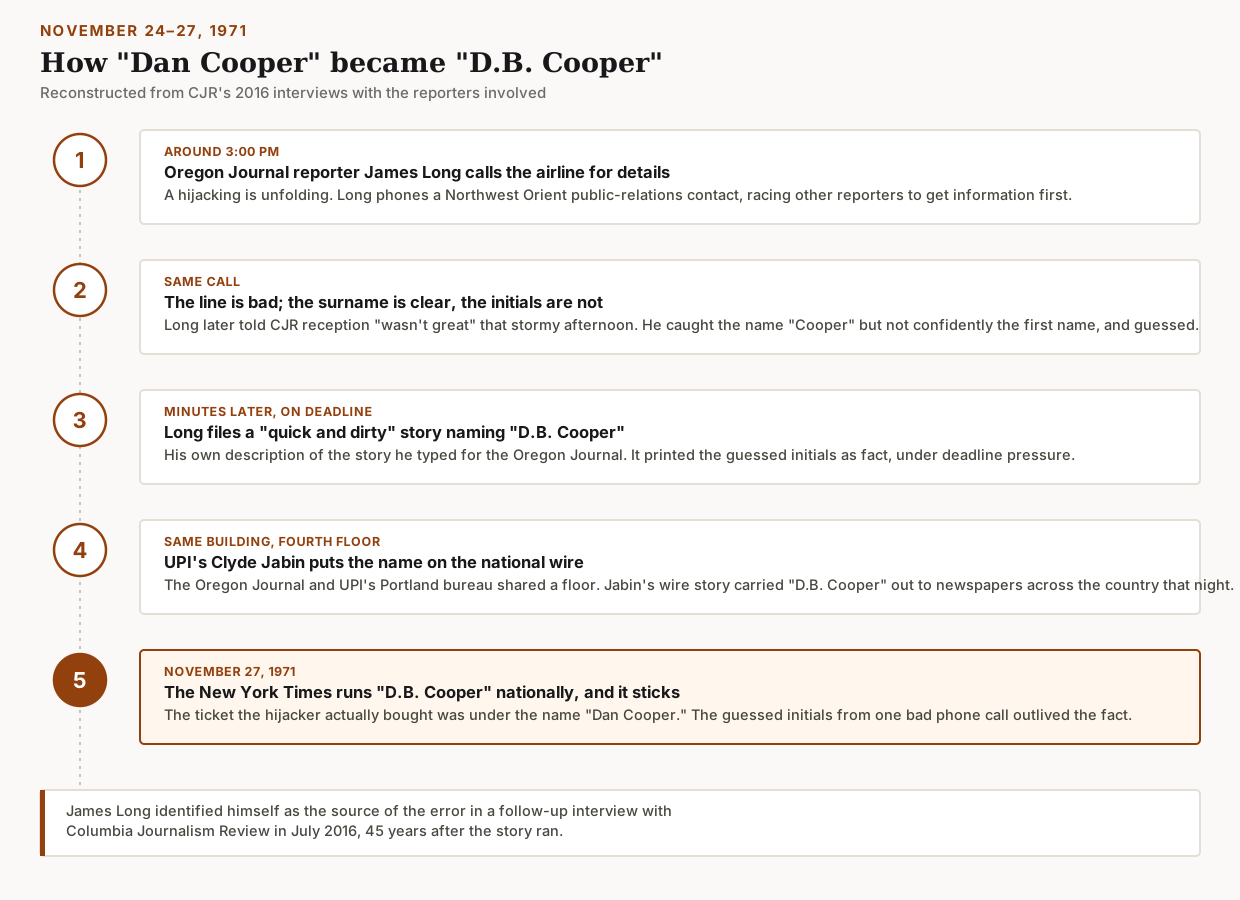
For decades, the exact origin of the name was one more unanswered question about the case. Columbia Journalism Review reconstructed it in July 2016 by tracking down the reporters who were working the story that night, and a follow-up days later filled in the last gap.
James Long, then a reporter for the now-defunct Oregon Journal in Portland, had a contact at Northwest Orient Airlines from a previous job. As the hijacking unfolded that afternoon, Long called him for details, racing other reporters to get through first. "So I called as fast as I could, hoping to get through while every other reporter was piling up in line behind me," Long later told CJR. It was a stormy afternoon in Portland, and, in Long's words, "there were times (this was one) that reception wasn't great." He came away with the surname clearly but was unsure of the first name, and guessed. He filed what he called a "quick and dirty" story to make deadline, naming the suspect D.B. Cooper.
The Oregon Journal and United Press International's Portland bureau shared the same floor of the same downtown building. UPI reporter Clyde Jabin, working the wire that evening, picked up the name from the Journal's copy and sent his own version out nationally. By November 27, a New York Times story datelined "Woodland, Wash." was already reporting that "the hunted man has been identified by the FBI only as D.B. Cooper." Within three days of a phone call with bad reception, the guessed initials had become the name attached to the case in the country's paper of record.
Long, who went on to a long investigative career at The Oregonian, never hid what happened. "It's not something you want to be remembered for," he told CJR, but he confirmed the mistake publicly, on the record, forty-five years after he made it.
The FBI's own explanation is vaguer than the record
Even after CJR's reporting made the chain traceable to a specific phone call, the FBI's public case page continued to describe the name a different way: "It was apparently a myth created by the press." That framing treats the origin as unknowable folklore. It is not. A named reporter called a named airline contact on a Wednesday afternoon, guessed at two initials over a bad phone line, and a named colleague put that guess on the wire.
When CJR asked the FBI's Seattle office who first changed "Dan" to "D.B.," a bureau spokesperson wrote back: "The FBI wasn't concerned with tracking circular media reporting. We were focused on our investigation." That is a reasonable statement about investigative priorities. It is also, functionally, a shrug at a documented fact, from the one institution whose case page is where most people go to check what is actually known about D.B. Cooper.
The sketch went through the same uncertainty
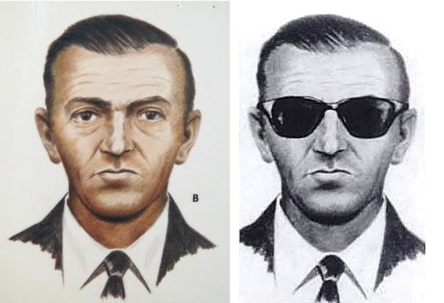
The composite drawing at the top of this page has its own history of disagreement. Witnesses on the flight described the hijacker inconsistently: one thought he had an "olive, Latin appearance," while another described a white man in his fifties. Flight attendant Florence Schaffner was the only crew member who saw him before he put on sunglasses, so her account shaped the first sketch heavily, and because two other crew members never saw his eyes, that first version was drawn without them.
The FBI was not satisfied with it. Citing ongoing concerns about the suspect's age, face shape, and hairline, the bureau commissioned a second composite in the fall of 1972, nearly a year after the hijacking. That second version, Composite Sketch B, shown above, is the one most people now picture when they hear "D.B. Cooper." It is a face reconstructed roughly a year later from witnesses who disagreed with each other and with the first attempt.
The 2016 documentary named a suspect the FBI had already ruled out
The same shape of problem repeated itself decades later: a claim treated as settled before it was actually verified, this time around a named suspect instead of a name. Beginning in 2011, television producer Thomas Colbert led a volunteer team of retired investigators pursuing a theory that a Vietnam veteran named Robert Rackstraw was D.B. Cooper. The Hollywood Reporter's account of the pursuit describes Colbert amassing what he called 95 pieces of "physical, forensic, direct, testimonial, foundational, hearsay and documentary evidence" by 2016.
That case became the basis of a History Channel special, D.B. Cooper: Case Closed?, that July. The special did not deliver the confident conclusion its title implied. Curtis Eng, the FBI agent then overseeing the case, said on camera that he had reviewed Colbert's evidence independently and concluded "it didn't prove that his suspect was Dan Cooper." A flight attendant who had dealt directly with the hijacker was shown photos and video of Rackstraw and said she did not recognize him.
There was also a plain factual problem the documentary had to work around: witnesses had estimated the hijacker's age at 35 to 45, while Rackstraw was 28 in November 1971, which is the reason the FBI had dismissed him as a suspect decades earlier. Colbert continued pursuing the theory after the broadcast, including a claim that decoded letters proved a CIA connection, but never produced evidence that changed the bureau's position. Rackstraw died in 2019 at 75, still only a suspect, not a confirmed identity.
What the case is useful for now
None of this proves who D.B. Cooper actually was. The point of tracing the name is narrower. A name printed in the New York Times can look like settled fact and still rest on a guess made under deadline pressure. So can a face on an FBI sketch built from witnesses who disagreed with each other, or a suspect fronted by "95 pieces of evidence" that the case's own investigator says never proved anything.
The next time a claim like that shows up in something you're reading, the useful move is small. Ask who is actually saying it and how they would know, which is the first thing worth checking about any claim before you repeat it yourself.
Kitty Genovese's case shows the same pattern on a bigger claim, where a number with no supporting document survived four decades in psychology textbooks. The FBI's own "myth created by the press" line is a small example of the same habit: a vague, deflecting phrase that sounds like an explanation without pointing to anyone or anything in particular. Naming the actual source, a specific person, a specific afternoon, a specific phone call, is more useful now than it used to be, given how much further an unverified guess can travel before anyone checks it.