
The short version
An allegory is a story where the characters, places, and events aren't just symbolic here and there, they map onto a second meaning almost element by element. That's what separates it from an ordinary metaphor, which stands for one thing at a time. An allegory builds an entire second story underneath the first, on purpose. It's one specific technique within the broader skill media literacy asks for: not just noticing a story is symbolic, but being able to describe how.
That structure does two very different jobs, depending on who's using it. It can carry a story past an audience's critical guard, because you're following a plot instead of evaluating a claim. And it can carry a story past a censor or an accusation of wrongdoing, because the writer can always point back at the surface reading and say it's just a story. Both uses rely on the same feature: a real allegory keeps working as a literal story even after you've spotted the second meaning underneath it.
What actually makes something an allegory, not just symbolic
A single symbol stands for one thing (a dove for peace, a rose for love). An allegory is bigger than that: nearly every major character, location, and event in the story has its own counterpart in a second, coherent system of meaning, and the two systems track each other for the whole length of the narrative.
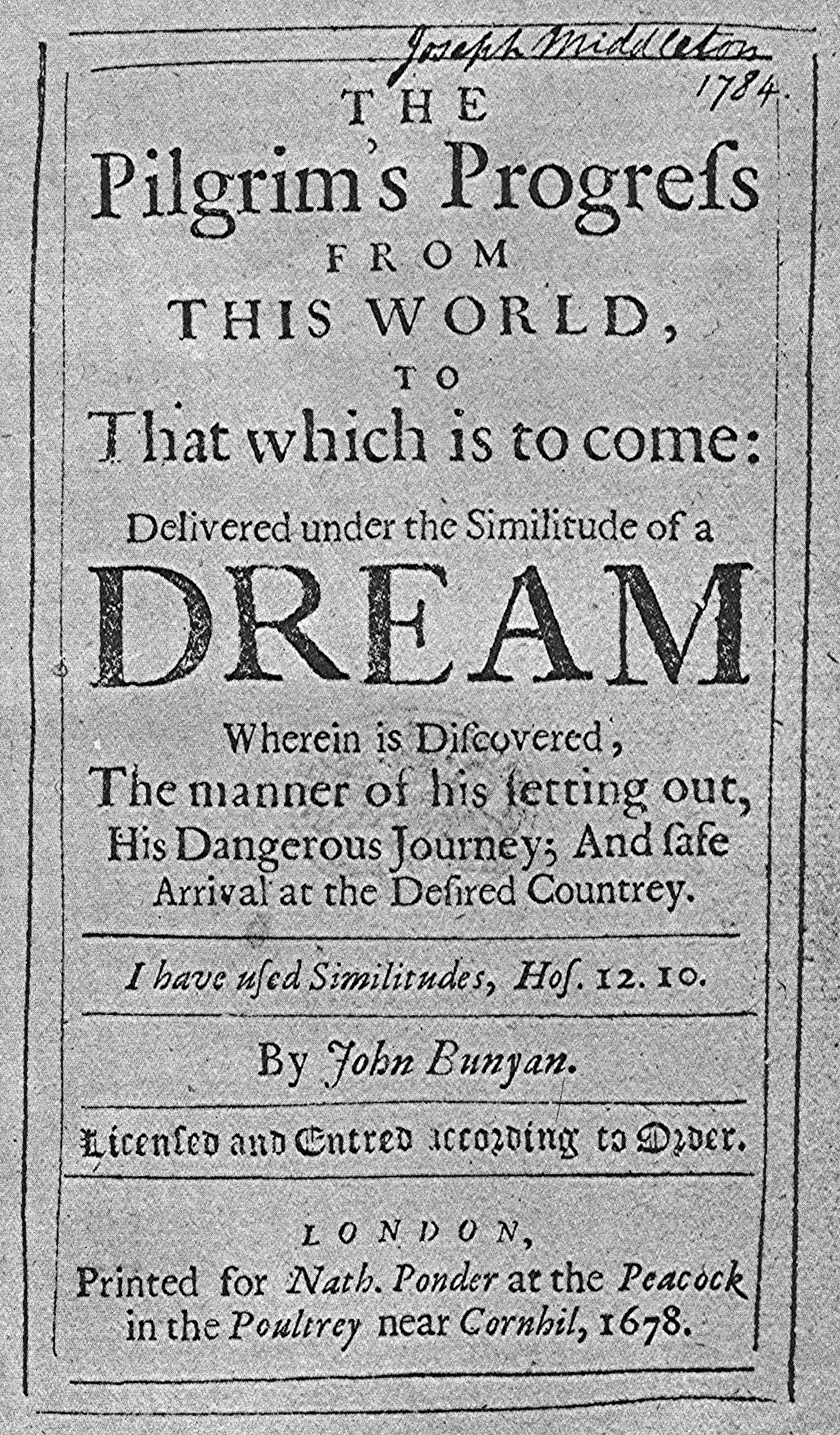
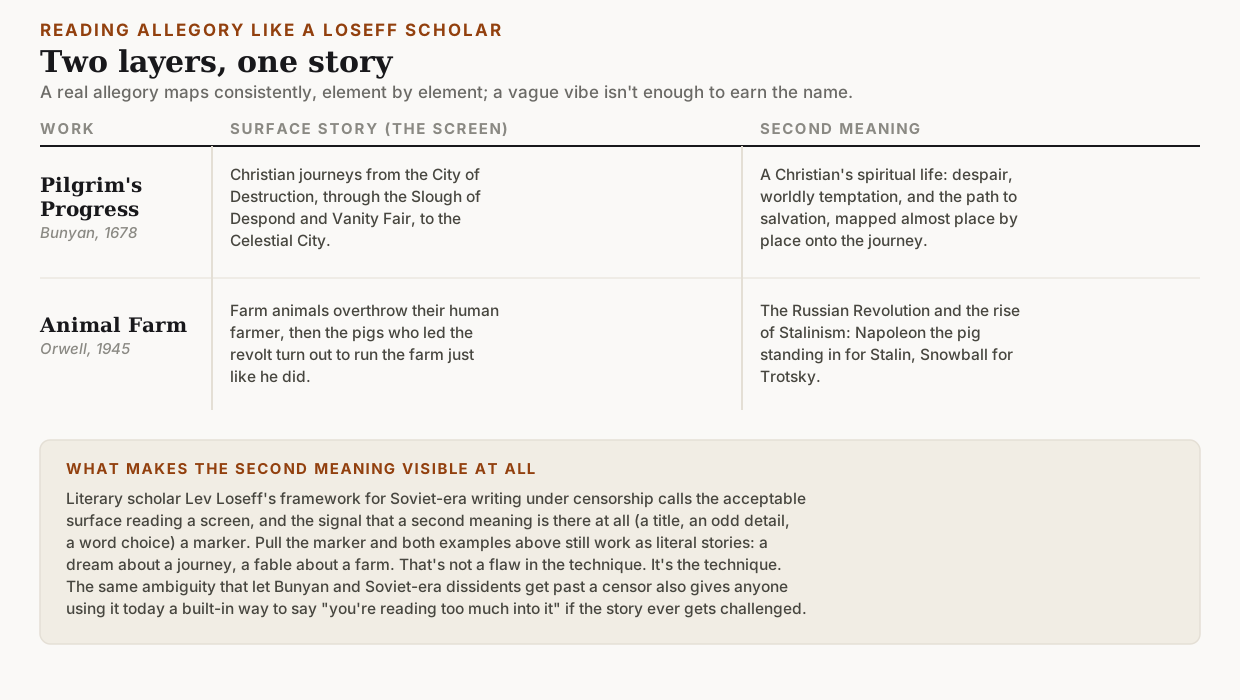
John Bunyan's The Pilgrim's Progress (1678) is the textbook case, in part because Bunyan didn't hide what he was doing. The title page announces the book is "delivered under the Similitude of a Dream." Its protagonist, named Christian, travels from the City of Destruction toward the Celestial City, passing through places named for what they represent along the way, the Slough of Despond, Vanity Fair, the Valley of the Shadow of Death. Almost nothing in the geography is incidental; each stop maps onto a specific spiritual state or temptation.
George Orwell's Animal Farm (1945) works the same way in a secular register. Per Britannica's entry on the novel, the farm animals' revolt against their human farmer, and the pigs' gradual takeover of the revolution they led, is a sustained allegory for the Russian Revolution and the rise of Stalinism, with specific characters standing in for specific historical figures: Napoleon for Stalin, Snowball for Trotsky, and Old Major for a composite of Karl Marx and Vladimir Lenin, the two thinkers whose ideas set the revolution in motion before either saw where it ended up. Take away the historical key and Animal Farm still reads as a complete, coherent fable about a farm. That's the tell of a real allegory rather than a loose "this is basically about X" reading: the surface story has to work on its own.
Why allegory persuades without feeling like an argument
There's a documented mechanism for why story-shaped persuasion behaves differently from a direct claim. Psychologists Melanie Green and Timothy Brock proposed "transportation" theory in a 2000 study in the Journal of Personality and Social Psychology: the more absorbed a reader becomes in a narrative, meaning focused attention, emotional engagement, and vivid mental imagery, the more their beliefs shift to match the story, and the less critically they evaluate what the story is telling them.
One of their four experiments made that second part concrete. In their second experiment (69 participants), readers who scored higher on transportation into a short story identified fewer "false notes," factual or logical inconsistencies planted in the text, than readers who were less absorbed. Being pulled into the story didn't just change what readers believed afterward; it measurably reduced how much scrutiny they applied while reading. An allegory runs on exactly that mechanism twice over: once as a story (following Christian's journey, watching the pigs take over the farm), and a second time on whatever claim the underlying mapping is making, largely without inviting the reader to separately fact-check that claim the way a direct statement would.
Allegory as a shield: saying the unsayable
The same structural trick, a coherent surface story sitting on top of a hidden second meaning, has a long history as a way to survive censorship. Russian satirist Mikhail Saltykov-Shchedrin, writing under the tsarist censors of the 1880s, coined the term Aesopian language for this kind of writing: communication that speaks, in his words, "between the lines," at a time when saying something directly would have been suppressed or punished.
Literary scholar Lev Loseff formalized the idea decades later in his study of Soviet-era Russian literature, describing Aesopian language as a special literary system whose structure lets an author communicate with the reader while concealing anything the censor would object to. Loseff's framework names two working parts: a screen, meaning the acceptable surface reading a censor could sign off on, and a marker, some detail, title, or word choice that signals to an informed reader that a second, hidden meaning is there at all. Without the marker, the writing is just the screen, indistinguishable from an ordinary story about talking animals or ancient kingdoms. With it, readers who know to look find the second story underneath.
The same ambiguity cuts the other way
The feature that let Aesopian writers get past a censor is exactly the feature that lets a bad-faith communicator dodge accountability today, deliberately built ambiguity that supports more than one reasonable reading. A 2025 paper in Communication Theory by Parker Bach, Carolyn Schmitt, and Shannon McGregor gives that a formal name: strategic ambiguity, a message constructed with multiple reasonable interpretations, aimed at different audiences at once, from which the communicator stands to gain some specific advantage. The paper's own case studies include political satire, the same allegory-adjacent territory Bunyan and Loseff's Soviet writers worked in, examined from the opposite direction.
The technique hasn't changed. What changed is who holds the power in the exchange. A censored writer using Aesopian language is smuggling a true thing past someone who could punish them for saying it plainly. A communicator using strategic ambiguity today can be doing the reverse, smuggling an accusation, a dog-whistle, or a claim they don't want to be pinned down on past an audience that would otherwise ask them to defend it directly. "It's just a story" and "you're reading too much into it" are the same defense in both cases. Whether that defense is protecting a powerless speaker from punishment or a powerful one from scrutiny is the actual question worth asking, and the allegory itself won't answer it for you.
How to read an allegory without getting played
Check whether the mapping is systematic, not just vibes. A real allegory has multiple, specific correspondences that hold up across the whole story, the way nearly every location in Pilgrim's Progress names the spiritual state it represents. "This is basically an allegory for X" based on one resonant scene is a much weaker claim, and worth treating as a reading rather than a fact about the work.
Check whether the surface story still stands on its own. If the only way the piece makes sense is as the hidden meaning, with the literal story falling apart otherwise, that's a weaker allegory or possibly not one at all. Genuine allegory, per Loseff's framework, keeps its screen intact.
Ask who benefits from the ambiguity staying unresolved. This is the question the Five Key Questions of media literacy frame as asking who made a message and why, and it's the same question that separates a dissident using Aesopian language from a public figure using strategic ambiguity to dodge a follow-up question. Allegory, like ethos, pathos, and logos, is a tool with an honest use and a faked one; the surface story never tells you which one you're looking at.