The short version
Catfishing is building a fake identity online, usually with someone else's photos and an invented backstory, to manipulate a real person into believing they're talking to someone who doesn't exist. Most explainers on this topic stop at a checklist of warning signs and treat the practice as monolithic, one predator, one playbook. It isn't. Someone catfishing for a laugh behaves differently than someone catfishing for a wire transfer, and a 2024 academic study is the first to ask perpetrators directly which one they were doing, rather than only asking victims what happened to them afterward.
That study, and current FTC fraud data, are the two things most catfishing content doesn't have. This piece leads with both.
The mechanism, a fabricated identity sustained convincingly enough for long enough to get someone to act on trust instead of verification, isn't unique to romance and money. It's the same one a double agent runs on a country's intelligence service, just aimed at one person instead of a government.
Where the word comes from
The term entered common use with Catfish, a 2010 documentary following the film's subject, Nev Schulman, through an online relationship with "Megan," an artist who turned out not to exist. The photos belonged to a 40-year-old woman posing as an 18-year-old. In the film, the woman's husband explains the fabrication using an old shipping story: fishmongers supposedly kept a catfish in tanks of live cod during transport to keep the cod active and fresh. That story traces back to two 1913 works, Henry Nevinson's essay collection Essays in Rebellion and Charles Marriott's novel The Catfish, not to any documented fishing practice. Even the metaphor is invented.
MTV turned the concept into Catfish: The TV Show in 2012. The word went mainstream a year later, when Notre Dame football star Manti Te'o revealed that his girlfriend, "Lennay Kekua," who he'd publicly said had died of leukemia, had never existed. Merriam-Webster added "catfish" to its dictionary in 2014. A scam pattern documented that clearly for over a decade has had plenty of time to get studied properly. It mostly hasn't.
What catfish perpetrators actually say motivates them
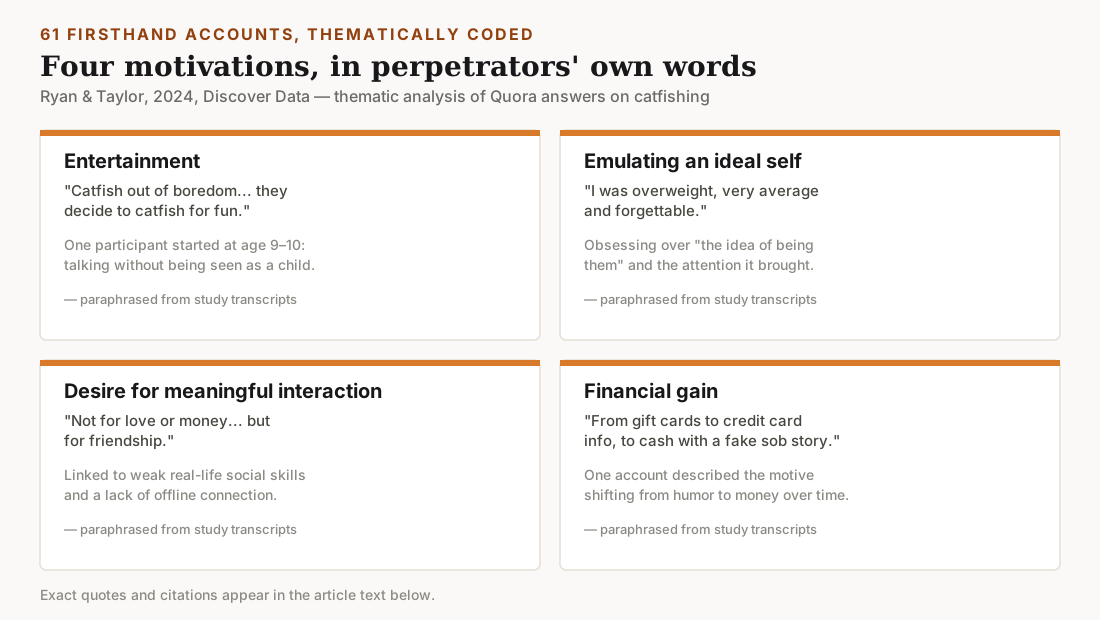
In 2024, psychologists Samuel Ryan and Jacqui Taylor at Bournemouth University published "An exploration of the motivations of catfish perpetrators and the emotions and feelings expressed by catfish victims" in the journal Discover Data. Prior research (Campbell and Parker) had linked catfish perpetration to traits like narcissism, high religiosity, and low conscientiousness, useful for predicting who might do it, but silent on why, in their own account, they actually did. Ryan and Taylor collected 61 anonymous answers from three Quora threads, including "Why do people catfish?", and ran a thematic analysis on the responses. Four motivations emerged.
Entertainment was one. Participant 4 put it plainly: "Sometimes people catfish out of boredom, because they have nothing else to do, so they decide to catfish for fun." One respondent said they started catfishing at age 9 or 10 because they "find it way more fun to talk to people without being seen as a child," a detail that complicates the assumption that every catfish account belongs to an adult with predatory intent.
Emulating an ideal self was another, and it read less like manipulation and more like insecurity turned outward. Participant 5 explained: "I had many reasons but they all boil down to the fact that I was very self-conscious... I was overweight, very average and forgettable," and described the escalation as an obsession: "It got to the point where I'd obsess over the idea of being them and what attention I would get if I was them." Participant 4 generalized the pattern: "If they see someone they think is really attractive, they'll want to be them online, and make sure people actually believe them."
A desire for meaningful interaction was third. Participant 6 wrote, "I did catfish people not for love or money or any illegal benefit but for friendship," describing a wish to "share my sadness when I am down" and "share my happiness when something good happens." Participant 2 attributed the underlying gap to poor real-world social skills: many "don't have any interpersonal skills or how to handle in your face conflicts."
Financial gain was the fourth, and the one most existing catfishing content treats as the only one. Participant 13 described the pattern directly: catfish scammers "will ask for money non stop." Participant 12 laid out the escalation, "from gift cards to credit card info, to straight up cash with a fake sob story," and offered a reason the anonymity itself is part of the appeal: "There are a lot of garbage people on the internet, safe from consequences with their anonymity." One account in the study is worth flagging on its own: Participant 8 said their original motive was humor, then added, "my motive now is money," suggesting motivations can shift over the course of a single deception rather than staying fixed.
Worth being upfront about the limits here: 61 self-selected, anonymous Quora answers is not a representative sample of everyone who catfishes, and the authors say as much. It's a start, not a final answer.
The financial version, at FTC scale
The financial-gain motivation Participant 12 described, gift cards to credit cards to cash, shows up in national fraud data at a scale that's hard to picture from a handful of quotes. The FTC's April 2026 Data Spotlight, "New FTC Data Show People Have Lost Billions to Social Media Scams," reported that in 2025, nearly 30% of people who lost money to a scam said it started on social media, with reported losses reaching $2.1 billion, an eightfold increase since 2020. Facebook accounted for more reported losses than any other social media platform, ahead of WhatsApp and Instagram.
Romance scams, the subtype closest to catfishing as most people picture it, are called out specifically: nearly 60% of people who reported losing money to a romance scam in 2025 said it started on a social media platform. The FTC describes the mechanism the same way Participant 12 did from the inside: scammers "tailored their pitch based on people's profiles, later inventing a crisis requiring money."
That figure is one subtype, not the whole picture. The Ryan and Taylor study is a useful corrective here: most of the Quora accounts describing why people catfish don't mention money as the starting motive at all. Financial fraud is the version that shows up in FTC data because it's the version with a dollar amount attached. Entertainment, self-image, and loneliness don't get filed with the FTC, so they're invisible in every report that only counts money lost.
What it feels like from the other side
The same 2024 study analyzed a second, larger dataset, 41 firsthand victim accounts, and found six recurring emotions: suspicion, love, depression, anger, embarrassment, and feeling foolish. One account described the slow build of doubt: "Throughout all of this, I grew more and more skeptical that she was who she really said she was." Another traced the exact moment suspicion actually solidified: "I finally started getting suspicious when I would ask if I could call him, since we never voice chatted.. only text." The giveaway, across multiple accounts, was consistently the same one: no voice, no video, ever.
Love showed up just as often, and not as something victims dismiss in hindsight. One wrote simply, "I was so in love with this person." Another described staying despite clear signs of harm: "So many hurtful incidents over time, mental & emotional abuse, disrespect, but I would just refuse to understand! Love-induced impaired judgement on my part? I guess so. I was lonely, I had no one else to talk to for feedback. I was the perfect victim for that horrible woman." That's worth reading next to Stockholm syndrome, a different label for a similarly shaped pattern: strong attachment persisting past evidence that should have broken it, driven less by the bond itself than by the isolation surrounding it.
Depression, anger, embarrassment, and a specific self-directed shame rounded out the six. "So 3 years of torture, one eating disorder later, and completely mentally destroyed," one account read. Another: "The only reason I'm answering this Anon is because of how embarrassed and ashamed of myself I am to have let something like this carry on." A third put it more bluntly than any clinical term could: "I ended up being the greatest idiot alive, I have STUPID written all over my face." None of the six emotions the study documented is unique to gullible people. They're what a real relationship feels like from the inside. That's exactly what's being exploited.
The signs, and why AI makes one of them weaker
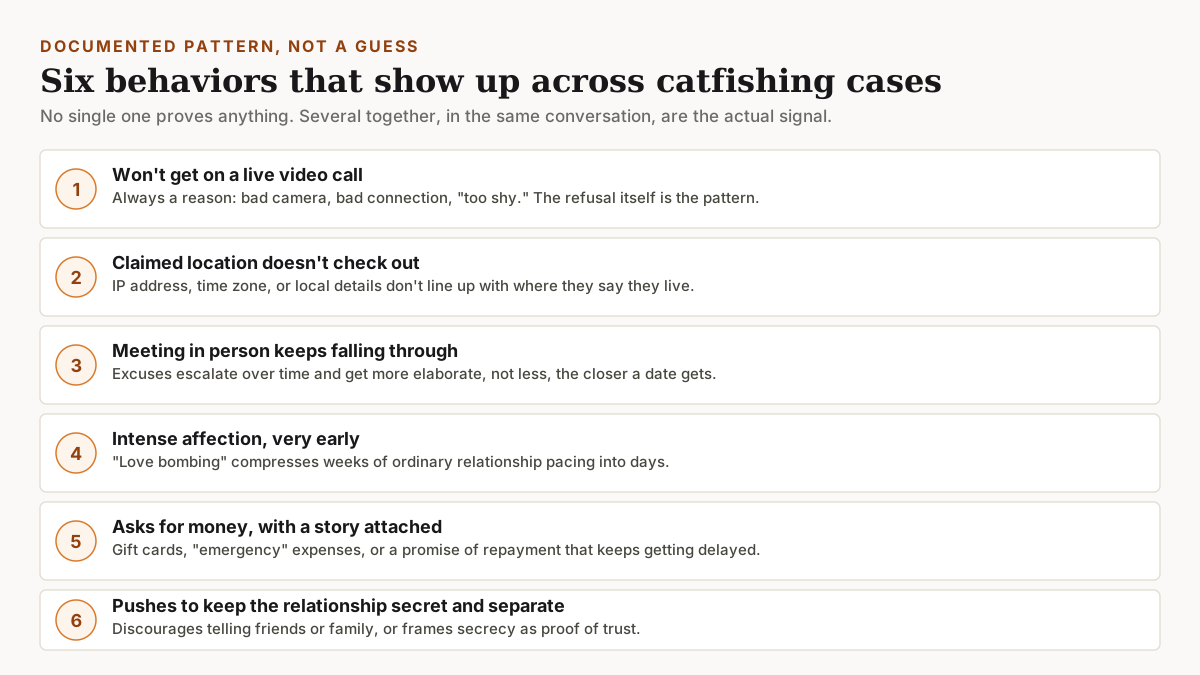
Beyond the study, a consistent set of behavioral signs shows up across catfishing cases and consumer-protection guidance: refusal to get on a live video call, an IP address or location detail that doesn't match the story, repeatedly postponed in-person meetings with increasingly elaborate excuses, intense affection very early (love bombing), requests for money attached to a backstory, and pressure to keep the relationship secret from friends and family, which doubles as isolation from anyone who might spot the pattern from outside.
Two of those signs map onto persuasion techniques with names of their own. A fabricated backstory and stolen photos are a false ethos, borrowed credibility standing in for real credibility. Love bombing is a pathos overload, emotional intensity arriving faster than the trust that would normally be required to earn it.
One sign is getting weaker as a defense, not stronger. Wikipedia's entry on catfishing documents "chatfishing," the use of AI-generated text to carry a conversation on dating apps, as a newer variant of the same deception. Consistency of voice, phrasing, and personality across a conversation used to be a decent informal signal that a real, single person was on the other end. Generative text erodes that signal specifically. Photos and even video calls can also now be synthetic, so the strongest check left to you is asking for something unscripted and specific in the moment, not something that can be prepared or generated in advance.
How to actually verify before it costs you something
Run a reverse image search on their profile photos. It catches a large share of stolen-identity catfishing, since most perpetrators reuse the same public photos across multiple platforms. Ask for a live, unscripted moment instead of a photo or video call you scheduled in advance, something like holding up a specific object or writing a word on paper right then on camera. It's harder to fake in real time than anything prepared ahead. And treat a money request tied to urgency, an emergency, a narrow window, a promise of fast repayment, as a stop condition, not a special case, no matter how convincing the story is or how long you've already been talking.
None of this is catfishing-specific. It's the same discipline the Five Key Questions of media literacy ask of any claim: what's the evidence, independent of how convincing or emotionally resonant the source feels. If a relationship can't survive one unscripted verification request, it was never verified in the first place.