.jpg)
The short version
The Mandela effect is what happens when a detail almost everyone gets wrong (a spelling, a costume, a line from a movie) turns out to have a name, a research literature, and a fairly mundane explanation once someone actually checks it. Confident, specific, and shared by strangers doesn't mean accurate. It means human memory works the same broken way in most people, on the same specific gaps, for identifiable reasons.
The paranormal explanation people reach for first, a shift between parallel universes, has never been the one that survives scrutiny. The one that does involves ordinary memory science: how brains store gist instead of detail, fill blanks with the most probable pattern, and get more confident the more times they hear someone else's version of the same gap-filled memory.
Where the name comes from
Fiona Broome, a self-described paranormal researcher, coined the term after an experience at Dragon Con in 2009. She recalled Nelson Mandela dying in prison in the 1980s, including, in her own account, "news clips of his funeral, the mourning in South Africa, some rioting in cities, and the heartfelt speech by his widow." Mandela had not died; he was released from prison in 1990 and lived until 2013.
In the VIP suite at that convention, Broome says a security team member named Shadowe "casually mentioned that other people 'remembered' when Nelson Mandela died in prison." That was the moment the false memory stopped looking personal. Broome registered MandelaEffect.com in August 2010 to collect other examples, and the term spread from there.
Broome's own framing was explicitly paranormal: she has proposed the Mandela effect as evidence of alternate timelines bleeding into each other. That origin story matters for calibrating expectations: the name comes from a paranormal researcher's website, not a psychology journal. The research that actually measured the phenomenon came more than a decade later, from a cognitive science lab, and reached a different conclusion.
The 2022 study that actually measured it
Deepasri Prasad and Wilma Bainbridge, at the University of Chicago's Bainbridge Lab, published "The Visual Mandela Effect as Evidence for Shared and Specific False Memories Across People" in Psychological Science in December 2022. It is the first work to empirically quantify what had, until then, been a purely crowdsourced phenomenon.
Across four experiments, they tested reactions to 40 well-known icons, among them the Monopoly Man, Pikachu, the Fruit of the Loom logo, C-3PO, Curious George, the Volkswagen logo, and Where's Waldo. Experiment 1 (100 adults) confirmed that specific images reliably produce the same false memory in most people, not random noise scattered across many different wrong answers. Experiment 2 (60 adults, using an eye-tracking-like method) tested whether people simply never looked at the relevant detail; it found no consistent attentional difference that explained the error. Experiment 3 ruled out the other obvious explanation from a different angle: the researchers scraped the top 100 Google Images results for each icon and checked how often the wrong version actually shows up online, and found no clear link between how often an icon's altered version circulates and whether people misremember it. Experiment 4 (50 adults) had participants draw the icons from memory, and the same errors (a monocle, a tail, a cornucopia) showed up spontaneously in the drawings.
Bainbridge summarized the core finding directly: people are "reporting a false memory for an image they've actually never seen — because you've never seen Pikachu with a black tip on the tail." Prasad, describing the Fruit of the Loom test, noted participants "could have picked the correct Fruit of the Loom logo, the Fruit of the Loom logo with the cornucopia, or the Fruit of the Loom logo with a plate underneath it," and a specific wrong answer won consistently. The researchers explicitly ruled out the simplest debunking explanations (inattention, low exposure) rather than assuming them.
What's actually happening in your brain
Dr. Aaron Bonner-Jackson, a neuropsychologist at Cleveland Clinic, frames the underlying mechanism plainly: "Memory is not necessarily a carbon copy of reality. Memory is influenced by different biases, perceptions, preconceptions and expectations." Brains don't record images the way a camera does. They store a compressed gist and reconstruct detail on demand, using whatever pattern is statistically most likely.
That reconstruction process explains why the errors aren't random: a chimpanzee gets drawn with a tail because cartoon primates almost always have one, and a "-stain" surname gets remembered as "-stein" because that's the far more common suffix. Bonner-Jackson also points to a social mechanism that amplifies the individual error: repeated exposure to other people's version of the same wrong memory functions like the children's "Telephone" game, where a detail drifts further from the source with each retelling, except that online, thousands of retellings can happen in the same afternoon.
None of this requires anything unusual about the people experiencing it. The same reconstructive process that lets you recognize a friend's face in bad lighting, or finish a common phrase before someone says it, is the one that quietly overwrites the exception you never paid attention to. The brain overriding raw input with its own best guess isn't unique to memory, either: the McGurk effect shows the same kind of override happening live, in real time, to what you perceive yourself hearing right now.
A theory the internet got right before the study did
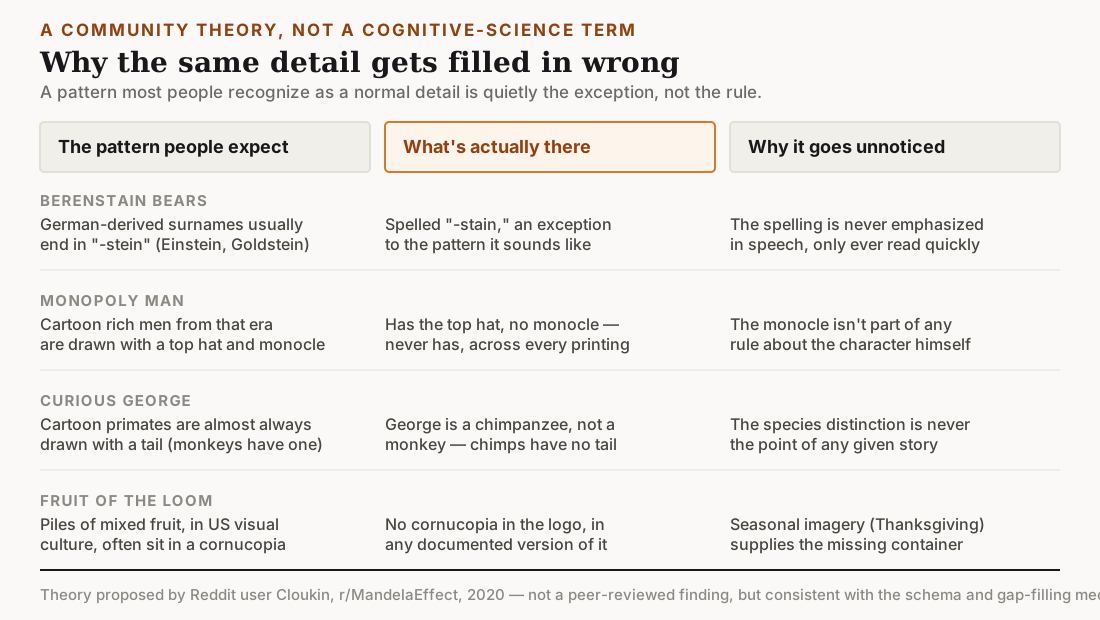
Years before Prasad and Bainbridge published, a Reddit user going by Cloukin posted a theory in r/MandelaEffect that has held up well against the research: most spelling and image Mandela effects, they argued, come from a common pattern that most people have internalized, paired with one specific brand or character that violates it in a way nobody bothers to notice. The post gathered roughly 2,100 upvotes and 295 comments, not a fringe take within that community, but closer to a working consensus among the skeptical wing of it.
The pattern holds up case by case: German-derived surnames overwhelmingly end in "-stein," so Berenstain reads as a typo of itself. Old cartoon rich men are reliably drawn with a monocle, so the Monopoly Man's bare face goes unremarked. Cartoon primates get a tail by default, so Curious George's total lack of one (he's a chimpanzee, not a monkey) never registers as strange until someone points it out.
A commenter further down that same thread, terryjuicelawson, added the piece that explains why the false memory turns into a fandom rather than a shrug: once someone posts their version online and other people reply "I remember that too," the collective agreement itself becomes evidence in people's minds. As they put it, people go online, find others who say they remember the same wrong detail, "and it snowballs. Then people do trust their memories more, it has to be the universe changing rather than more than one person making the same mistake." That's confirmation bias with an audience, not a new phenomenon, just one the internet runs at a much higher volume than a dinner-table conversation ever could.
"I know what I saw" is a feeling, not a check
Some Mandela effect testimony is vivid and completely sincere, which is exactly what makes it worth examining rather than dismissing. In the same Reddit thread, one commenter described a years-long, detailed conviction that the Volkswagen logo and the geography of Sicily had both physically changed, describing the realization as feeling "like a punch to the stomach" and stating flatly that they knew they weren't "in the same world" anymore. That level of conviction is real. It is also not evidence of anything beyond how convincing a reconstructed memory can feel from the inside: confidence and accuracy are measured separately in memory research precisely because they don't reliably move together.
That gap between how sure something feels and whether it's correct is the same gap Stockholm syndrome runs into as a diagnosis: strong, specific, widely shared conviction that a term or memory describes a case, unsupported by the underlying record once someone checks it against the primary source. Vivid personal certainty is a real experience worth taking seriously as a psychological phenomenon. It is a poor substitute for checking the artifact itself. It's also close kin to source amnesia: both describe a feeling of familiarity or certainty that has come loose from the specific thing that would justify it, a childhood cereal box in one case, the original source of a claim in the other.
How to check a Mandela effect claim before trusting your memory
Most Mandela effect claims resolve in one of two ways once you actually look. Spelling and logo claims (Berenstain Bears, Fruit of the Loom, Froot Loops) resolve by checking an original, dated physical artifact, such as an old book, a vintage cereal box photo, or an archived product image, rather than a re-typed list circulating on social media, which can itself introduce or repeat the same error. Claims about real documented events (a death, a speech, a news report) resolve by checking a contemporaneous source: a newspaper from the actual date, not a modern retrospective.
None of the Five Key Questions of media literacy ask directly whether a claim is true; that's the gap fact-checking fills, not this framework. But the underlying habit still applies: a thousand people agreeing on a detail is a fact about the popularity of a shared reconstruction error, similar to how a single misreported detail can outlive the correction that followed it once it's been retold enough times. It is not, on its own, evidence about what actually happened.
The practical test: before treating a Mandela effect as unexplained, find the oldest verifiable copy of the artifact itself (not someone else's memory of it) and check it directly.